




Ever wonder how mass timber beam-to-column and column-to-column connections hold up when seismic deformation begins to push a structure beyond its expected limits? For engineers working with mass timber, understanding this behavior is central to design decisions, connection detailing, and project performance. Simpson Strong-Tie senior product engineer Alex Mueller and product engineer Giovanni Pereira will examine seismic deformation compatibility for mass timber connections in a webinar on December 17, 2025, at 10:00 a.m. PT. Presented by Simpson Strong-Tie and hosted by STRUCTURE as part of its sponsored webinar series, the session reviews the mechanics, research insights, and engineering considerations that shape connection performance during seismic demand. Read on to learn more about the focus of this webinar.
Authored by Alex Mueller and Giovanni Pereira.
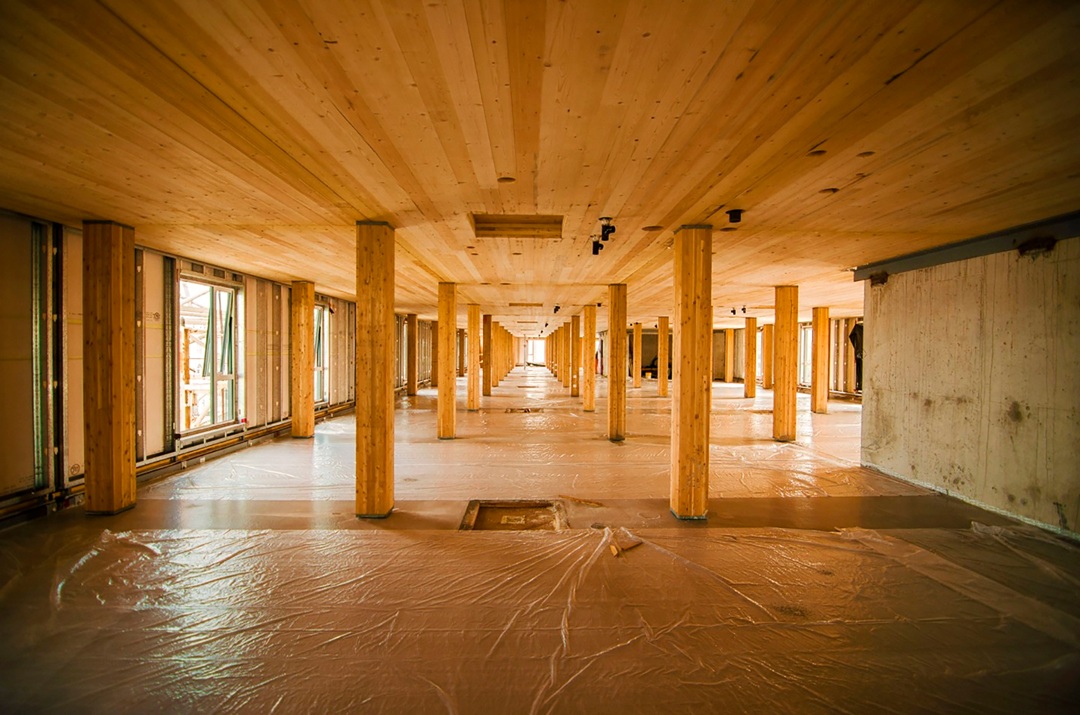
Mass timber construction is rapidly gaining popularity for its sustainability, aesthetics, and structural performance. However, when it comes to building in high seismic regions, ensuring the performance of mass timber connections amidst seismic deformation evaluation is critical.

Earthquakes impose significant lateral displacements and drifts on structures. The 2024 International Building Code (IBC) and ASCE 7-22 require deformation compatibility for components in Seismic Design Categories D, E, and F. While lateral-force-resisting systems are designed to handle these movements, gravity connections must also be designed to retain gravity load carrying capacity during and after the event.

Drift demands calculated for design-level earthquakes may underestimate actual deformation during a maximum considered earthquake (MCE). Factors like deflection amplification and short-period structures can lead to higher-than-expected drifts. If the code requires 2% drift, is that enough? We believe in designing for resilience. Our target is 5% drift, providing a factor like the overstrength concept in ASCE 7 to account for this underestimation. This approach helps protect critical connections even during extreme seismic events.

To ensure our connections meet this criteria, Simpson Strong-Tie has conducted full-frame cyclic tests on many of our concealed beam hangers and column connectors for mass timber construction. Results show that our connectors can achieve rotational capacities beyond code minimums up to and exceeding the 5% drift target without a loss in gravity load-carrying capacity. This physical testing is complemented with finite element analysis (FEA) for accurate performance evaluation.
Structural engineers, architects, and construction professionals involved in mass timber projects, especially in seismic regions, will benefit from our upcoming presentation. Please join us as we dive deeper into this topic and walk you through our methodology and case studies on some of our recent full-scale testing and FEA analysis.
If this sounds like something you want to learn more about, register today to secure your place in the webinar. Continuing education credit for participation will be provided by Simpson Strong-Tie. The session will be recorded and posted on the STRUCTURE website, and a link to the recording will be made available in this blog after the webinar. If you can’t attend live, be sure to look for the recording.
