




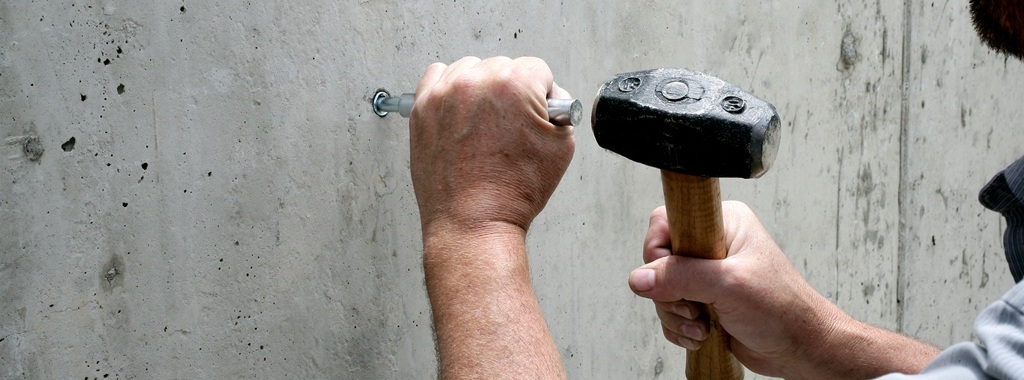
This is the fifth Anchor Anatomy 101 blog post focusing on anchor systems. Each post is designed to clarify anchor components, installation processes, and common applications to help you make informed anchor selection decisions based on your project’s unique requirements. Our preceding post focused on the Heli-Tie™ helical wall tie. This post reviews a few types of drop-in internally threaded anchors.
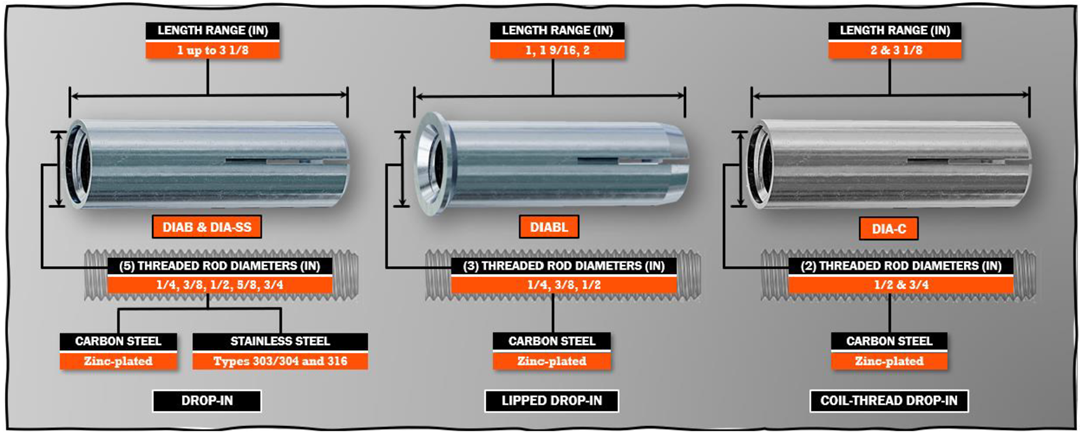
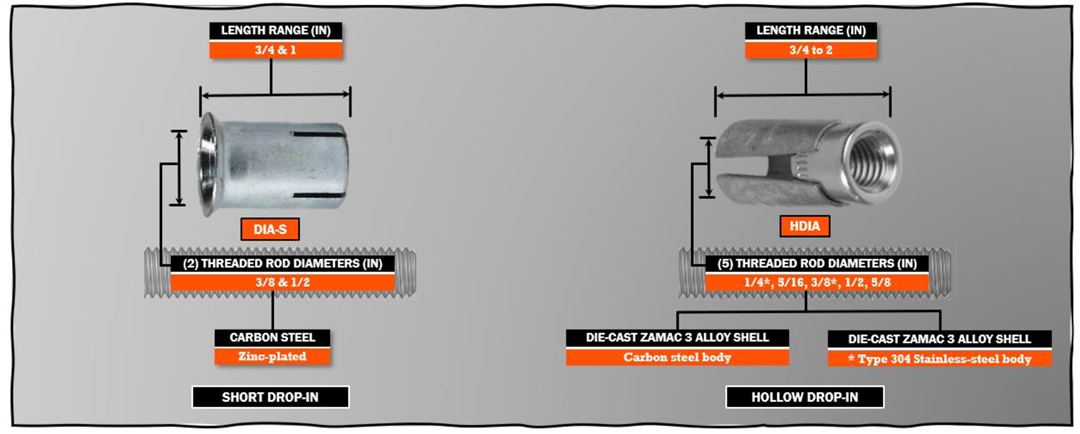
Drop-in anchors are a versatile and reliable light-duty fastening solution ideal for use with hollow base materials such as CMU and hollow-core plank as well as in solid normal-weight and lightweight concrete. Known for their ease of installation, drop–in type anchors are commonly used on new construction, restoration, and retrofit projects. Similar to the Strong-Bolt® 2 wedge anchor (STB2) discussed in this blog post, the drop–in anchor develops load-resisting capacity by expanding against the sides of a predrilled hole. Unlike the STB2, Simpson Strong-Tie drop–in anchors sit flush to the base material, contain internal threads, and install by striking a setting tool. They are categorized as displacement-controlled expansion anchors. As the setting tool drives the internal expander plug element downward, it forces the anchor body outward and engages the drilled hole substrate over a specific distance. Drop-in anchors receive threaded rods or bolts and typically provide support for mechanical, electrical, plumbing, and fire protection (MEP/FP) systems. Let’s take a closer look at the anchor anatomy of the Simpson Strong-Tie® drop–in (DIAB, DIA-SS, DIABL, DIA-C, DIA-S) and hollow drop–in (HDIA) internally threaded anchors (Figures 1–3).
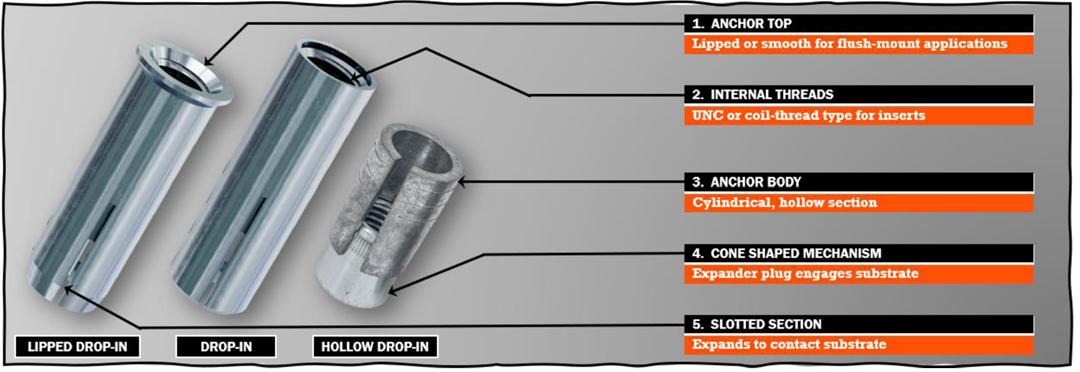
Drop-In Internally Threaded Anchor Features
- Anchor Top: The top of the anchor (Figure 1) is either lipped or smooth shaped, which allows for flush mounting. The lipped feature limits the anchor position in the drill hole and facilitates proper installation seating and embedment depth.
- Internal Threads: The internal threads are uniform national coarse (UNC) or coil-thread type and accept threaded rod or bolt-type inserts. The total thread length depends on the drop-in anchor type. Hollow drop-in anchors have shorter thread lengths than standard drop-in anchors. The thread options give drop-in anchors flexibility in accepting a range of insert diameters and supporting fixture types.
- Anchor Body: The drop-in anchor body is a cylindrical-shaped section. The outside is smooth with internal threads. The anchor body is available in zinc-plated carbon steel and in Type 303 or 304 and Type 316 stainless steel. The HDIA anchor body or “shell” has a series of horizontal embossments and is not threaded. The HDIA body is die-cast Zamac 3 alloy material. Zinc is the main component of Zamac 3 alloy with smaller amounts of aluminum, magnesium, and copper. The DIAB and HDIA accept 1/4″, 3/8″, 1/2″, 5/8″, and 3/4″ and 1/4″, 5/16″, 3/8″, 1/2″, and 5/8″ threaded inserts, respectively. The DIAB is available in long and short lengths (Figures 2 and 3).
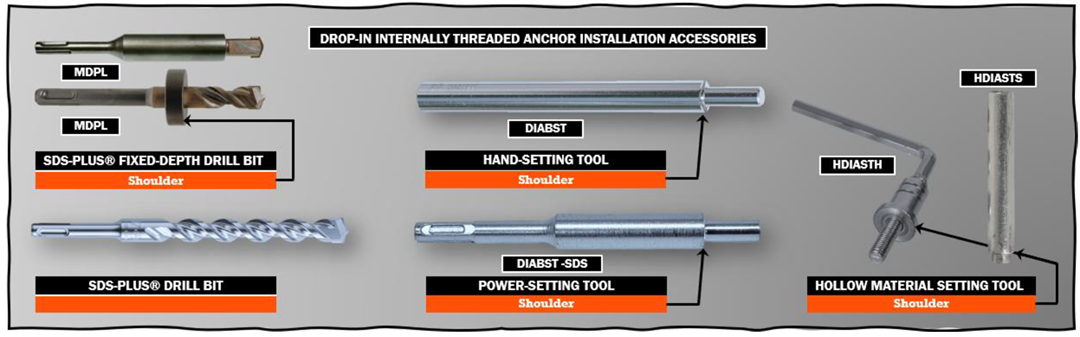
- Cone Shaped Mechanism: The DIAB expander plug and HDIA cone shaped expansion mechanism, located at the bottom of the anchor body, are designed to engage the drill hole sides when their respective setting tool (Figure 7) is hammer-driven down or torque is applied during installation. The outward pressure created by the DIAB plug moving downward or HDIA cone moving upward forces the anchor body to contact the drill hole sides. The DIAB expander plug material matches that of the anchor body. After the setting is completed and the setting tool removed, the threaded insert is installed. The DIAB expander plug is zinc-plated carbon steel or Type 304/Type 316 stainless steel. The HDIA cone is zinc-plated carbon steel or Type 304 stainless steel.
- Slotted Section: The bottom of the DIAB anchor and the top of the HDIA anchor have vertical slots (Figures 1–3). The slotted design allows the anchor body to expand outward as the expander plug or cone moves. Before installation, the anchor body is free to rotate around the expander plug or cone. Once properly set, it fits tightly against the expander plug or cone and contacts the drilled hole sides.
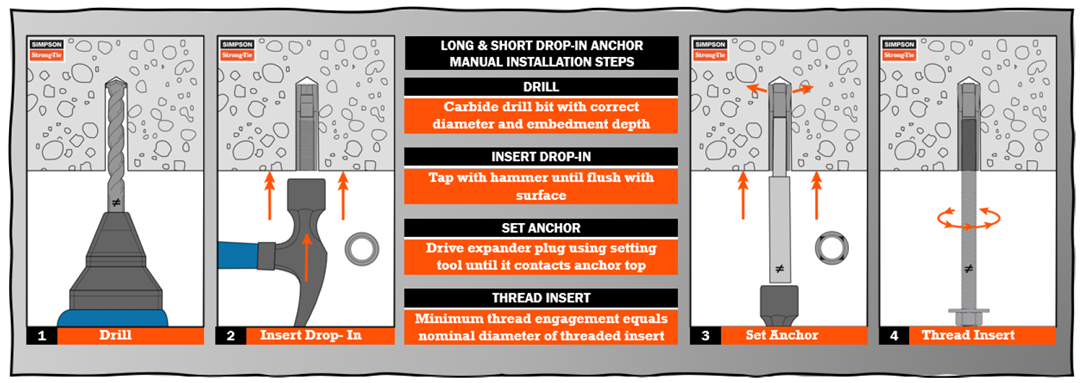
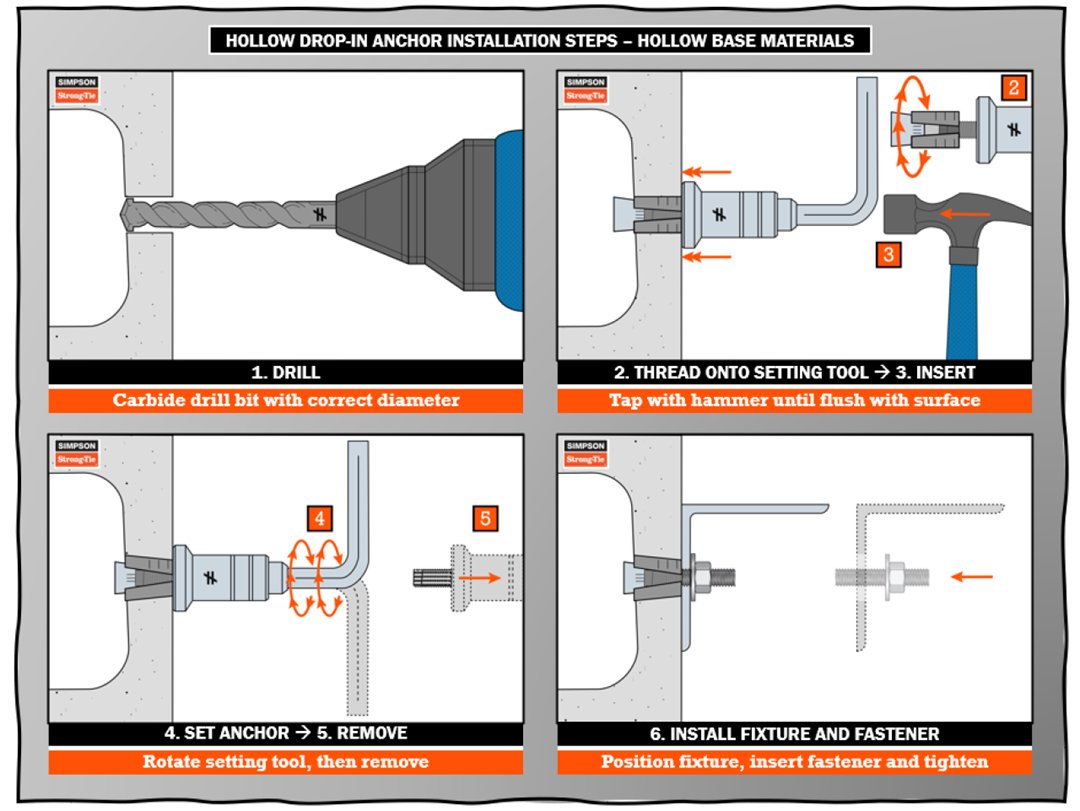
Installation Process (See Figures 4–8)
- Drill: Installation starts with drilling a hole into the base material using a rotary hammer drill equipped with a carbide-tipped drill bit or fixed-depth bit (Figure 7). It’s good practice to drill in rotation-only mode when anchoring into soft masonry or hollow block to minimize substrate damage. Drill the hole to the specified embedment depth. Blow the hole clean using oil-free compressed air to remove dust and debris. Overhead installations need not be blown clean.
- Insert: For solid substrate installations, insert the drop-in anchor into the clean drill hole, then hammer strike until the top of the anchor is flush with the substrate surface. For hollow substrates, thread the HDIA onto the appropriate-size setting tool and insert assembly into the drill hole. Using a hammer, tap the setting tool until the face of the tool contacts the substrate surface.
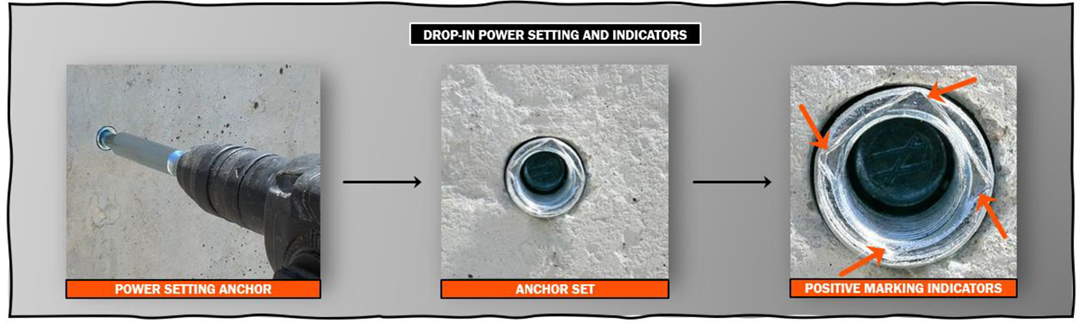
- Set: For manual installation in solid substrates, drive the expander plug towards the bottom of the anchor until the shoulder of the setting tool contacts the top of the anchor. For power set installation in a solid substrate, an SDS setting tool bit is needed (Figure 7) and the rotary hammer drill should be set to hammer-only mode. When the drop-in is properly set, four indentations are visible on the top of the anchor, indicating full expansion. For the HDIA installation in hollow substrates, rotate the HDIA-specific setting tool two complete rotations to set the anchor, then remove the setting tool.
- Thread: Position the fixture, then thread the fastener (threaded rod or bolt) into the drop-in and tighten. The minimum thread engagement should be equal to the nominal diameter of the threaded insert

Typical Drop-In Internally Threaded Anchor Applications
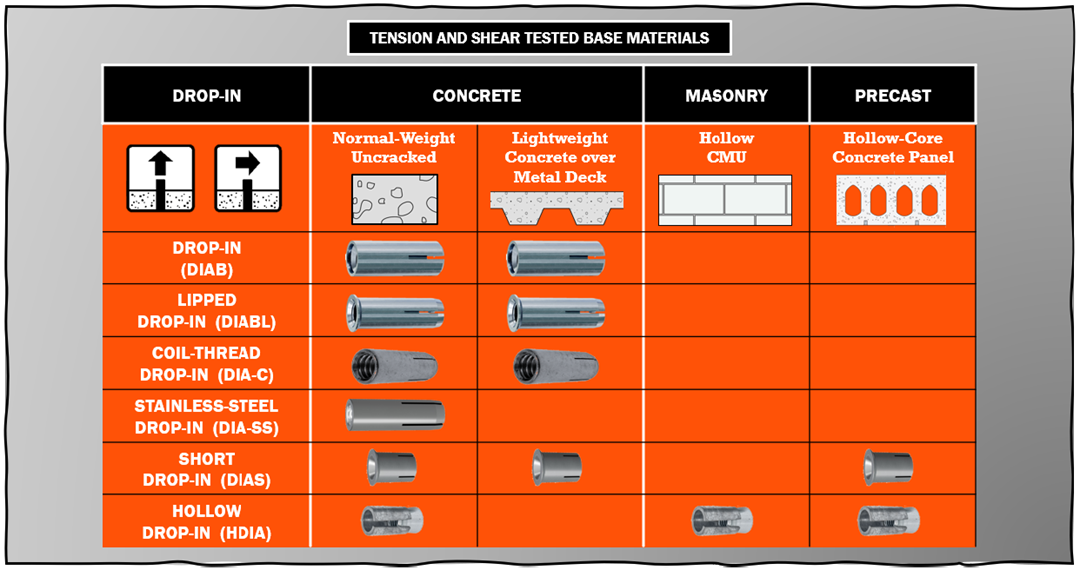
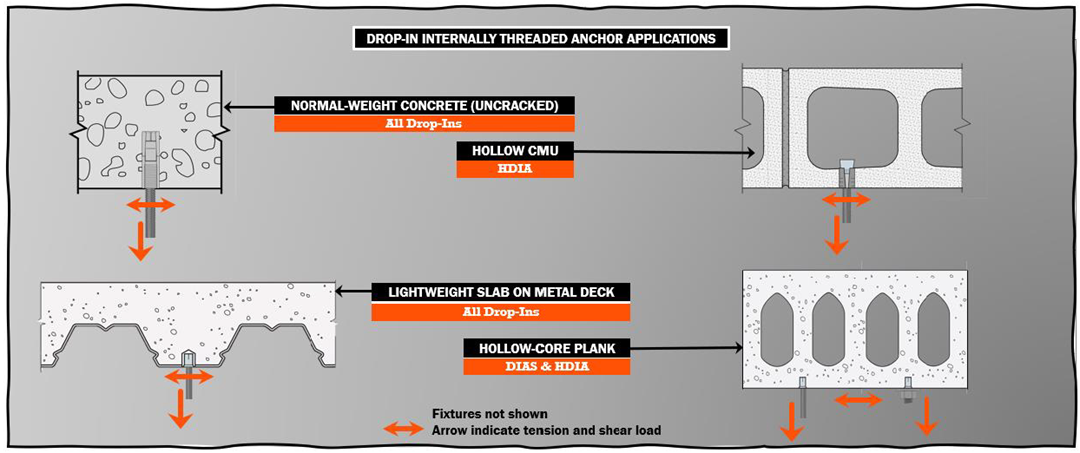
Drop-in anchors are commonly used in MEP or FP applications to secure system elements such as piping, ductwork, cable trays, conduits, and equipment. They provide resistance to allowable tension and shear loads of up to 2,900 lb. and 4,000 lb., respectively, in 4,000 psi concrete. Their ease of installation in a variety of solid and hollow substrates, including concrete, slab-on-metal deck, CMU, and hollow-core planks, combined with internal threading, gives installers flexibility to accommodate changing substrate conditions and fixture types along the installation route. Simpson Strong-Tie drop-in anchors carry UL certification and FM approvals in the pipe hanger category. Figure 9 highlights the tested tension and shear performance in different base materials, while Figure 10 illustrates typical application examples across various substrates.
Conclusion
Simpson Strong-Tie post-installed, internally threaded mechanical expansion anchors offer a simple solution for attaching fixtures to solid concrete, concrete slabs on metal deck, CMU, and hollow-core planks. By understanding the different drop-in anchor types, installation procedures, tested substrates, and typical applications, you can confidently select, design, and specify the appropriate anchor to meet your project’s demands. Please stay tuned for the next Anchor Anatomy 101 blog post, featuring the new Titen Turbo™ stainless-steel concrete and masonry screw anchor. For questions about Simpson Strong-Tie concrete and masonry anchoring systems or project-specific applications, please contact your local Simpson Strong-Tie field engineer.
