





We’re back today with our third Anchor Anatomy 101 blog post focusing on anchor systems. Each post is designed to clarify anchor components, installation processes, and common applications to help you make informed anchor selection decisions based on your project’s unique requirements. Our preceding post focused on adhesive anchor systems, while this post will look at wedge anchors.
The modern mechanical edge-type wege anchor has been in use since the early 1900s. At the most basic level, these anchors gain their load-resisting capacity by expanding against the sides of a predrilled hole. Current post-installed concrete and masonry wedge anchors are referred to as “torque-controlled” mechanical anchors and consist of a threaded section, expansion clip, tapered mandrel, nut, and washer. Torque-controlled anchors require a specific installation torque to be applied for the anchor to properly engage the substrate. Wedge anchors are often qualified to resist static, wind, or seismic tension and shear loads in concrete, concrete on metal deck, or grout-filled masonry. Let’s take a closer look at the anchor anatomy of the Strong-Tie Strong-Bolt® 2 (STB2) Wedge Anchor

- Head Stamp and Chamfered Top: The top end of the anchor body (Figure 2) features a length identification head mark. This mark is a letter that corresponds to the anchor’s length, ranging from A to T, with A indicating 1.5 inches and with size increments increasing up to T, which represents 13 inches. Length information is included in our product catalog. Head stamps facilitate embedment depth verification during field inspections. Additionally, the top of the anchor shaft includes a smooth, unthreaded, chamfered section. The chamfer helps prevent damage to the shaft threads when the anchor is hammer-driven into the drilled hole.
- Nut and Washer: The carbon-steel STB2 hex nut complies with ASTM A563, Grade A, and the washer complies with ASTM F844. The stainless-steel STB2 hex nut and washer comply with AISI Type 304 or Type 316 stainless steel. The hex nut and washer are preassembled on the anchor body. This feature makes it easy for installers to grab an anchor from the box and install it quickly instead of having to assemble three individual pieces first.
- Threaded Anchor Body: The STB2 anchor body is threaded to receive the nut and washer. The threading length varies but is always less than the total anchor length. The STB2 carbon-steel anchor body is either zinc plated to comply with ASTM B633, SC1, Type III or mechanically galvanized. The stainless-steel STB2 anchors are manufactured from either AISI Type 304 or AISI Type 316 stainless steel. The STB2 available anchor diameters include 1/4″, 3/8″, 1/2″, 5/8″, 3/4″, and 1″. The long threading allows for versatility in meeting actual embedment depths encountered in the field.
- Anchor Body Collar: The STB2 anchor body threads transition to a smooth body collar section (Figure 2). The anchor body collar is a solid, unthreaded section with matching diameter. It separates the threaded section and the tapered mandrel end. The anchor body collar prevents the three-segment expansion clip from moving up the anchor body shaft during installation. This allows for the tapered mandrel end to be drawn up into the three-segment expansion clip.
- Three-Segment Expansion Clip: The three-segment expansion clip (Figure 2) wraps around the tapered end of the mandrel. Before installation, the clip is free to rotate around the mandrel. After installation, it fits tightly against the tapered surface, and the dual embossments engage securely with the sides of the drilled hole in the substrate. The expansion clips for the 1/4″, 3/8″, 1/2″, 5/8″, and 3/4″-diameter carbon-steel STB2 anchors are fabricated from carbon steel and conform with ASTM A568. The expansion clip for the 1″-diameter carbon-steel STB2 anchor is made from stainless steel and complies with ASTM A240, Grade 316. For stainless-steel STB2 anchors, the expansion clips are manufactured from AISI Type 304 or Type 316 stainless steel.
- Tapered Mandrel End: The STB2 anchor body has a tapered mandrel (Figure 2) formed on the installed end of the anchor. The taper of the mandrel starts after the anchor body collar and increases in diameter toward the installed end of the anchor. As the mandrel moves up, due to torquing of the anchor, the clip expands over the mandrel.

Figure 2 — STB2 Enlarged Anchor Components 
Figure 3 — STB2 Materials, Finishes, and Dimensions


Installation Process (See Figure 4)
- Drill: Installation starts with drilling a hole into the base material. Use a rotary hammer drill equipped with a carbide-tipped drill bit that complies with ANSI B212.15. Drill to the specified nominal embedment depth (‘hnom’). The drill bit diameter should match the nominal anchor diameter.
- Clean: After drilling, blow the hole clean using oil-free compressed air to remove dust and debris. This step ensures optimal anchor performance and proper embedment. Overhead installations need not be blown clean. As an alternative to cleaning, the hole may be drilled deeper than the nominal embedment depth. The over drilling allows space for dust accumulation at the bottom of the drill hole without affecting anchor performance.
- Drive: Make sure the nut and washer are located at the top of the anchor shaft, ensuring that the top of the nut is flush with the top of the anchor. Insert the assembled anchor into the fixture hole. Using a hammer, drive the anchor into the predrilled hole until the washer and nut are firmly seated against the fixture surface.
- Torque: Using a calibrated torque wrench, tighten the nut to the specified installation torque. The specific torque value varies by diameter and is listed in the product catalog, on a card within the box, and on strongtie.com.
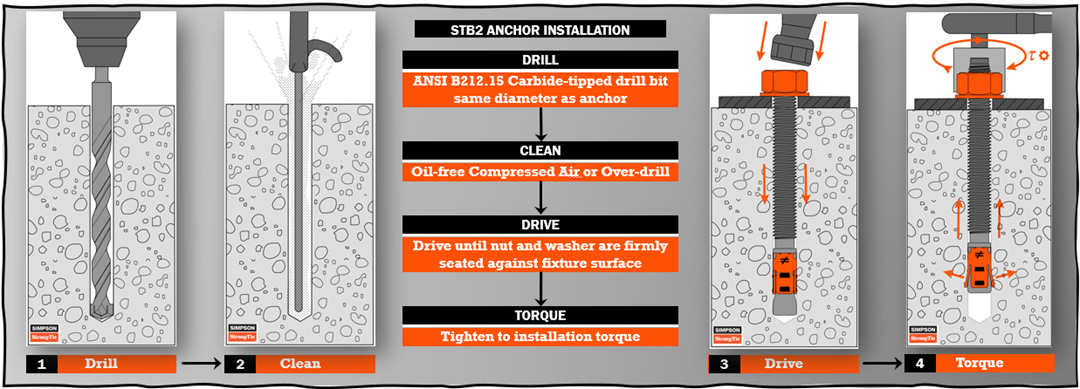
Figure 4 — STB2 Installation
Typical Wedge Anchor Applications
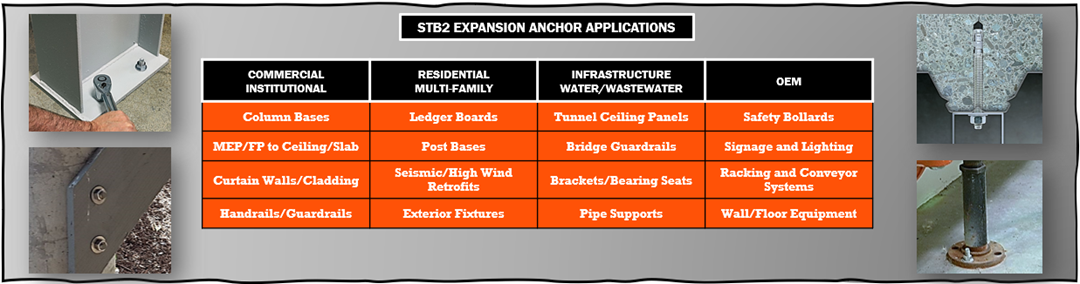
STB2 wedge anchors are used to resist static, wind, and seismic tension and shear loads for a variety of uses, ranging from anchoring down racking in big box stores to resisting lateral loads from steel moment frames. STB2 anchors are easy to use in vertical, overhead, upwardly inclined, and horizontal installations. Carbon-steel and stainless-steel STB2 anchors are ICC-ES qualified for installation in cracked and uncracked concrete elements and slab-on-metal-deck floor and roof systems. In addition, STB2 has both UL and FM approvals, making it a good choice for fire suppression systems where these approvals are required. The carbon-steel STB2 is qualified by IAPMO UES for use in uncracked solid grouted concrete masonry unit (CMU) construction. Due to its long history of use in construction, availability, and ease of installation, the STB2 is a go-to anchor for installers across all disciplines and construction types. Figure 5 highlights some typical wedge anchor application examples per market sector.
Conclusion
Post-installed mechanical wedge anchors, such as the STB2, are a widely accepted solution for structural connections to concrete and grout-filled masonry elements. By understanding the system components, installation procedures, and structural applications, you can confidently select, design, and specify the appropriate anchor type to meet your project’s demands. Stay tuned for the next Anchor Anatomy 101 blog post, featuring the Heli-Tie™ helical wall tie. For questions about anchoring products or project-specific applications, please contact your local Simpson Strong-Tie field engineer.
