


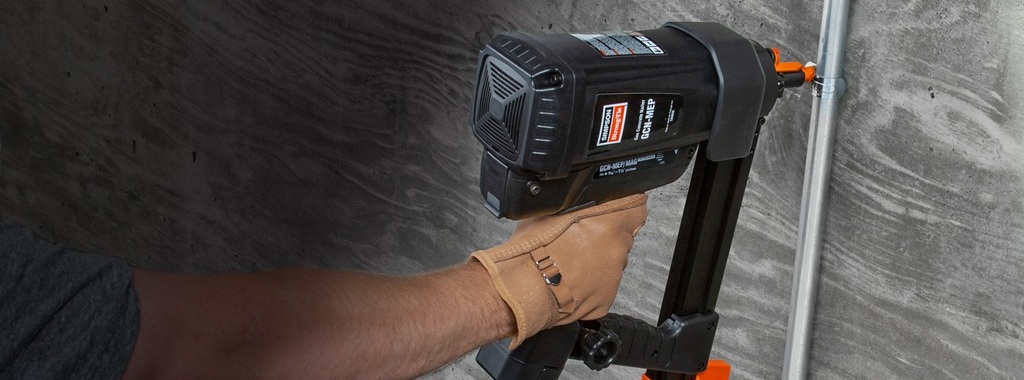
In Part 1 of this two-part series, we discussed how power-actuated fasteners work, the varying load strengths, the similarities and differences between powder-actuated and gas–actuated tools and pins, and the approval process for Evaluation Reports. Now that we have a basic understanding of pins and power–actuated tools (PATs), we are ready to dive into the acceptable uses for these fastening systems and specific limitations that exist as they pertain to the resistance of seismic forces.
Seismic Performance
The limitations for use of pins are primarily driven by Seismic Design Category and their use in resisting seismic forces. The restrictions depend on the base material and the application of the pin. Limitations of pins for use in structures can be found in ASCE 7 and ICC-ES AC70, in addition to manufacturer’s evaluation reports, such as ICC-ES ESR-2138 for the Simpson Strong-Tie PDPA pin. Power-actuated fasteners fall outside of the scope of ACI 318 and AISC 360 and are not covered in either document.
ASCE 7-22 addresses the use of power-actuated fasteners in Chapter 13, the “Seismic Design of Non-Structural Components”. The applicability of Chapter 13, and whether the nonstructural element or system needs to consider seismic forces, is determined by Table 13.1-1, below.
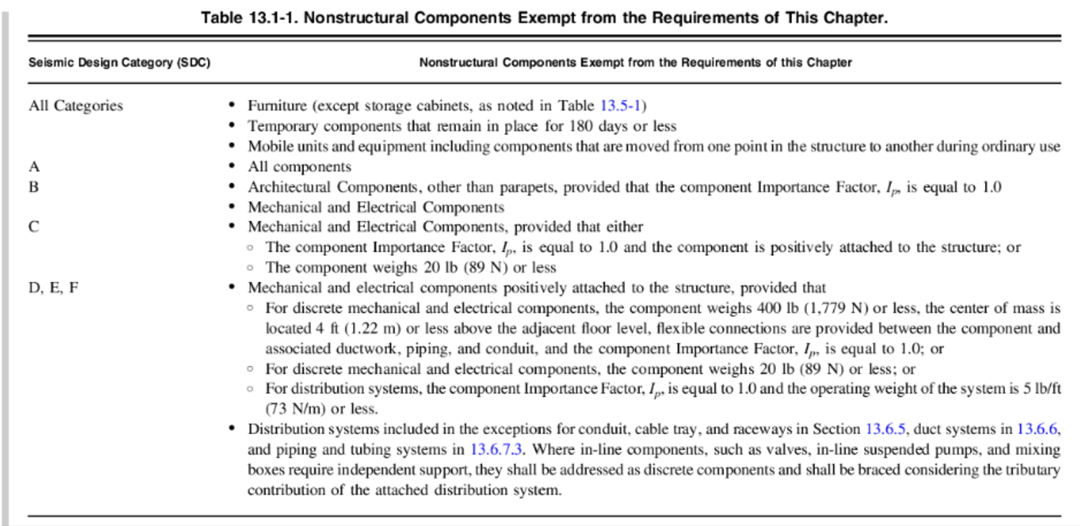
If the structure falls into Seismic Design Category A or the component is listed as “exempt” per the aforementioned table, PAF attachments do not need to consider seismic forces and may be used without restriction except as defined by the manufacturer’s evaluation report or local jurisdiction. If the connection falls into anything outside of these conditions, seismic forces must be considered and additional restrictions apply. Section 13.4.5 of ASCE 7-22 outlines these restrictions, as shown in the excerpt below.
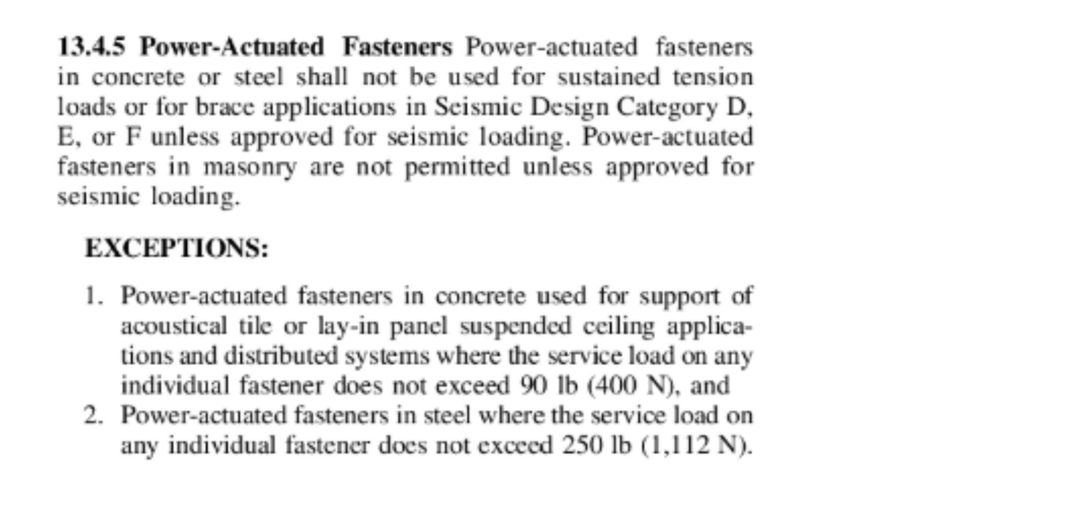
Per ASCE 7-22, Chapter 13, PAFs into masonry are not permitted to resist seismic forces. Fastening to steel or concrete, however, has higher reliability for seismic performance and is permitted so long as the pins are not in sustained tension or being used for brace applications. The exception to this restriction for fastening to concrete, as seen in the excerpt above, is when it’s used to suspend acoustical tile or to lay in suspended ceiling systems and when the load on any single fastener does not exceed 90 lbf. This exception aims to capture the redundancy in the multitudes of PAFs used when attaching distributed systems and also limits the application to relatively lightweight overhead systems. When attaching to steel, the exception restricts the force per fastener to a maximum of 250 lbf, but the application is not restricted to suspended ceilings like it is for concrete.
Readers familiar with code language have likely inferred that, based on the way ASCE 7 Section 13.4.5 is written, power-actuated fasteners are allowed in all instances not addressed, correct? If I looked at this document in isolation, I would naturally agree. However, AC70 takes a more positive stance on the use of PAFs. Rather than saying, “here is where you cannot use PAFs” as ASCE 7 does, AC70 flips to language that states “here is where you can use PAFs,” restricting the use in seismic applications to only the applications listed in the document.
As previously mentioned, Chapter 13 of ASCE 7 pertains specifically to the seismic design of nonstructural components, and ASCE 7 does not address the use of PAFs for structural connections; AC70, however, does. Before discussing the allowed structural connections for PAFs, though, it’s important to note that PAFs are not permitted to be used as part of the Seismic Force Resisting System per Section 1.2.1 of AC70.
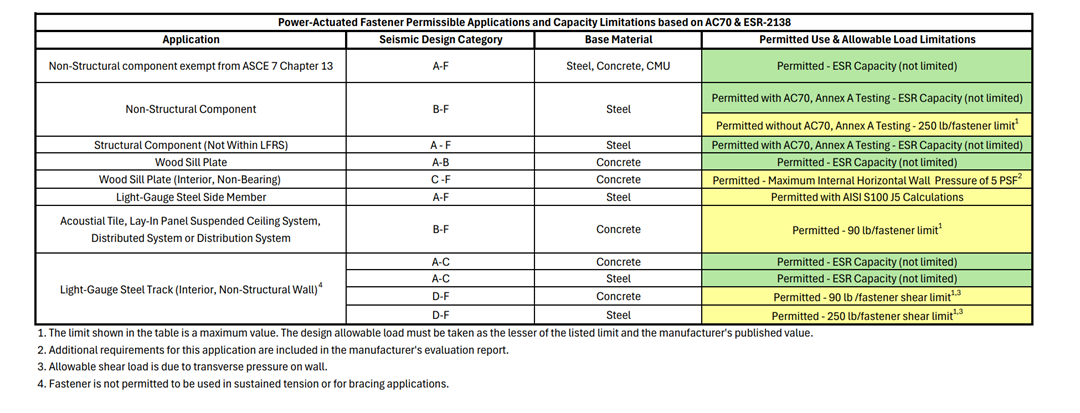
Section 1.2.1 of AC70 contains the limitations stated in ASCE 7, Section 13.4.5, in addition to PAF applications with wood sill plates, steel track, and structural steel connections (see the following section on Annex A Seismic Testing). Attachment of wood sill plates of light-frame structural walls to concrete is limited to Seismic Design Category A and B. In Seismic Design Categories A – F, pins are acceptable for use in attaching interior, nonstructural walls to concrete where the maximum horizontal transverse load on the wall is limited to 5 psf. Similarly, PAFs may be used to attach the steel track of interior, nonstructural walls to concrete or steel in all Seismic Design Categories, so long as they are not subject to sustained loads or used in bracing applications. However, in Seismic Design Categories D – F, this application has an allowable load limit due to transverse pressure of 90 lb. per fastener when fastening to concrete, or 250 lb. per fastener when attaching to steel.
Annex A Seismic Testing
If we look back at the ASCE 7-22 13.4.5 excerpt, we see that there is an additional exception that relieves the restrictions placed on PAFs if they are “approved for seismic loading.” ICC-ES has developed Annex A within AC70as a means of testing and gaining seismic approval for the use of PAFs installed into steel base materials. Currently, Annex A only pertains to steel base materials and there is not a route for gaining seismic approvals into concrete or masonry. The commentary of ASCE 7, Section 13.4.5 adds that PAFs installed into steel typically exhibit reliable cyclic performance and that the restrictions found within Section 13.4.5 are due to observed failures of sprinkler pipe runs during the 1994 Northridge earthquake, which primarily were PAF-to-concrete attachments in sustained tension loading. The susceptibility of shallowly embedded, small-diameter fasteners to reduced performance in cracked concrete is the reason for the limits contained in Section 13.4.5. Predrilled, post-installed concrete screw or wedge anchors with cracked concrete approvals like the Titen HD®, Titen HD threaded rod hanger, or the Strong-Bolt® 2 have more reliable performance and are the appropriate solution when anchoring to concrete to support loads higher than 90 lbf per fastener or systems other than light ceilings.
To qualify PAFs for seismic loading in steel per Annex A, fasteners must pass a series of simulated seismic tension and shear tests through cyclic loading as outlined in the references below.
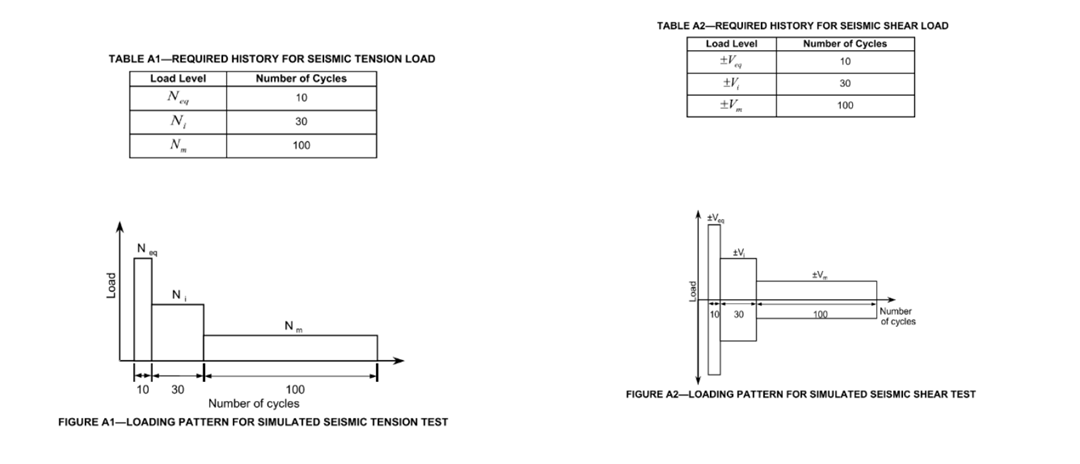
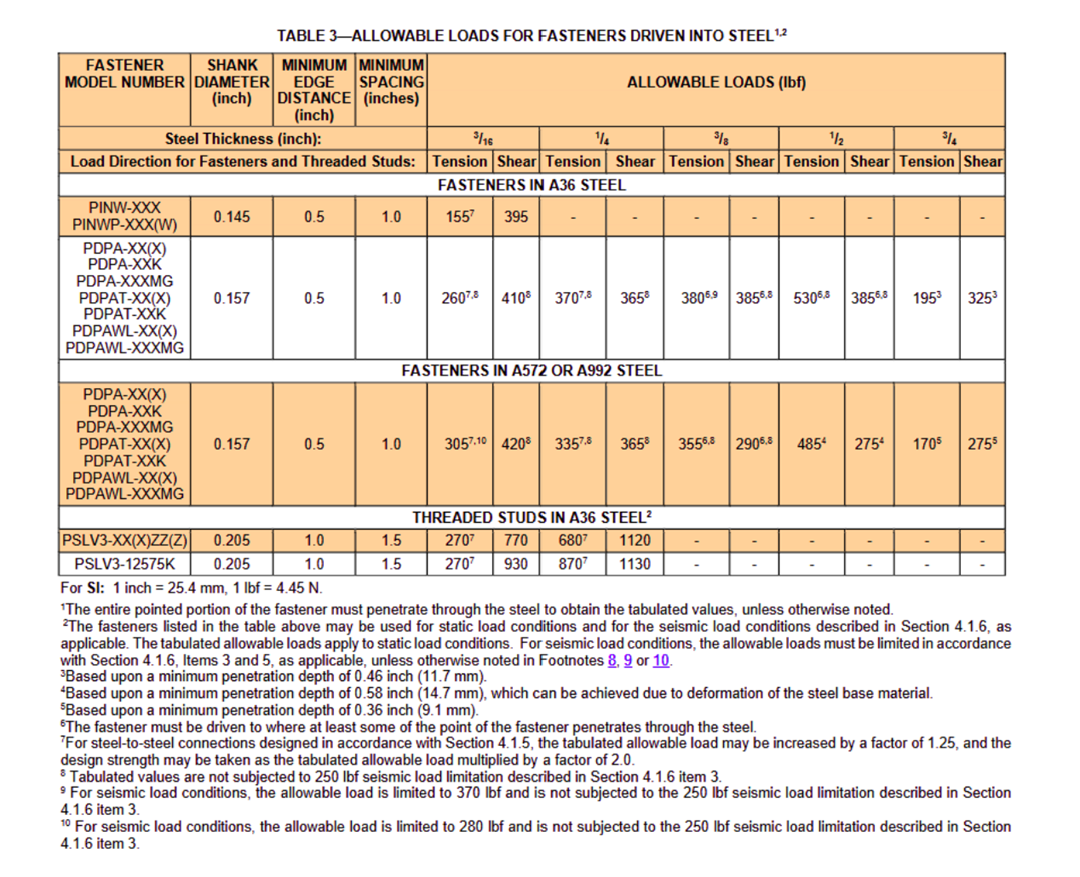
The load levels are based on tension and shear reference test values determined within the standard AC70 protocol. This is just a small glimpse into the test procedure, but it’s worth knowing it exists and allows for power-actuated fasteners’ capacities in steel to exceed the prescribed 250 lbf limit when tested. For example, from ESR-2138 for the PDPA, values listed in Table 3 (below) denoted with footnote 8, 9, or 10 show allowable capacities in excess of the 250 lbf limit and indicate successful testing per Annex A.
Summary
Powder– and gas-actuated fasteners are a fast and practical means of fastening, but care should be taken to ensure that the seismic limitations outlined in ASCE 7, AC70, and evaluation reports are understood and followed. Below is a table that captures the permitted use of PAFs based on the provisions reviewed within this blog. Now you hopefully have the tools to decide whether you should “PAF, GAF, or Pass” on your next connection!