





We often get questions about using fasteners different from those listed in a connector’s catalog load tables. A question came up recently, and I said, “I did a blog post about that not too long ago.” Turns out that blog post is over 10 years old, which no longer qualifies as “not too long ago.” The options we offer as alternative fasteners for our connectors have grown since that blog post, so I thought it was worth revisiting the topic.
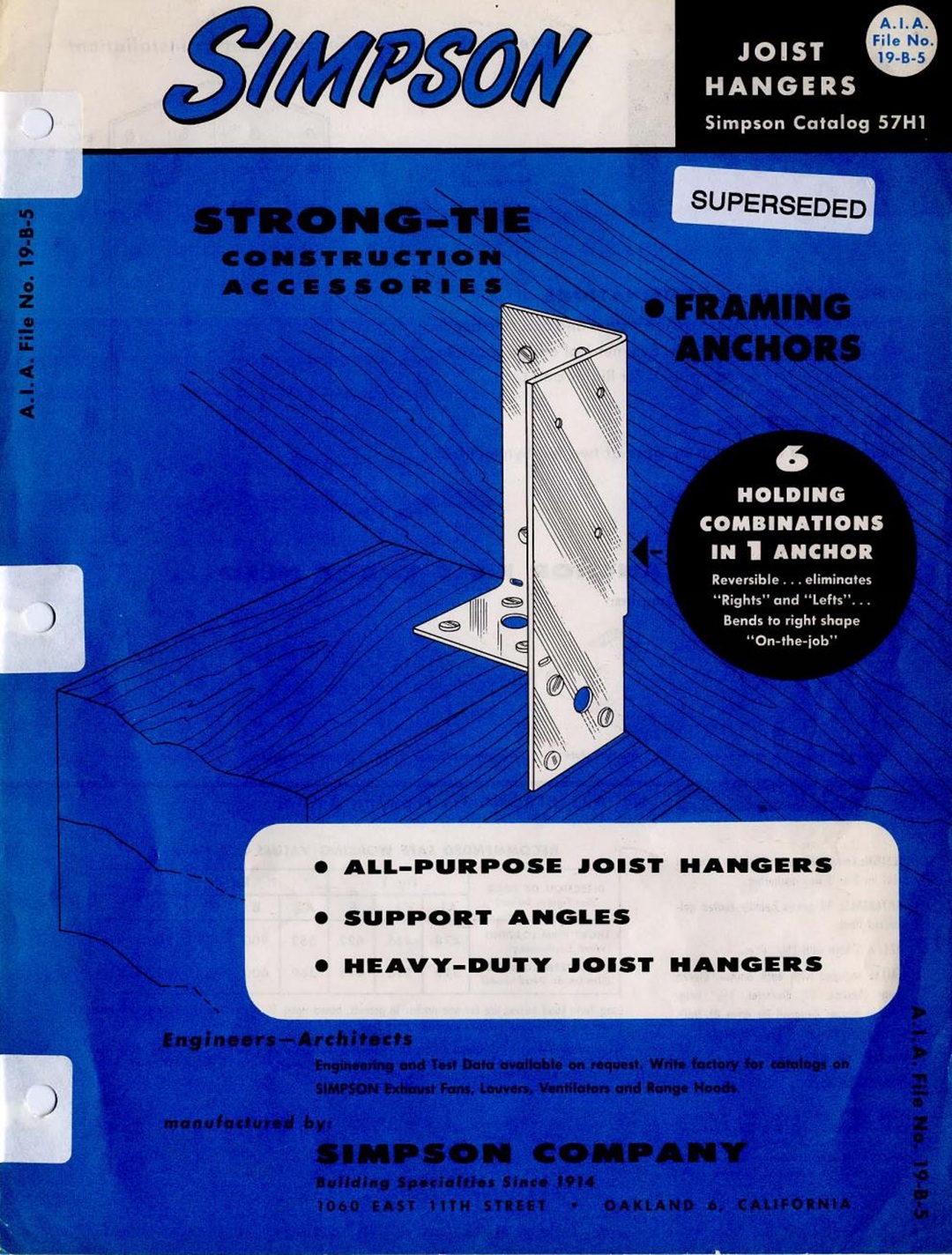

Nothing to do with fasteners, but I would be remiss not to mention that our first catalog in 1957 was four pages long. The first “Nail Conversion” table did not arrive until 37 years later, when we added this section to our 1994 Connectors catalog.

A bit more about double-shear nails. We introduced double-shear nailing in 1984 with the HUS hangers and later created the LUS, HGUS and HHUS hangers to take advantage of this innovative feature. The Eighth Day of Christmas blog post from December of 2023 discussed the innovation of double-shear nailing. In straight-nailed hangers, the joist nails are important in securing the joist for uplift, but they don’t help increase the download capacity of a hanger. In double-shear hangers, dome holes angle the joist nails so they penetrate through the hanger, through the joist and into the header. This allows both the hanger face nails and the joist nails to transfer load into the header, resulting in higher allowable loads. Double-shear nails need to be long enough to penetrate the header, so we required 10d common (0.148″ x 3″) or 16d common (0.162″ x 3 1/2″) nails for double-shear nailing.

Positive placement nailers are pneumatic tools that have a mechanism that helps locate the nail in the connector hole. Many of these tools are limited to 2 1/2″-long nails, so contractors wanted the option to use short nails in double-shear joist hangers. We created a separate technical bulletin that provided reduction factors for short nails in specific hanger models. We incorporated these reduction factors into the connector catalog to make sure the information was readily available. We also expanded the substitution options to include post caps and post bases based on new testing.
Finally, we have Strong-Drive® SD CONNECTOR Screws, which we designed as a replacement for nails and which are awesome for people like me who aren’t good at driving nails.
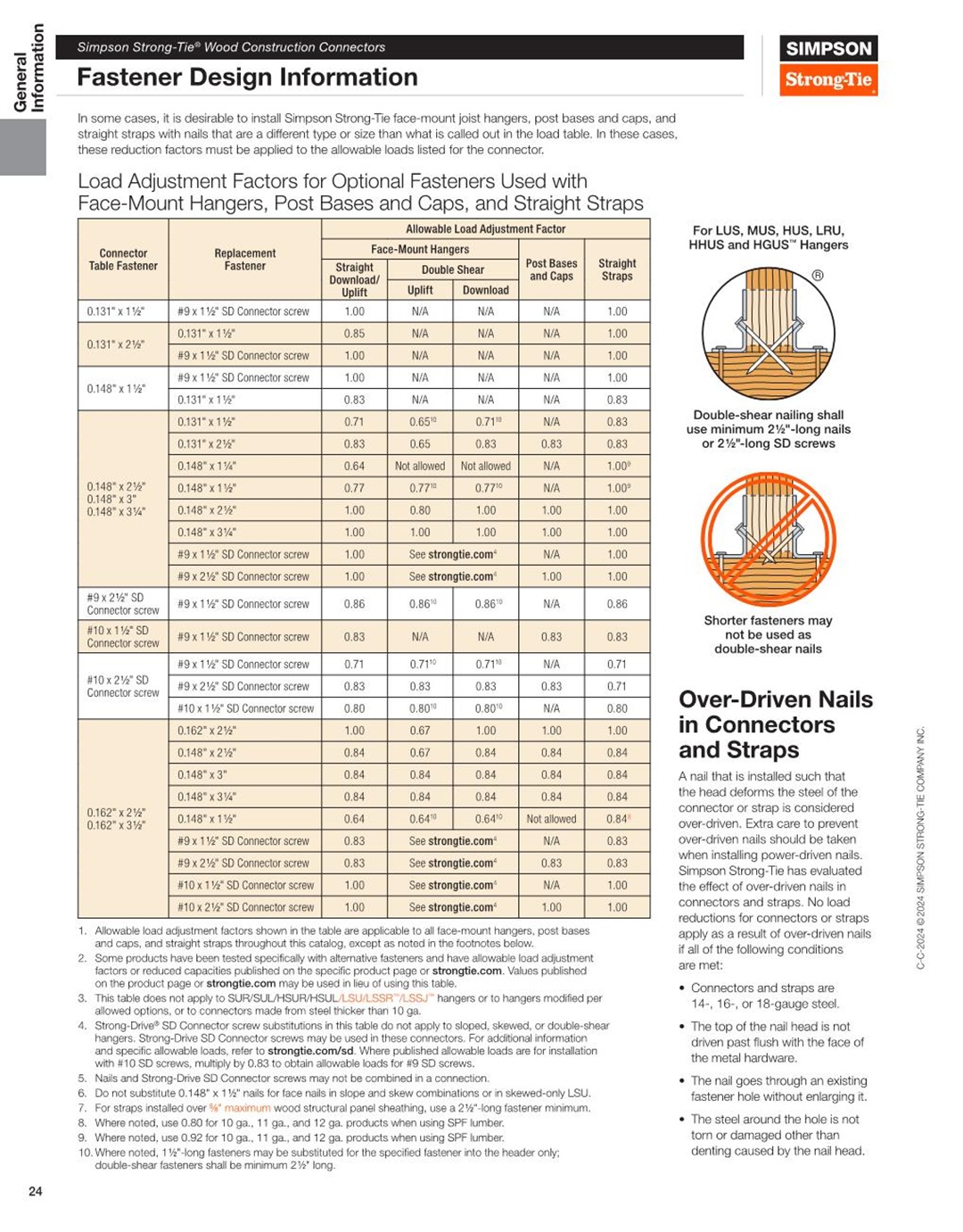
I’ll copy this portion about rim board fasteners from my previous blog post.
The question of nail size also comes up when attaching hangers to rim board, which can range from 1″ to 1 3/4″ thick. The adjustment factors in C-C-2024 do not necessarily apply to rim board, which may be thinner than the length of the nails used. We have a technical bulletin for Hangers on Rim Board Headers — T-C-RIMBDHGR.

Most of the reduction factors are the same as those in the catalog, although some are lower based on reduced nail embedment in thinner materials. Testing of hangers with 10d x 1 1/2“ nails on 1“ OSB or 1 1/4“ LVL did not do as well, however. We observed that once the nails withdrew a little bit under load, they quickly lost capacity. For that reason, we recommend full length 10d or 16d nails on those thinner rim board types.

Finally, how does Simpson Strong-Tie specify nails in our literature? Prior to 2019, we used penny size — 16d, 10d, 8d, 10d x 1 1/2“, 8d x 1 1/2“. Nails were common nails, unless noted otherwise. We recognized over time, though, that nail manufacturers most prominently identified their nails by diameter and length, often not listing the penny size at all. In our 2019 Wood Construction Connectors catalog, we therefore switched to specifying nails by diameter and length, which matches up with the nail labels you’ll see at the hardware store.
