



Cold-Formed Steel Connectors

This blog has described how we load rate different products based on test standards, which are covered under various ICC-ES Acceptance Criteria, or ACs. The first was a post on wood connectors (AC13), then holdowns (AC155), threaded fasteners (AC233) and cast-in-place anchors for light-frame construction (AC398 and AC399). I realized today that I have never talked about how we test and load rate connectors for cold-formed steel.
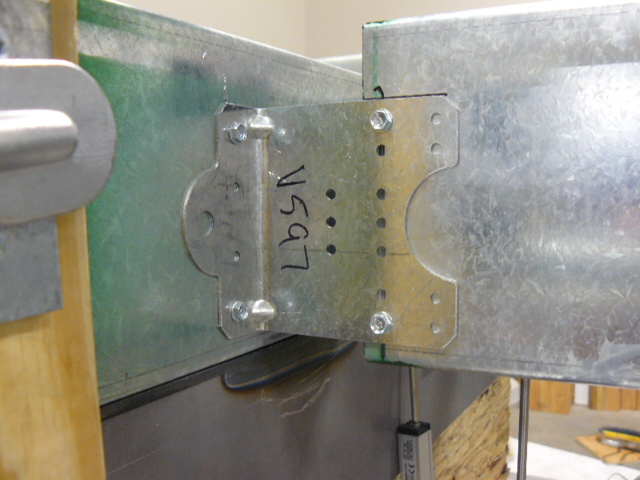
AC261 Joist Test 1

But first, a confession – it has taken me many years to stop calling it “light-gauge steel.” When I started designing with cold-formed steel, I called it “light-gauge” because I had a binder of design information put together by the Light Gauge Steel Engineers Association. Advocates for CFS felt that “light-gauge” may make people think “weak” or “non-structural,” and that perception would limit the use of cold-formed steel in construction. So there was a deliberate effort to banish the word light-gauge and replace it with cold-formed steel, or CFS. I still slip every once in a while.

Connectors for light-gauge, ahem, I mean cold-formed steel members are covered under ICC-ES AC261 – Acceptance Criteria for Connectors Used with Cold-formed Steel Structural Members. The physical testing for cold-formed steel is similar to wood connectors. Build a setup representative of field conditions, apply load till failure and measure the load and deflection data. Both wood-to-wood and CFS connectors have a service limit state of 1/8” deflection.

Strength data for CFS connectors is analyzed much differently, however. Wood connectors generally use a safety factor of 3 on the lowest ultimate load (or average ultimate if six tests are run). We are often asked what the safety factor for CFS connectors is.
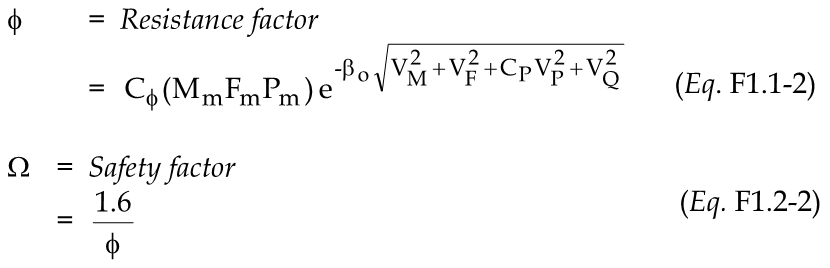
AISI S100 Safety Factor

AISI S100 Chapter F details how to determine design strengths for tested CFS products. The design strength is the average test value, Rn, multiplied by an LRFD resistance factor, Φ, or divided by an ASD safety factor, Ω. Determining the resistance factor or corresponding safety factor is based on a statistical analysis dependent on several variables. This is similar in concept to how embedded concrete connectors tested to AC398 or AC399 are evaluated, which I discussed in this post.
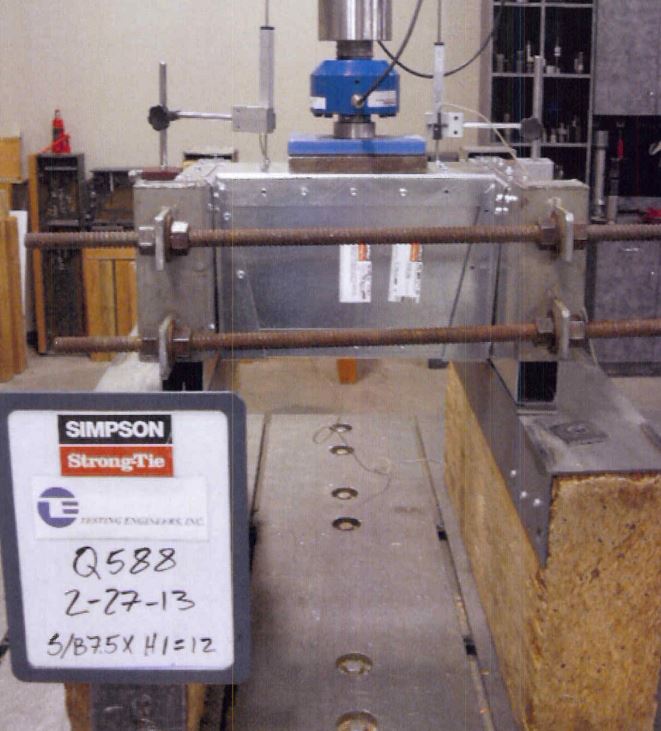
AC261 Joist Test 2

I don’t want to get too deep into the Greek letters involved in the calculation. The factors that affect the allowable load calculation are type of member tested, variation in the test values, type of manufacturing, and number of samples tested. One factor that has a large impact on the calculation is the target reliability index, βo. In connector testing, this factor is 2.5 if the structural member (joist, stud, track, etc) fails and 3.5 if the connection fails. The net result is a higher safety factor for test values limited by the connection, and lower safety factors if the structural members governed the test load. Typical safety factors for CFS connectors are 1.8 to 2.0 where the failure mode is in the structural members and 2.2 to 2.9 for tests where the connection failed.
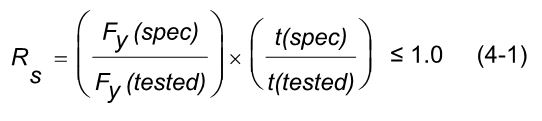
Strength Reduction Factor

AC261 has a reduction factor, RS, which is used to adjust test values if your steel strength and/or steel thickness are over the specified minimum. CFS test setups often use different steel in the joist, header and the connector. Reductions are calculated based on the tested and specified strength and thickness for each member. The lowest reduction is used to adjust the test values.
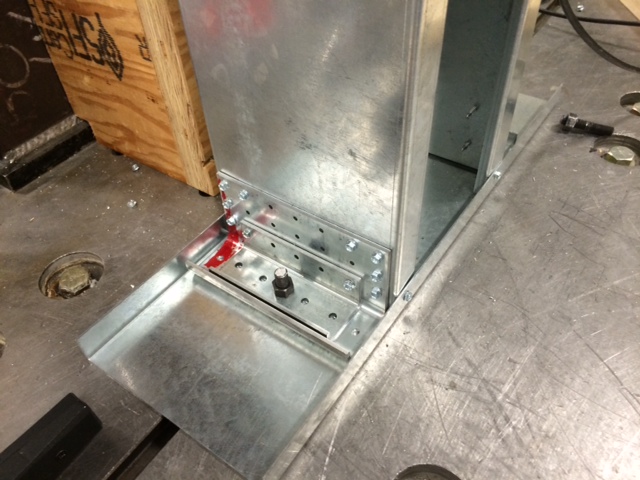
RCKW Kneewall Setup

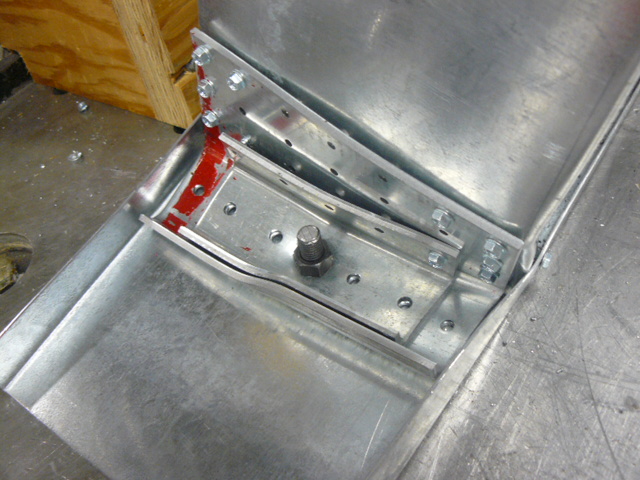
RCKW Kneewall Failure

One additional complexity in CFS testing is the multiple gauges of steel which must be evaluated. This requires more CFS test setups than a comparable wood connector would require. In the end, we have what we are really after. Design loads that specifiers can be confident in.
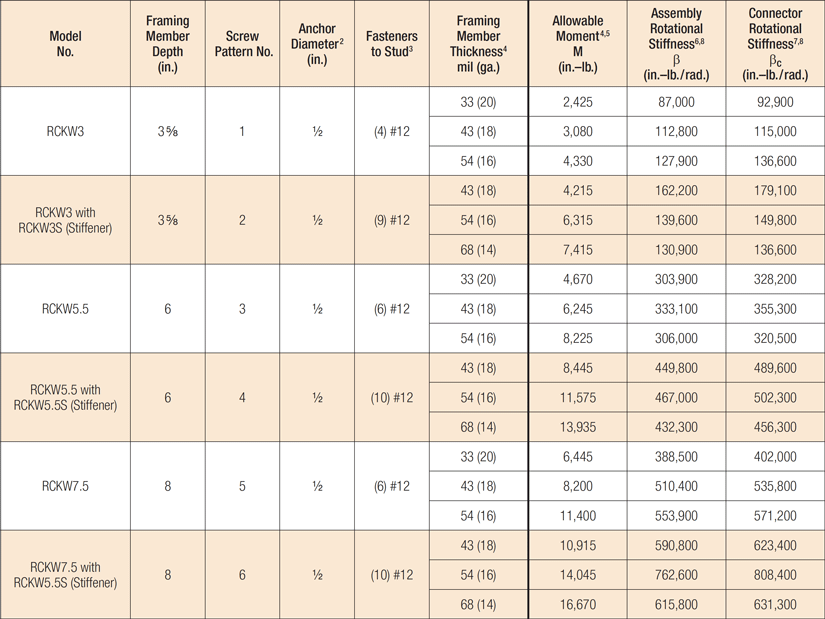
RCKW Load Table

How to Safely Select Nail Substitutions for Connectors

A few days ago, I was speaking to a customer about an application using nail substitutions for a joist hanger installation. Her questions come up often, so I thought I would dedicate a blog post to some of the resources available that cover the use of different nails in connectors.

Designers and builders often wish to use different fasteners than the catalog specifies. The application could require short nails that don’t penetrate through the back of a ledger or they want to use screws or sinker nails for easier installation. The Wood Connectors Catalog provides multiple options for alternate nailing for face mount hangers and straight straps on page 24.

The load adjustments for alternate fasteners cover substitutions from a common diameter of 16d to a 10d, or a 10d to an 8d. Multiple different replacement lengths are also covered, with reduction factors ranging from 0.64 to 1.0.

It is important to remember that double shear hangers require 3” minimum joist nails. Short nails installed at an angle in double shear hangers will not have adequate penetration into the header.

Pneumatic nail guns used for connector installation are commonly referred to as positive placement nail guns. These tools either have a nose piece that locates connector hole, or the nail itself protrudes from the tool so that the installer can line the nail up with the hole. Most positive placement tools do not accept nails longer than 2½”, so framers using these tools will want to use 1½” or 2½” nails. To accommodate installers using pneumatic nails, we have a technical bulletin T-PNUEMATIC. This bulletin provides adjustment factors for many of our most common embedded holdowns, post caps and bases, hangers and twist straps.

The question of nail size also comes up when attaching hangers to rim board, which can range from 1” to 1¾”. The adjustment factors in C-2013 don’t necessarily apply with rim board, since the material may be thinner the length of the nails used. We also have a technical bulletin for that application – T-RIMBDHGR.

Rim Board Reduction Factors

Several of the reduction factors are the same as those in the catalog. Testing of hangers with 10dx1½ nails on 1” OSB or 1¼” LVL did not do as well, however. We observed that once the nails withdrew a little bit under load, they quickly lost capacity. For that reason, we recommend full length 10d or 16d nails on those materials.

Rim board failure
Rim board failure

Understanding that alternate fasteners are available for many connectors can help you pick the right fastener for you application. When you specify a connector, it is important to also specify the fasteners you require to achieve your design load.

How We Test – Part I: Wood Connectors

If you have followed some of my earlier blog posts, you know I am passionate about testing. In my post, Testing – Then and Now, I said, “There simply is no substitute for a physical test.” Something I haven’t discussed in much detail, however, are some of the complexities involved in a good test.

LUS2 10-2 Uplift Test SetupLUS2 10-2 Uplift Test Failure
LUS2 10-2 Uplift Test Setup                  LUS2 10-2 Uplift Test Failure

For wood connector testing, we follow ASTM D7147-21 Testing and Establishing Allowable Loads of Joist Hangers. The actual testing is relatively straight forward – build at least three setups, test them, measure the deflection and ultimate loads.

It actually was that simple years ago, but modern test standards have more requirements than just breaking the part. First off, the steel used in the connector is important. To prevent overestimating a connector’s performance, ASTM D7147 has limits on the strength and thickness of steel used for testing relative to the specified material.

ASTM Steel Reduction Factor

The test standard acknowledges that actual steel strength will exceed the specified strength and the 3/2.5 term in the reduction factor gives you 20% leeway to exceed the specified minimums and not take reductions in allowable loads. Locating production parts made with the right strength steel requires a little bit of searching and we need to do a base metal thickness test on production parts. Prototype parts are somewhat easier because we can hand pick the steel used for making them.

Wood in Conditioning Room

Once we have the parts made with the correct steel in the test lab, we need the right wood. Two properties that affect hanger performance are specific gravity and moisture content of the wood. Moisture content is simply a measure of how wet the lumber is, and the test standards require load reductions if testing is done on wood at less than 11% moisture content. We test the moisture content and specific gravity of every board we receive prior to building test setups. All the good wood is stored in the conditioning room.

Baking Specific Gravity Samples

Specific gravity is a measure of how dense the wood is – denser wood usually means better test performance. Similar to steel, the test standard requires reductions if your tested specific gravity exceeds the specified. Unlike steel, there is no 20% fudge factor. Once a test is run, specific gravity samples are taken, numbered, measured, and then put in the oven to dry. With testing complete, we can finish the test report and do the calculations to load rate the product. It is a lot of work to create one allowable load for a table in a catalog or a flier – and I still love testing!

– Paul