




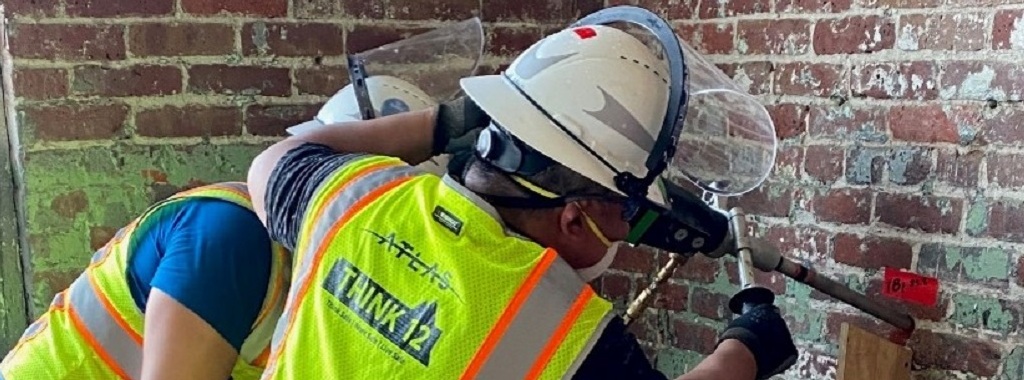
Have you ever specified an adhesive for an unreinforced masonry (URM) retrofit? If so, you may have wondered about the difficulty of drilling holes at 22.5° from horizontal in order to properly install an anchor to take tension loads.
Author: Wendy Allen
Wendy Allen, P.E. has been part of Simpson Strong-Tie's Northwest Engineering team for more than 20 years. As a Senior Field Engineer, she has had constant exposure to the concerns of the Engineering community and has made it a passion to try to help Engineers understand complex code provisions and assist by providing solutions for those dealing with the resulting design issues. During her career she was elected to serve a 2 year term on SEAONC (Structural Engineers of Northern California) Board of Directors from 2013 to 2015. Previous to joining Simpson Strong-Tie, she worked as a consulting structural engineer in the Bay Area. Hailing from Southern California, Wendy graduated from UC San Diego with a Structural Engineering degree and is a licensed P.E, In her spare time Wendy likes to mtn. bike, ski or hike in the Lake Tahoe area.
How Should I Determine a Tension Test Load? Guidelines on Proof Loading Adhesive Anchors
Have you ever been involved on a project where a post-installed anchor failed when loaded? What was the circumstance? Was the anchor installed with incorrect torque or was the hole improperly cleaned, resulting in lower capacities than published? Unfortunately, in the world of concrete anchors, installations are sometimes incorrect as a result of not following instructions. Alternatively, perhaps you’re working on a project where special inspection wasn’t performed as required by the building code. What should be done in these cases?