


The Omega Factor

Section 12.4.3.3 of ASCE 7-05 (or -10) deals with overstrength (Ωo) load combinations and allows a 1.2 increase in allowable stress when using these combinations. We received a question from a customer last week asking if the 20% increase applies to Simpson Strong-Tie connectors. The simple answer is yes. When demand loads are based on amplified seismic forces, connector allowable loads may be increased by 1.2 per Section 12.4.3.3.
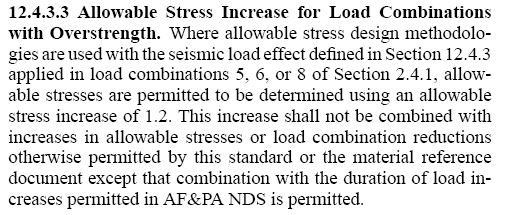
Image credit: ASCE 7-05.

Since the increase may be combined with the duration of load increases permitted in the NDS, you would apply the 1.2 increase to connector allowable loads at a load duration of 1.6, which makes the overstrength factor a little less terrible.

The question got me thinking a little more about overstrength load combinations, so I wanted to discuss what they are used for. It also made me think about a sales meeting several years ago where one of our engineers was addressing a question about an application that required a design using amplified seismic forces. A salesperson asked why the forces needed to be amplified and he said, “Well, there’s this Omega subzero factor…” Never speak in Greek letters to salespeople. They call him Omega Subzero to this day.

So why does the code have amplified forces?

Continue Reading

Unreinforced Masonry (URM) Buildings: Seismic Retrofit

Unreinforced masonry (URM) buildings in moderate- to high-seismic areas can be a disaster in waiting. These types of structures have very little of the ductility required of structures to prevent loss of life or business disruption in a seismic event. (Consult our Structural Engineering Blog post “Building Drift – Do You Check It?” for a discussion on ductility.) Many of these buildings are in densely populated areas, have historical meaning, provide important living or business spaces, and can be costly to retrofit. In this blog, Simpson Strong-Tie engineers discuss tools available for engineers to assess these buildings and design the retrofits needed to mitigate a potential loss of life and increase seismic resiliency.

Continue Reading

Structural Engineering Blog: One-Year Anniversary

Photo credit: Thinkstock.

This month marks the one-year anniversary of the Simpson Strong-Tie® Structural Engineering Blog! To celebrate, we are holding a contest for our blog readers and sharing a few interesting statistics about the blog, along with our Top 5 Blog Posts from April 2012 to today.

Everyone who posts a comment or subscribes to receive email notifications to the blog (new subscribers only) from now until April 30, 2013 will be entered to win one of five Prize Packs. The Prize Pack consists of:

The contest is open to U.S. and Canadian residents (except Quebec) only. One entry per person. Five entries will be randomly selected to receive a Prize Pack. You can read the Official Rules here.

Continue Reading

Overview of Code-Plus Programs

We all know that the purpose of a building code is to provide minimum requirements for the health, safety, and welfare of the occupants of buildings built under that code.  But what if the owner wants a building that will perform better than the absolute minimum allowed by the code?Continue Reading

Is Designing with Wood Easy?

In college, I spent some of my free time either attending seminars or reading about high profile structural engineering projects. These projects tend to be noteworthy due to their massive scale or their use of innovative construction technologies (often both). Taipei 101 is 508 meters tall, and used to be the tallest building in the world. The Burj Khalifa has surpassed it as not only the tallest building in the world, but as the tallest manmade structure at 828 meters.

I never thought I would design the world’s tallest buildings, but I did think it would be cool to work on some mid-rises. I never did. My design firm didn’t do that type of work – which looking back, was a good thing for me. We worked on a lot of everything, including commercial, industrial, multi-family and mixed-used projects. The variety of projects meant designing with all the major building materials, including concrete, steel, masonry, and wood. Reviewing my project portfolio and thinking about what was really satisfying to work on, the projects that stand out most were wood-framed.

Continue Reading

Code Reports: Uniform Application of Code Intent in a Diverse Environment

Woodworks invited me to do a presentation on Testing and Evaluation of Products for Wood-framed Construction, and I found you can’t really talk about testing without talking about the test standards and criteria used in product evaluations. Usually the goal in testing to these standards is to show compliance with the intent of the building code and have the product listed in a code report.

Why not just follow the code?

Innovative architectural and structural building products not addressed by the building code are in every building. Revisions to the building code are considered on a three-year cycle and some standards are on a five-year cycle. Sometimes it may take several cycles to address a new building product.

Continue Reading

Tell Us Your Genuine Story for a Chance To Win!

You may have noticed that the cover of our new 2013-14 Wood Construction Connectors Catalog features the word GENUINE. What do we mean by Genuine Simpson Strong-Tie Connectors? It’s really based on our roots and our founder Barclay Simpson, who made his very first connector for a customer in 1956. Barc believed in doing whatever it took to help the customer succeed.Today, helping the customer remains our number one priority. Whether that’s being on a jobsite to help with a product installation, spending endless hours on R&D and product testing or making sure our products get to our customers on time. This is what we promise to do everyday, and we do it genuinely.Continue Reading

Congratulations to the "Creative Use of Our Product" Contest Winners!


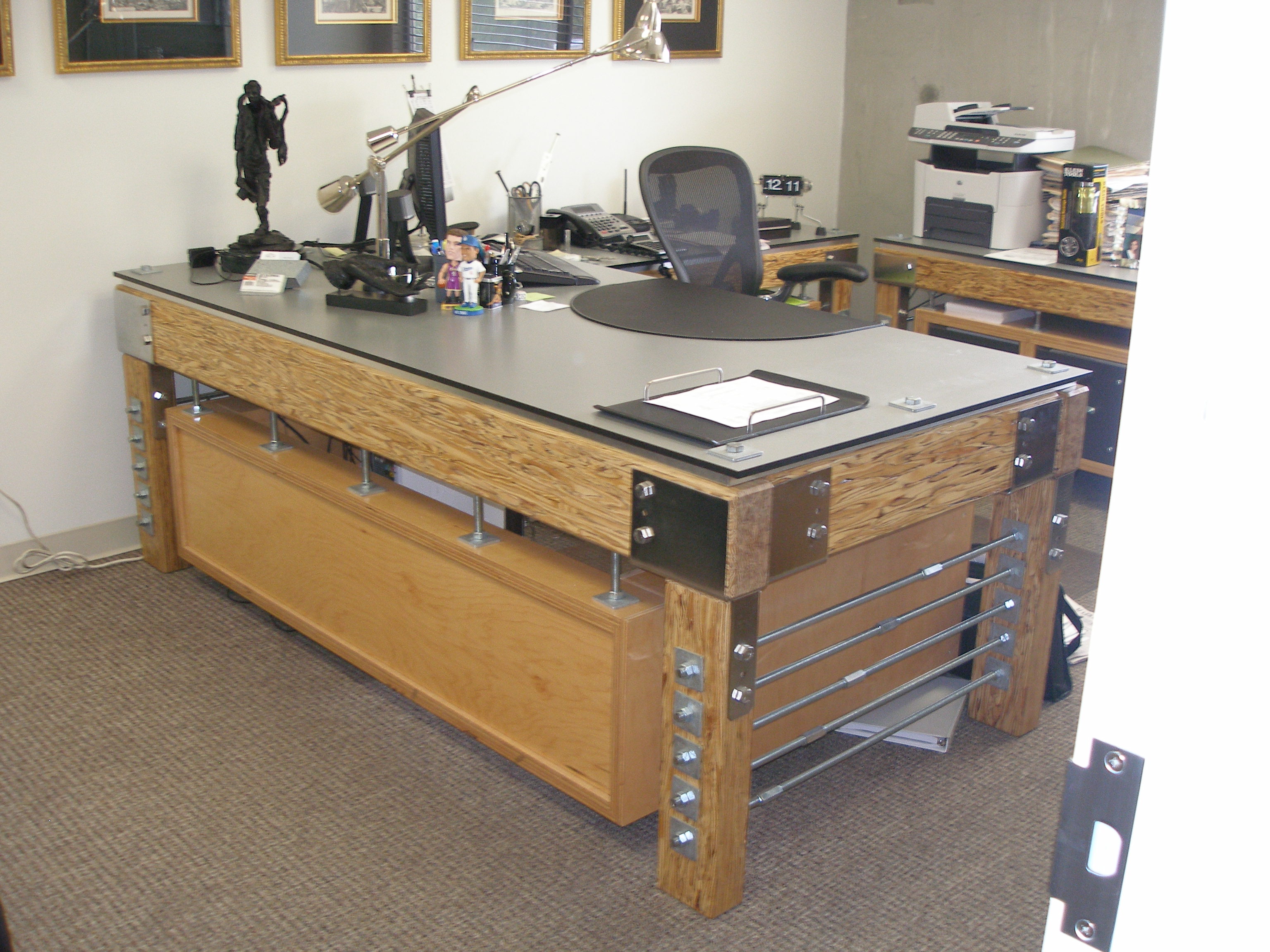
Engineered Desk: Winning photo of the Creative Use of Our Product contest. Photo credit: Alan Hanson, Simpson Strong-Tie.

Thank you to everyone who participated in our “Creative Use of Our Product” contest! This was our most popular post yet. Based on comments received, the Top 5 photos were:
1. Engineered Desk
2. Statue of David
3. Top Flange Spoiler Bracket
4. & 5. (Tie): Truss Coffee Table and HD Trailer Hitch Adapter
The winners of the Simpson Strong-Tie Prize Pack, chosen randomly among all comments on the post are:
1. Kimberly T., Brea, CA
2. Natalie D., Pleasanton, CA
3. Zoran P., Vaughan ON
4. Evan L., Pullman, WA
5. Mary P., Franklin, WI
Congratulations to the winners.
If you’d like automatic email updates when a new blog entry is posted (usually once a week), sign up here.

Corrosion: The Issues, Code Requirements, Research and Solutions

When you hear $452 billion, what comes to mind? Perhaps the annual state budgets of California, Texas, Florida or New York? Maybe the combined net worth of Bill Gates, Larry Ellison, or the Walton Family? While those would be good guesses, I bet you didn’t think of corrosion! According to a May 2012 Congressional Briefing hosted by NACE International and ASM International, corrosion-related costs are a staggering 3.1% of the U.S. GDP, which is more than the individual budgets of those states above, and the combined net worth of the top 15 people listed on the Forbes 400: The Richest People in America.

Corrosion of metallic surfaces is an electrochemical process typically involving an anode, electrolyte and a cathode. An anode is a metal zone which loses electrons when exposed to an electrolyte, an electrolyte is a non-metal electrical conductor, and a cathode is the zone where an oxidizing agent (e.g., oxygen) gains the electrons. While there are many different forms of corrosion (e.g., pitting, intergranular, wet storage stain, etc.), and various sources of causes (e.g., treated lumber, moisture level, temperature, atmosphere, air quality, etc.), other factors such as exposure related to time of wetness are equally important. In a study presented in Dr. X.G. Zhang’s book Corrosion and Electrochemistry of Zinc, time of wetness is 50% greater near the top of a structure compared to the bottom, leading to greater corrosion.

Continue Reading

Vote For Your Favorite “Creative Use of Our Product” Photo For A Chance To Win!

In my previous life as a building designer, I occasionally saw some creative installations of Simpson Strong-Tie products. These usually came in the form of an RFI where the contractor was asking for forgiveness for a misinstallation. However, this week’s post pays tribute to the creativity and ingenuity of our customers. The following photos are some of my favorite interesting applications and creative uses of our products. Some are purely utilitarian, which describes most of the aftermarket automotive uses. Others have a unique beauty while solving a problem or filling a need. Some are truly works of art and the rest are just plain silly. I hope you enjoy them as much as I do.

Tell us which picture is your favorite by posting a comment, or tell us about an interesting application or creative use for Simpson Strong-Tie products you’ve seen. We’ll be awarding five commenters with a Simpson Strong-Tie Prize Pack via random drawing (one entry per person, please). Details and rules here.

Continue Reading