



3 Hot Tips for Structural Engineers Who Want to Earn Education Credits and Stay Sharp

Do you ever get so busy that you can’t keep up with the structural engineer training opportunities that are available? We have previously shared online resources and webinars that are available to structural engineers, but did you know that you can take advantage of Simpson Strong-Tie regional training centers that offer complimentary workshops and classes about proper specification, product installation and inspection of connectors and structural systems? Here are some tips on staying current with your training.

Simpson Strong-Tie training courses and webinars are focused on improving building standards and the overall safety of structures. With eight training centers across North America, Simpson Strong-Tie provides hundreds of complimentary classes to engineers, architects, builders and code officials each year. In fact, we have trained more than 24,000 participants online and in-person in 2016 alone.

“The workshops are very interactive,” explained Charlie Roesset, Director of Training for Simpson Strong-Tie. “Depending on the course, students may have the opportunity to view product samples or take part in product testing and installations.”

Tip #1 Make Training Offerings Work for You

If you specialize in a specific discipline, look for courses that are targeted to your area of interest or expertise. Simpson Strong-Tie courses include a broad range of topics from anchor system installation and engineered wood frame construction to seismic and high-wind design. We also incorporate the latest building-code updates and industry trends into our training curriculum. No matter where you are in your professional career, we offer a course that’s right for you. There are introductory courses as well as more advanced workshops for repeat and seasoned attendees.

Training participants receive a certificate of attendance with professional development hours (PDHs) at the end of each workshop, and may earn continuing education units (CEUs) and/or learning units (LUs) by completing additional requirements. Simpson Strong-Tie is a registered education provider with a number of industry organizations and associations including CSI, BIA, ACIA, AIBD, ICC, AIA* and IACET**.

Tip #2 Find Trainings That Are Current

Do your research to find workshops and online courses that are regularly updated to reflect changes within the industry. For example, we have regular trainings that focus on the new seismic retrofit ordinances in various municipalities on the West Coast (such as Los Angeles’ Soft-Story Retrofit Ordinance) and others on high-wind design and construction in the Southeast. Our trainings are tailored to your design needs based on your practice’s location.

Full-day workshops typically run from 8:00 a.m. to 4:00 p.m. Classes are often tailored toward specific audiences types to ensure that the training is appropriate and effective. Many courses are team-taught by registered engineers to provide in-depth technical expertise in the subject matter. While much of the instruction is technical in nature, many real-life examples and hands-on demonstrations are provided to help all attendees fully understand the material presented.

Tip #3 Hear What Other Structural Engineers Have to Say

Training

It is always a good sign when others in your field have good things to say about the courses they have taken. Below are some comments past participants have said about our training offerings:

Fred B., S.E., an engineer from Las Vegas, NV, has been a regular attendee of Simpson Strong-Tie workshops. He says the training keeps him informed of topics relevant to his industry and is a great way to keep up with his professional development hours. “Some of the courses offered by other groups are just not that interesting and they can be quite expensive. Simpson programs are interesting, hands-on and free. It’s the whole package.”

Bob N., an engineer from Richmond, VA, wrote, “Keep up the good work; I have found your seminars to be well done, pertinent, and useful. We also specify a lot of your products because of the training and the fact that you have an excellent product line.”

Kathy P., an engineer from Somerville, TX, shares: “You guys are so great! You teach well and keep it interesting. . . . . You support the industry to the benefit of everyone, not just your bottom line, and you make educational credits cost effective. Thank you, thank you, thank you!”

Sign up for a workshop and find out more about Simpson Strong-Tie training programs, including our latest online courses, by visiting www.strongtie.com/workshops.

* Simpson Strong-Tie is registered with the American Institute of Architects, Continuing Education System (AIA CES) as a provider of AIA Learning Units (AIA LUs).

** Simpson Strong-Tie is accredited by the International Association for Continuing Education and Training (IACET) and is authorized to issue the IACET CEU.

Written by Minara El-Rahman in collaboration with the Simpson Strong-Tie Training Department.

 

Use Strong-Wall® Shearwall Selector to Design Shearwalls

In time for spring and summer 2017 construction projects, Simpson Strong-Tie has launched the newest version of the Strong-Wall Shearwall Selector for use with engineered design. The latest release is an easy-to-use Web-based application (that’s right, no software to download) that has been updated to comply with the 2015 IBC and now provides solutions for all three Strong-Wall Shearwall types: the Steel Strong-Wall® shearwall (SSW), the Strong-Wall wood shearwall (WSW) and the wood Strong-wall shearwall (SW). If you are familiar with the Strong-Wall Shearwall Selector, you can begin using the web application immediately. For those of you who would like to know more about the web app, please read on.Continue Reading

Top Three Reasons Why Structural Engineers Should Attend Webinars

We encourage all our employees to always keep learning and seeking out resources that can stimulate new ideas or help improve processes in their jobs. Webinars are a great way for you to stay engaged in your profession and learn new things about the industry. They mix the convenience of online availability with the interactivity of live seminars, and because some are free or offered at a much lower cost than live trainings, they make it even easier to stay up to date on current issues in your field. Our top three reasons why you should attend structural engineering webinars are below:

Close up shot of webinar on a laptop.

Some Webinars Offer Continuing Education Credits

Webinars for structural engineers can be very useful for staying current with professional development requirements. Look to see if the webinar you are interested in attending offers credits. Simpson Strong-Tie offers a wide range of webinars that allow structural engineers to earn CEU and PDH credits. There are plenty of other professional organizations that offer accredited webinars for structural engineers, also. Paul McEntee shares his list of recommended professional resources (including webinars) for structural engineers here.

Learn About Code Changes and Requirements

Staying up to date on code changes and requirements is one of the reasons why continuing education is so important. The Structural Engineers Association of California (SEAOC) has a helpful lunchtime webinar series that delves into 2015 International Building Code (IBC) changes. Simpson Strong-Tie webinars always review current code requirements for the kinds of structural design under discussion. For example, the Best Practices on Prefabricated Wood Shearwall Design webinar covers code reports on shearwall applications.

Learn About the Latest Products and Technology

 If you can’t make it to a live training session, using webinars to learn about the most recent products and technology is an effective way to stay current in the field. Whether you want to learn about the latest in prefabricated Strong-Wall® Shearwall panels or to gain fuller understanding of Best Practices for FRP Strengthening Design, webinars can help you design using the most advanced technology.

What was the best webinar you’ve attended? Why was it so good, or what was it you learned? Let us know in the comments below.

Three Pieces of Advice for Structural Engineering Grads

If you are a civil engineering student finishing your degree, you are probably starting to explore all the options and opportunities available in the workforce. While structural engineering may be a specialized discipline, there are many paths and backgrounds that can lead someone into an exciting career that is innovatively transforming modern development in cities and towns all over the world.Continue Reading

Galvanic Corrosion

This week we are blogging about being “galvanic,” and we don’t mean with respect to people, but with respect to the corrosion that occurs between dissimilar metals.

Here is a question, and it is not a joke: What is one significant result that can occur when you have both electrochemical activity and intimate contact?  The answer is galvanic corrosion.

Galvanic corrosion can take place when two or more metals of different electrochemical activity are in intimate contact in the presence of an electrolyte. The dissimilar metals form a galvanic couple, and with the aid of the electrolyte, a galvanic current flows between the metals of the galvanic couple. The more anodic metal corrodes in the presence of the more cathodic metal. In fastening systems, this can be a significant issue because the metal of the fastener often does not match that of the connection materials, making their electrochemical activity dissimilar.

Let’s examine the requirements for galvanic corrosion to occur.

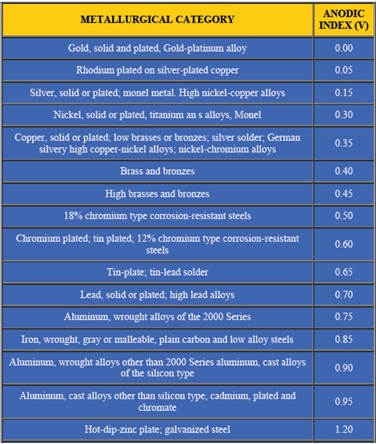
First – In the most common instance, the metals are dissimilar, which means that the metals have different chemical potentials. You may be familiar with the galvanic series where metals are rated by their tendency to give up electrons in a salt-water solution. See Figure 1 for a chart of the galvanic series. The chart is structured with the most cathodic metals at the top and progresses to the most anodic at the bottom. The anodic index shown in the chart is normalized so that gold is the minimum numerical value, while zinc has the greatest numerical value. Stainless steel (300 series) is hidden in the terminology of “18% Chromium type corrosion-resistant steels.”  In this chart, the stainless steel is assumed to be passivated.

Second – The metals must be in direct contact.

Third – An electrolyte must be present to facilitate the movement of electrons. The electrolyte in construction environments is usually plain water that occurs in the form of precipitation, condensation or water splash. Electrolytes that are solutions of chlorides (for example, salt water) are particularly effective electrolytes because they are more conductive.

The size of the anodic and cathodic parts can also be important in galvanic corrosion. If the anodic area is small relative to the cathodic exposed area, then the severity of the anodic corrosion is amplified. We can write an equation to explain the role of area in the galvanic process. We know that no corrosion will occur if the corrosion current density (icor) in μA/cm2 is the same for the anode (icor-a) and the cathode (icor-c). Here we are using a and c as subscripts to identify the anode and the cathode in the galvanic system. We know that current density is a function of total anodic current (I) in μA (where italicized A is amps), and the exposed area (A) is in cm2, which (according to ASTM G102-89) can be written as

icor =   Icor/A

No galvanic corrosion transpires if icor-a for the anodic material is equivalent to icor-c of the cathodic material, which is to say Icor/Aa = Icor/Ac. However, when Ac ≠ Aa, then the corrosion function is not balanced, and relative areas can drive the severity of the galvanic reaction. Inasmuch as area can affect the galvanic process, it will help connection performance if the more anodic material is larger than the more cathodic material. And, by making the Aa>>Ac, we can arrest or minimize the galvanic process. Generally, this means it is best to have a fastener that is more cathodic than the materials being fastened.

We also know that the environment can affect galvanic activity. The differential in the anodic index of dissimilar metals is amplified in harsh environments, but in controlled environments, a greater differential in anodic index can be tolerated.

Let’s summarize some best fastening practices for preventing galvanic conditions that could undermine an otherwise good connection design (Claus, L. 2014. “Galvanic Corrosion.” Fastener Technology, April, pp. 64–66.):

  • Use fasteners that are galvanically similar to the connection materials.
  • Isolate the dissimilar materials by using a plastic washer or durable coating.
  • Prevent entrapment of water or shield the connection from direct weather exposure.
  • If the fasteners are dissimilar from the connection materials, choose a fastener that is cathodic relative to the connection materials.
Figure 1. Galvanic series with anodic index voltages (http://engineersedge.com/galvanic_compatibility )
Figure 1. Galvanic series with anodic index voltages (http://engineersedge.com/galvanic_compatibility
)

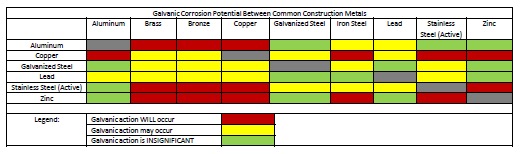
Some good information is available that can help to avoid a galvanic design challenge. First, see Figure 2. This chart provides color-coded galvanic compatibility that is fast and easy to use. The chart suggests material combinations where there will be galvanic action (red), material combination that might demonstrate galvanic activity (yellow), and material combinations that will have insignificant galvanic activity (green).

Figure 2. Galvanic compatibility between common construction materials (Stuart, D.M. 2013. Dissimilar Materials. PDHonline course S118. Fairfax, VA)

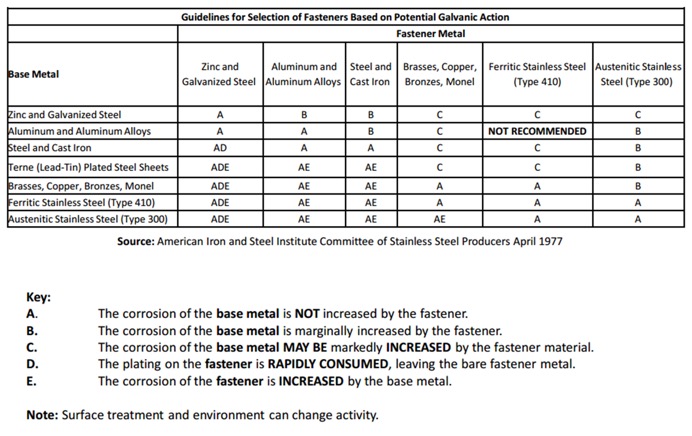
Then see Figure 3 because it gives more information about choices of materials for the fastener and connection materials. Here the probable results of galvanic corrosion to the fastener and base metals are described for various common combinations of common construction materials. It will help to explain which parts of the connection will be affected by galvanic corrosion and how severe the corrosion is likely to be.

Figure 3. Guidelines for selecting fasteners based on potential galvanic action (Stuart, D.M. 2013. Dissimilar Materials. PDHonline course S118. Fairfax, VA)

We know that you have many challenges when designing fastener connections, and it is our hope that this discussion helps you make informed choices when fastening dissimilar materials. Remember: Galvanic corrosion happens! Let us know if you have any comments.

Great ShakeOut Earthquake Drill 2016

The Great ShakeOut Earthquake Drill is an annual opportunity for people in homes, schools and organizations to practice what to do during earthquakes and improve their preparedness. In a post I wrote last October about the Great ShakeOut, I reminisced about the first earthquake I had to stop, drop and cover for – the Livermore earthquake in January, 1980. This year got me thinking about how our evacuation drills work.

At Simpson Strong-Tie, we use the annual Great ShakeOut drill to practice our building evacuation procedures. Evacuation drills are simple in concept – alarms go off and you exit the building. We have volunteer safety wardens in different departments who confirm that everyone actually leaves their offices. There are always a few people who want to stay inside and finish up a blog post. Once the building is empty and we have all met up in the designated meeting area, we do a roll call and wait for the all-clear to get back to work.

Several years ago the alarms went off. While waiting for the drill to end, we were concerned to see fire fighters arrive and rush into the building. Realizing this was not a drill, there were some tense moments of waiting. The fire chief and our president eventually walked out of the building and our president was yelling for one of our engineers. Turns out the engineer (who shall remain nameless) was cooking a chicken for lunch. Yes, a whole chicken. The chicken didn’t make it – I’m not sure what the guilty engineer had for lunch afterwards. At least we received extra evacuation practice that year. We aren’t allowed to cook whole chickens in the kitchen anymore.

Simpson Strong-Tie is helping increase awareness about earthquake safety and encouraging our customers to participate in the Great ShakeOut, which takes place next Thursday on October 20. It’s the largest earthquake drill in the world. More than 43 million people around the world have already registered on the site.

On October 20, from noon to 2:00 p.m. (PST), earthquake preparedness experts from the Washington Emergency Management Division and FEMA will join scientists with the Washington Department of Natural Resources and the Pacific Northwest Seismic Network for a Reddit Ask Me Anything – an online Q&A. Our very own Emory Montague will be answering questions. The public is invited to ask questions here. (Just remember that this thread opens the day before the event and not sooner.)

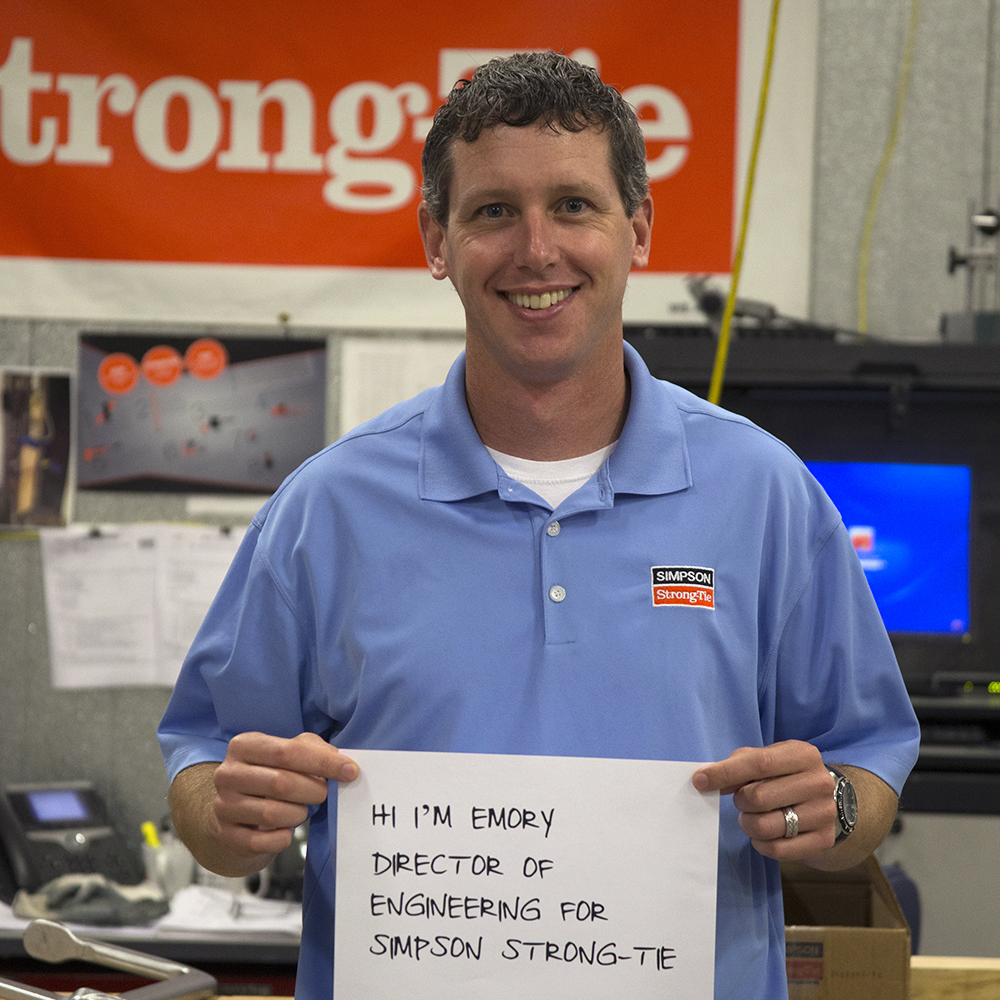
Emory Montague from Simpson Strong-Tie
Emory, ready to answer some seismic-related questions.

We’re also providing resources on how to retrofit homes and buildings, and have information for engineers here and for homeowners here.

Earthquake risk is not just a California issue. According to the USGS, structures in 42 of 50 states are at risk for seismic damage. As many of you know, we have done a considerable amount of earthquake research, and are committed to helping our customers build safer, stronger homes and buildings. We continue to conduct extensive testing at our state-of-the-art Tye Gilb lab in Stockton, California. We have also worked with the City of San Francisco to offer education and retrofit solutions to address their mandatory soft-story building retrofit ordinance and have created a section on our website to give building owners and engineers information to help them meet the requirements of the ordinance.

Last year, Tim Kaucher, our Southwestern regional Engineering Manager, wrote about the City of Los Angeles’s Seismic Safety Plan in this post. Since that time, the City of Los Angeles has put that plan into action by adopting mandatory retrofit ordinances for both soft-story buildings and non-ductile concrete buildings. Fortunately, California has not had a damaging earthquake for some time now. As a structural engineer, I find it encouraging to see government policy makers resist complacency and enact laws to promote public safety.

Participating in the Great ShakeOut Earthquake Drill is a small thing we can all do to make ourselves more prepared for an earthquake. If your office hasn’t signed up for the Great ShakeOut Earthquake Drill, we encourage you to visit shakeout.org and do so now.

Being an Engineering Intern at Simpson Strong-Tie

Editor’s Note: This week’s blog post is written by one our college interns in the Engineering Department. Ian Kennedy spent the summer of 2016 as an intern for the McKinney office of Simpson Strong-Tie. He will be starting his second year at Calpoly San Luis Obispo in Fall 2016 studying Mechanical Engineering. As an intern, he spent his time helping the branch engineering department with numerous projects, as well as exploring projects of his own. He enjoys metalworking, fitness, and the outdoors. Thank you to Ian Kennedy for this week’s post.

As I write this, I can’t help but laugh that of all the interns studying structural, civil or architectural engineering in school, the intern writing the post for our Structural Engineering Blog is studying mechanical engineering. I haven’t met too many mechanical engineers during my time here at Simpson Strong-Tie. I know there are a few, but while a lot of mechanical engineers are focused on making things move, most of the people here concentrate primarily on making things stay still. I’ve found what Simpson does to be more important than a lot of my peers at school may realize – it seems ME students are more preoccupied with cars and equipment than with what’s keeping the roof from coming down on top of them. Still, my exigence alone wasn’t enough to cancel the uneasiness of a first-time intern doing things he never knew he would be doing.Continue Reading

Facebook Tips for Structural Engineers

facebook-logoIn our last social media–related blog post, I shared the Top 5 LinkedIn Groups to Follow for Structural Engineers. Following groups on LinkedIn allows you to share content, post or view job openings, network and help establish yourself as a key opinion leader in your industry. But what about critical design questions or help? How do you deal with office dynamics or a difficult client as a structural engineer?

LinkedIn groups may assist with questions like these, but there are other social media platforms that might make it easier to have a more in-depth discussion about issues that you face. While LinkedIn is certainly an important social media platform for professionals such as structural engineers, it is not the largest social media platform. That title goes to the social media giant Facebook. Facebook has the social advantage of engaging more than 1.7 billion active users.

You are probably using Facebook already for personal social networking. However, there are some professional applications for structural engineers on Facebook that you may not have heard about. Here are some Facebook tips for structural engineers that you can use to jumpstart your professional social media arsenal:

Follow Industry-Related Pages

There are a variety of pages that you can follow on Facebook to give you an idea of what is happening in the industry. Following and engaging with pages like Structural Engineering World for design inspiration or Civil + Structural Engineer magazine for project management ideas allows you to have a more professionally focused newsfeed around content that matters to you (while still allowing time for cat memes and Buzzfeed quizzes if you want those, too). One useful page for engineers is the Autodesk Revit page, because it has things like tips on how to share large BIM files.

Join Structural Engineering Groups

Groups are a great way to connect with other Facebook users. As a structural engineer, you are bound to come across an issue that you would like some advice on. By joining a group of other structural engineers, you can ask design questions, questions about calculations and get tips on the best tools for your profession. I would ask your colleagues which groups they recommend joining.

Jumpstart Your Job Search

If you are looking for a new position, I am sure that you already know about LinkedIn. But did you know that there are things like the Career Center App on Facebook pages like the ASCE? The app works for employers looking to hire, too!

Do you have Facebook tips that would you recommend for structural engineer? Let us know in the comments below.