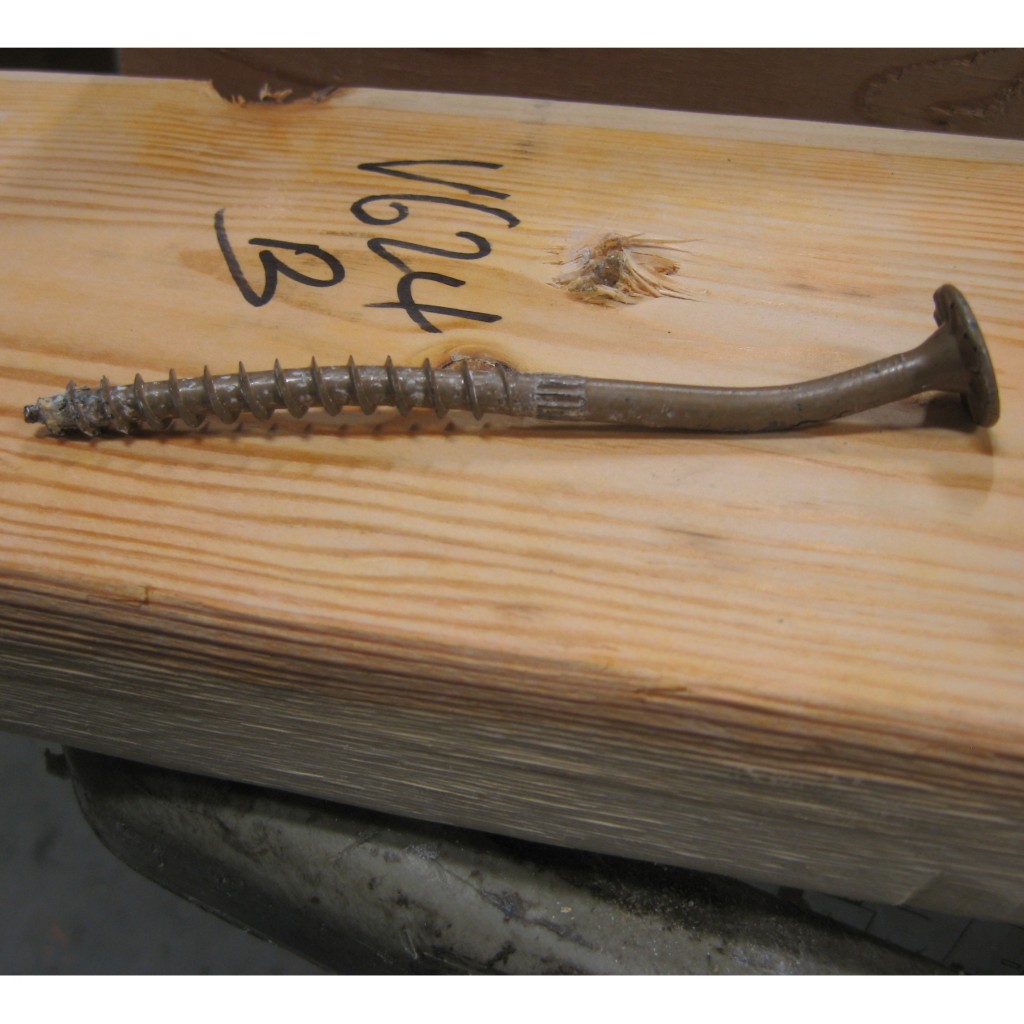




Top 10 Changes to Structural Requirements in the 2018 IBC

This blog post will continue our series on the final results of the 2016 ICC Group B Code Change Hearings, and will focus on 10 major approved changes, of a structural nature, to the International Building Code (IBC).

  1. Adoption of ASCE 7-16
    • The IBC wind speed maps and seismic design maps have been updated.
    • A new section has been added to Chapter 16 to address tsunami loads.
    • Table 1607.1 has been revised to change the deck and balcony Live Loads to 1.5 times that of the occupancy served.
  2. New and Updated Reference Standards
    • 2015 IBC Standard ACI 530/ASCE 5/TMS 402-13 will be TMS402-16.
    • ACI 530.1/ASCE 6/TMS 602-13 will be TMS 602-16.
    • AISC 341-10 and 360-10 have both been updated to 2016 editions.
    • AISI S100-12 was updated to the 2016 edition.
    • AISI S220-11 and S230-07 were updated to the 2015 edition.
    • AISI S200, S210, S211, S212 and S214 have been combined into a new single standard, AISI S240-15.
    • AISI S213 was split into the new S240 and AISI S400-15.
    • ASCE 41-13 was updated to the 2017 edition.
    • The ICC 300 and ICC 400 were both updated from 2012 editions to 2017 editions.
    • ANSI/NC1.0-10 and ANSI/RD1.0-10 were all updated to 2017 editions.
  3. Section 1607.14.2 Added for Structural Stability of Fire Walls
    • This new section takes the 5 psf from NFPA 221, so designers will have consistent guidance on how to design fire walls for stability without having to buy another standard.
  4. Modifications of the IBC Special Inspections Approved
    • Section 1704.2.5 on special inspection of fabricated items has been clarified and streamlined.
    • The Exception to 1705.1.1 on special inspection of wood shear walls, shear panels and diaphragms was clarified to say that special inspections are not required when the specified spacing of fasteners at panel edges is more than 4 inches on center.
    • The special inspection requirements for structural steel seismic force-resisting systems and structural steel elements in seismic force-resisting systems were clarified by adding exceptions so that systems or elements not designed in accordance with AISC 341 would not have to be inspected using the requirements of that standard.
  5. Changes Pertaining to Storm Shelters
    • A new Section 1604.11 states that “Loads and load combinations on storm shelters shall be determined in accordance with ICC 500.”
    • An exception was added stating that when a storm shelter is added to a building, “the risk category for the normal occupancy of the building shall apply unless the storm shelter is a designated emergency shelter in accordance with Table 1604.5.”
    • Further clarification in Table 1604.5 states that the type of shelters designated as risk category IV are “Designated emergency shelters including earthquake or community storm shelters for use during and immediately after an event.”
  6. Changes to the IBC Conventional Construction Requirements in Chapter 23
    • The section on anchorage of foundation plates and sills to concrete or masonry foundations reorganized the requirements by Seismic Design Category (SDC) and added a new section on anchoring in SDC E. It also states that the anchor bolt must be in the middle third of the width of the plate and adds language to the sections on higher SDCs saying that if alternate anchor straps are used, they need to be spaced to provide equivalent anchorage to the specified 1/2″- or 5/8″-diameter bolts.
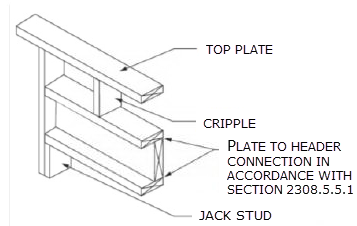
    • The second change permits single-member 2-by headers, to allow more space for insulation in a wall. 
  7. Modification to the Requirements for Nails and Staples in the IBC
    • ASTM F1667 Supplement One was adopted that specifies the method for testing nails for bending-yield strength and identifies a required minimum average bending moment for staples used for framing and sheathing connections.
    • Stainless-steel nails are required to meet ASTM F1667 and use Type 302, 304, 305 or 316 stainless steel, as necessary to achieve the corrosion resistance assumed in the code.
    • Staples used with preservative-treated wood or fire-retardant-treated wood are required to be stainless steel.
    • The new RSRS-01 nail was incorporated into TABLE 2304.10.1, the Fastening Schedule. The RSRS nail is a new roof sheathing ring shank nail designed to achieve higher withdrawal resistances, in order to meet the new higher component and cladding uplift forces of ASCE 7-16.
  8. Truss-Related Code Change
    • The information required on the truss design drawings was changed from “Metal connector plate type” to “Joint connection type” in recognition that not all trusses use metal connector plates.
  9. Code Change to Section 2304.12.2.2
    • A code change clarifies in which cases posts or columns will not be required to consist of naturally durable or preservative-treated wood. This change makes the requirements closer to the earlier ones, while maintaining consistency with the subsequent section on supporting members.
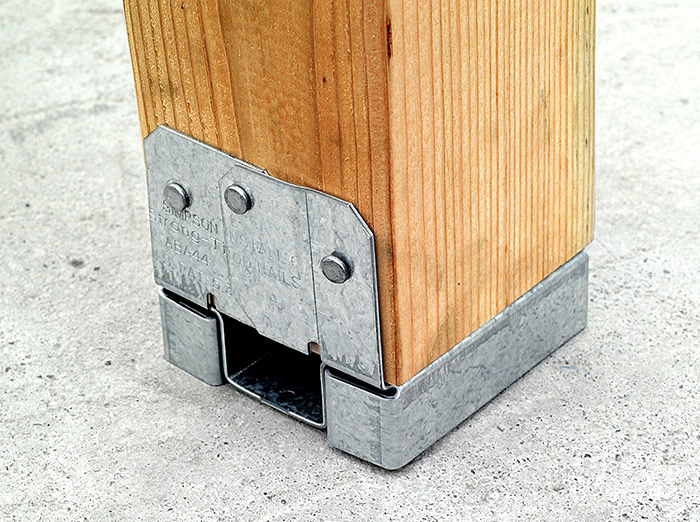
    • If a post or column is not naturally durable or preservative-treated, it will have to be supported by concrete piers or metal pedestals projecting at least 1″ above the slab or deck, such as Simpson Strong-Tie post bases that have a one-inch standoff.
  10. Code Change to IBC Appendix M
    • A code change from FEMA makes IBC Appendix M specific to refuge structures for vertical evacuation from tsunami, and the tsunami hazard mapping and structural design guidelines of ASCE 7-16 would be used rather than those in FEMA P-646.
Once the 2018 IBC is published in the fall, interested parties will have only a few months to develop code changes that will result in the 2021 I-Codes. Similar to this last cycle, code changes will be divided into two groups, Group A and Group B, and Group A code changes are due January 8, 2018. The schedule for the next cycle is already posted here.

What changes would you like to see for the 2021 codes?

Keep Your Roof On

He huffed, and he puffed, and he blew the roof sheathing off! That’s not the way kids’ tale goes, but the dangers high winds pose to roof sheathing are very real. Once the roof sheathing is gone, the structure is open and its contents are exposed to the elements and much more vulnerable to wind or water damage. It is a storyline that we meet all too often in the news.

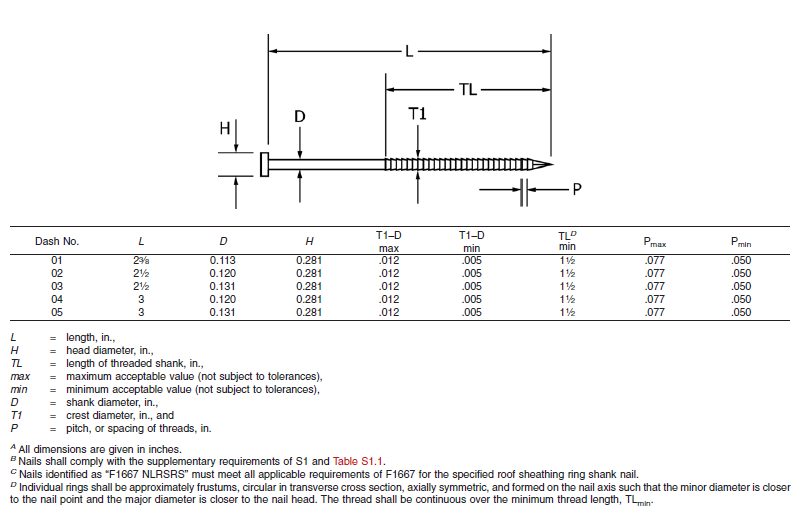
About two years ago, the ASTM subcommittee on Driven and Other Fasteners (F16.05), addressed fastening for roof sheathing in high-wind areas by adding a special nail to ASTM F1667-17 – Standard Specification for Driven Fasteners: Nails, Spikes and Staples. The Roof Sheathing Ring-Shank Nail was added to the standard as Table 46. Figure 1 illustrates the nail and lists its geometrical specifications. This is a family of five ring-shank nails that can be made from carbon steel or stainless steel (300 series). Specific features of these nails are the ring pitch (number of rings per inch), the ring diameter over the shank, the length of deformed shank and the head diameter. Also, note B specifies that the nails shall comply with the supplementary requirement of Table S1.1, which tabulates bending yield strength. In this diameter class, the minimum bending yield strength allowed is 100 ksi.

Figure 1. Roof Sheathing Ring-Shank Nails (ASTM. 2017. Standard Specification for Driven Fasteners: Nails, Spikes and Staples, F1667-17. ASTM International, West Conshohocken, PA.)

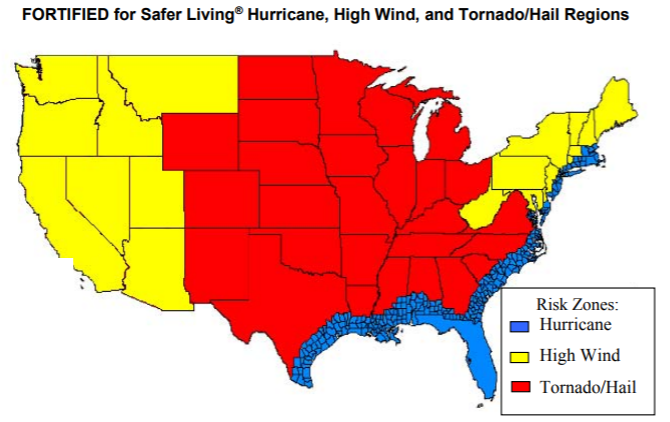
The IBHS (Insurance Institute for Business and Home Safety) discusses roof deck fastening in its Builders Guide that describes the “FORTIFIED for Safer Living” structures. The IBHS FORTIFIED program offers solutions that reduce building vulnerability to severe thunderstorms, hurricanes and tornadoes. Keeping the roof sheathing on the structure is critical to maintaining a safe enclosure and minimizing damage, and roof sheathing ring-shank nails can be part of the solution. As Figure 2 from IBHS (2008) shows, every wood-frame structure has wind vulnerability.

Figure 2. Hurricane, high wind and tornado regions of the US (IBHS. 2008. Builders Guide, Fortified for Safer Living. Tampa, FL. 81 pp.)

More importantly for the wood-frame engineering community, the Roof Sheathing Ring-Shank Nails are being included in the next revision of the AWC National Design Specification for Wood Construction (NDS-2018), which is a reference document to both the International Building Code and the International Residential Code. You will be able to use the same NDS-2018, chapter 12 withdrawal equation to calculate the withdrawal resistance for Roof Sheathing Ring-Shank Nails and Post Frame Ring-Shank nails. The calculated withdrawal will be based on the length of deformed shank embedded in the framing member. Also, Designers need to consider the risk of nail head pull-through when fastening roof sheathing with ring-shank nails. If the pull-through for roof sheathing ring-shank nails is not published, you will be able to use the new pull-through equation in the NDS-2018 to estimate that resistance.
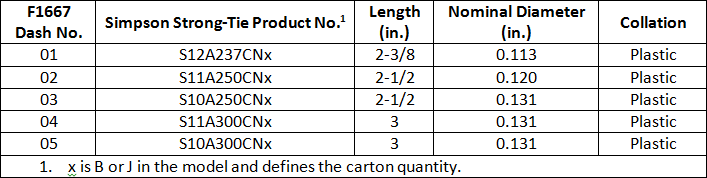
Simpson Strong-Tie has some stainless-steel products that meet the requirements for Roof Sheathing Ring-Shank Nails. These will be especially important to those in coastal high-wind areas. Table 1 shows some of the Simpson Strong-Tie nails that can be used as roof sheathing ring-shank nails. These nails meet the geometry and bending yield strength requirements given in ASTM F1667. See the Fastening Systems catalog C-F-2017 for nails in Type 316 stainless steel that also comply with the standard.

Table 1. Simpson Strong-Tie collated nails made from Type 304 stainless steel that comply with F1667-17 specifications for Roof Sheathing Ring-Shank Nails.

Improve your disaster resilience and withstand extreme winds by fastening the sheathing with roof sheathing ring-shank nails. You can find Roof Sheathing Ring-Shank nails in ASTM F1667, Table 46, and you will see them in the AWC NDS-2018, which will be available at the end of the year. Let us know your preferred fastening practices for roof sheathing.

The Cold-Formed Steel Construction Catalog is HOT off the press!

The SE Blog is taking some time off for the 4th of July holiday this week. However, we’ve just released the 2017 edition of our Connectors for Cold-Formed Steel Construction catalog – order a hard copy to be mailed to your office or download a PDF copy and start using it today!

Connectors For Cold-Formed Steel Construction

The C-CF-2017 is a 308-page catalog including specifications, load tables and installation illustrations for our cold-formed steel connectors and clips, helping you easily specify and install in commercial curtain-wall, mid-rise and residential construction.


Revisiting Spanning the Gap

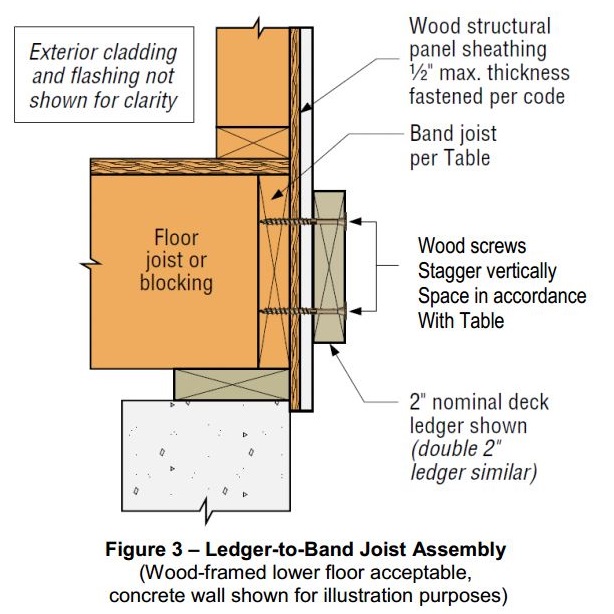
Three years ago, we created this blog post based on a technical support question we often receive about allowable fastener loads for ledgers to wood framing over gypsum board. Given that this is still a frequent question and a relevant topic, we decided to revisit the post and update it.

Drywall. Wall board. Sheetrock. Sackett Board? A product called Sackett Board was invented in the 1890s, which was made by plastering within wool felt paper. United States Gypsum Corporation refined Sackett Board for several years until 1916, when they developed a new method of producing boards with a single layer of plaster and paper. This innovation was eventually branded SHEETROCK®. More details about the history of USG can be found here.

No matter what you call it, gypsum board is found in almost every type of construction. Architects use it for sound and fire ratings, while structural engineers need to account for its weight in our load calculations. A common technical support question we receive is for allowable fastener loads for ledgers to wood framing over gypsum board.

Ledger over Gypboard

One method to evaluate a fastener spanning across gypsum board is to treat the gypsum material as an air gap. Technical Report 12, General Dowel Equations for Calculating Lateral Connection Values, is published by the American Wood Council.

Technical Report 12
Technical Report 12

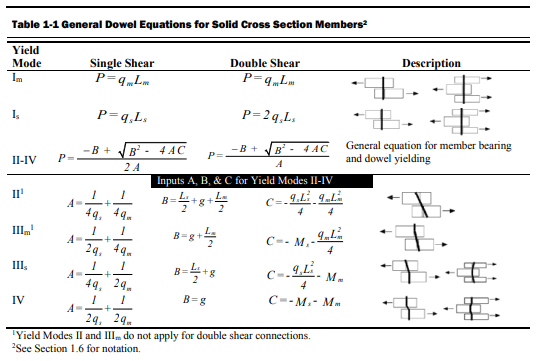
TR12 has yield limit equations that allow a designer to account for a gap between the main member and side member of a connection. With a gap of zero (g=0), the TR12 equations provide the same results as the NDS yield limit equations.

Technical Report 12 Yield Limit Equations

The equations are fairly complex, but it should be intuitive that the calculated fastener capacity decreases with increasing gap. Engineers are often surprised to see a 40, 50, even 60% drop in fastener capacity with one layer of 5/8” gypsum board. So what else can you do?

Testing, of course! In So, What’s Behind a Screw’s Allowable Load? I discussed the methods used to load rate a proprietary fastener such as the Simpson Strong-Tie® Strong-Drive® SDS or SDW screws. To recap, ICC-ES Acceptance Criteria for Alternate Dowel Type Fasteners, AC233, allows you to calculate and do verification tests, or load rate based on testing alone. We develop our allowable loads primarily by testing, as the performance enhancing features and material optimizations in our fasteners are not addressed by NDS equations.

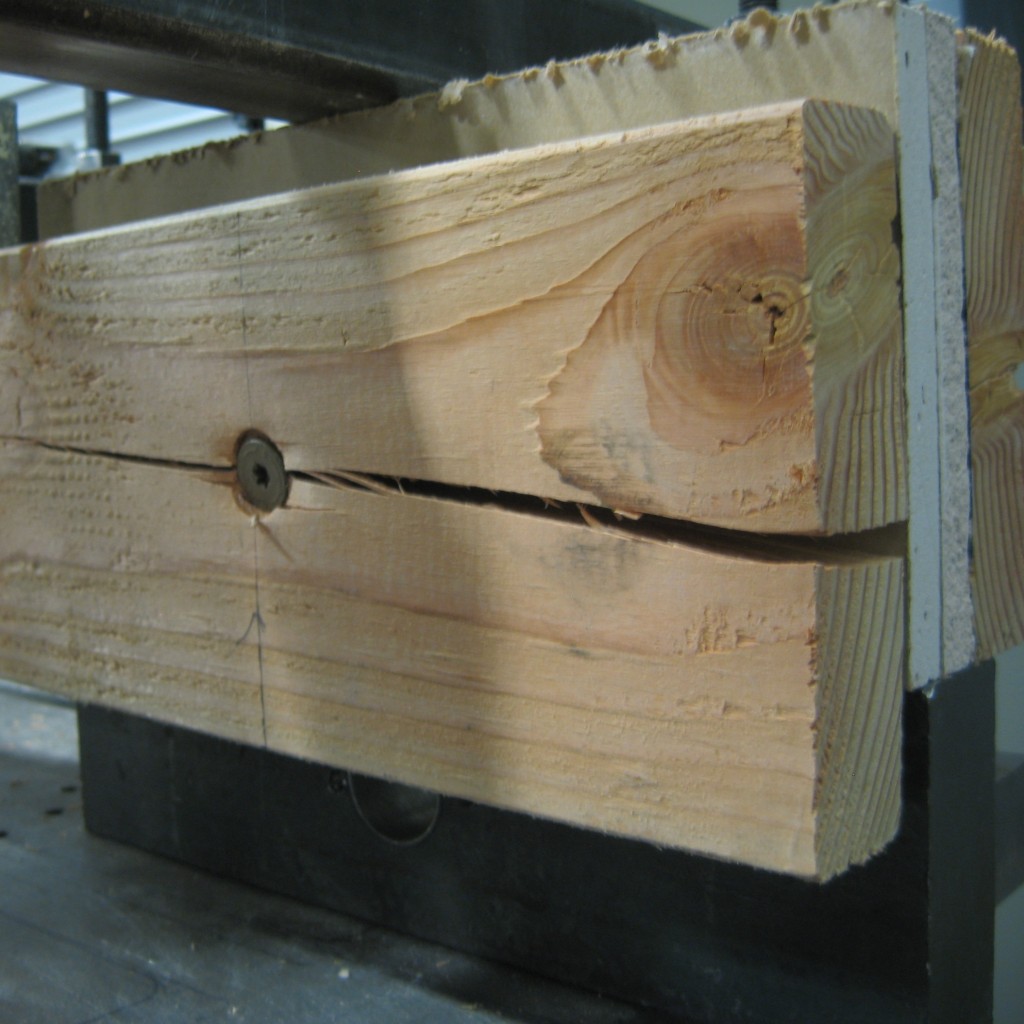
So to determine the performance of a fastener installed through gypsum board, we tested the fastener through gypsum board. This is easier to do if you happen to have a test lab with a lot of wood and fasteners in it. We did have to run down to the local hardware store to pick up gypsum board for the testing.

SDWS Over 2 Layer Gypboard
SDWS-Over-2-Layer-Gypboard-Failure
SDWS Over 2 Layer Gypboard Failure

A full set of allowable loads for Strong-Drive SDWH and SDWS are available on strongtie.com. The information is given as single fastener shear values for engineered design, and also screw spacing tables for common ledger configurations. As much fun as writing spreadsheets to do the Technical Report 12 calculations is, having tabulated values based on testing is much easier.

Fastening Systems

In the fastener marketplace, Simpson Strong-Tie stands apart from the rest. Quality and reliability is our top priority.


How Are Deck-Drive™ DWP Screws Load-Rated?

Experiential learning — has it happened to you? Certainly it has, because experiential learning is learning derived from experience. It happens in everyday life, in engineering and in product development, too. For example, experience has taught us that after a product is launched, our customers will find applications for the product that were never expected or listed in the product brief. Also, experience has shown us that larger fasteners tend to be placed in applications that have greater structural and safety demands.

When the larger Deck-Drive™ DWP screws were manufactured, we decided that they should be marketed as “load-rated” screws because they were big enough to support physically large parts and would be expected to provide structural load resistance.

So what is a “load-rated” screw? To Simpson Strong-Tie, a load-rated screw is a threaded fastener that has controlled dimensions and physical properties, as well as validated connection properties.  Load-rated fasteners are also subject to the same quality inspection that would occur if they were undergoing an evaluation report.

Continue Reading

5 Tips to Stay Informed on Construction News and Industry Updates

For a structural engineer working on multiple projects in various stages of design and construction, it can be challenging to keep up to date on the latest industry trends. However, many of us in the construction industry enjoy learning about new construction techniques and unique projects. Being educated about new technology and design tools can also increase efficiency in the office.Continue Reading

Introduction to the Site-Built Shearwall Designer Web Application

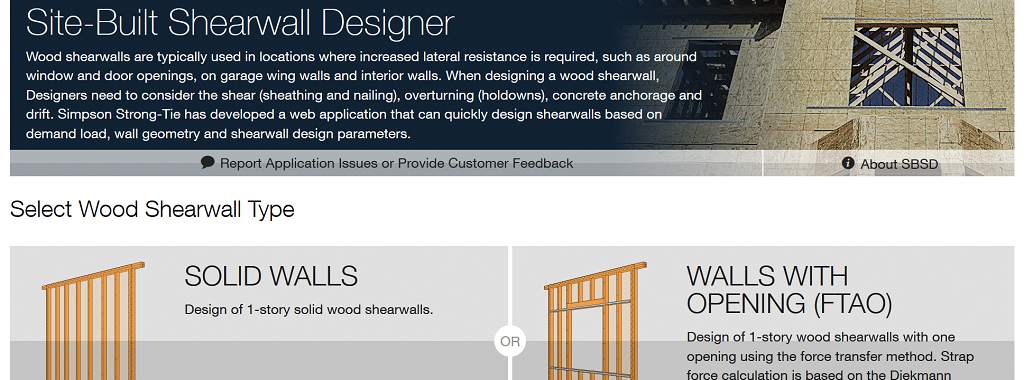
Wood shearwalls are typically used as a lateral-force-resisting system to counter the effects of lateral loads. Wood shearwalls need to be designed for shear forces (using sheathing and nailing), overturning (using holdowns), sliding (using anchorage to concrete) and drift, to list some of the main dangers.  The Simpson Site-Built Shearwall Designer (SBSD) web app is a quick and easy tool to design a wood shearwall based on demand load, wall geometry and design parameters.Continue Reading

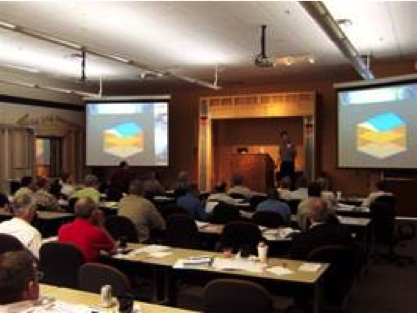
What Makes a Good Training Facility?

When it comes to choosing a training facility, there are many well-researched principles about what makes an environment conducive to improved adult learning.

While we try to hold all training events in facilities that meet most of these principles, (even when traveling to our customers or users means we have to conduct events in hotel meeting rooms) we prefer to host you at our own locations.

To this end, we invest a tremendous amount of time and resources to build and offer dedicated training facilities across the country. These facilities meet all the basic requirements for improved adult learning, but much more as well.

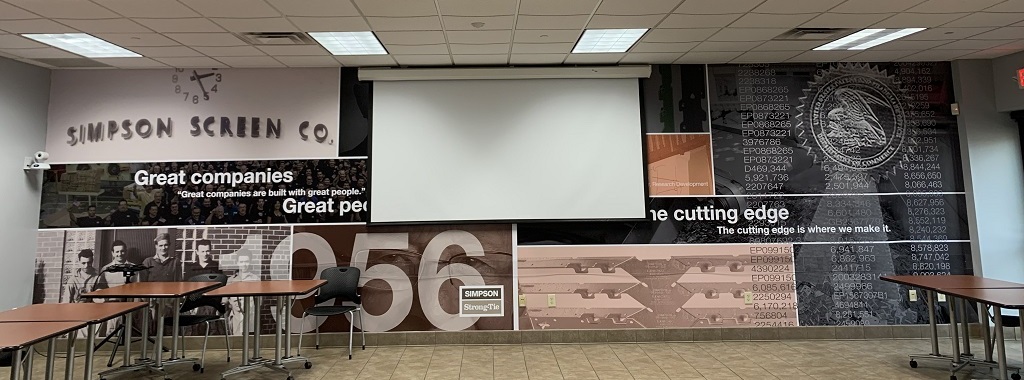
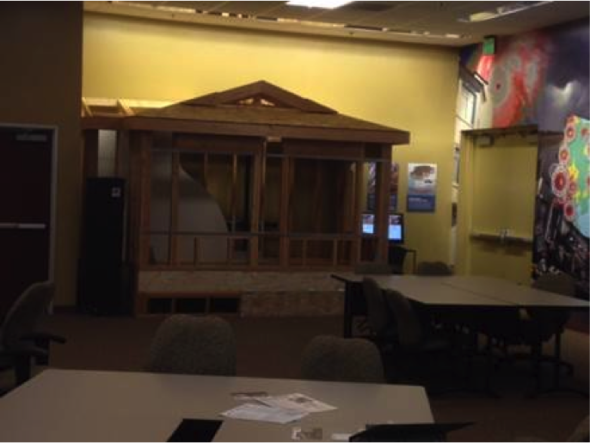
By having our own dedicated training facilities, we can provide learners with a much richer experience and contextually relevant displays.

These displays include partially deconstructed wall segments, foundations and roof systems that give learners a bigger picture of the applications being studied.

Many displays allow for hands-on installations and exercises that allow for improved comprehension of the product use and limitations. Even for the engineering community, who typically are limited to images from a catalog, the hands-on activities add great value. It’s always interesting to see the reaction that engineers have to actually seeing a system approach and having an opportunity to participate in learning that goes way beyond sitting and listening to a lecture.

Sometimes learners just need to see, feel or hold something in order to really understand a concept or product application. We make every effort to bring legitimate educational content to our workshops, supported by products that we hope will furnish solutions to your needs.

Many of our facilities include a plant tour and/or testing-facility tour as well. While these components don’t always align directly with the learning objectives, they do offer a chance for our guests to raise their energy levels and get a better understanding of that scale, capabilities, and commitment to quality that we bring to bear in our endeavor to help people build safer structures.

Additionally, we offer our facilities to customers, associations and industry organizations to use for their own meetings and training events. If you haven’t been to one of our workshops or visited one of our facilities, I highly encourage you to join the 35,000 plus who have over the last four years. You can find a complete list of workshops on our training home page. I expect that you’ll find it an educational and highly engaging experience that helps you build safer structures as well.

SST Training Website


Sneak Peek: Our New and Improved Deck Design Guide

One of the ways I get through winter every year is by looking forward to the weekend in March when we set our clocks ahead and “spring forward” into Daylight Savings time. Some people don’t like this change because of the lost hour of sleep, but to me it means the weather shouldn’t be cold for much longer.

The coming of spring means getting to walk to the car in daylight at the end of the workday. It also means getting the garden started for the year and spending more time outside in general.

Of course, I’m not alone in being happy to see winter go.

In the residential world, the phenomenon of “deck season” coincides with this time of year.  Homeowners with decks are getting ready for summer by giving their decks a cleaning and looking them over for any needed maintenance. Now’s the time that new or replacement decks are being planned and built to be enjoyed for the rest of the year.

deck-season

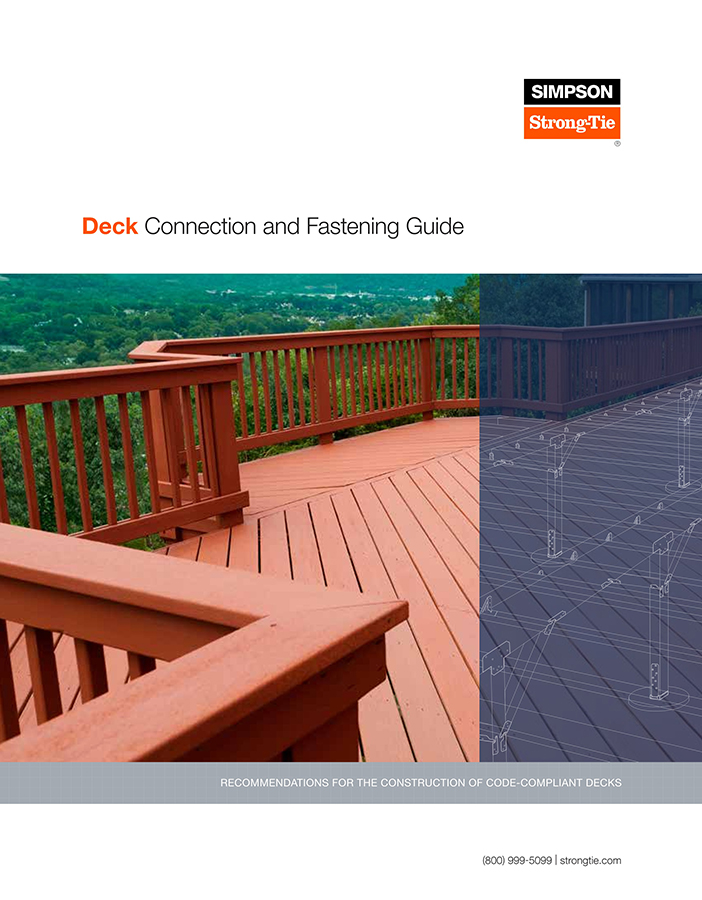
It’s no coincidence, then, that our deck-code guide has been updated again in time for warmer weather. The Deck Connection and Fastening Guide goes detail by detail (ledger connection, joist-to-beam connection, beam-to-post connection, etc.) through a typical deck and identifies the relevant building-code requirements (2012 and 2015 IRC/IBC) and connection options.

Our deck-code guide can be a helpful reference to an engineer who is just getting acquainted with decks, and can also bring you up to speed on revisions to the IRC that can necessitate engineering changes to even a relatively simple residential deck. Multilevel decks, guardrail details, ledger details and foundation challenges are all examples of things a deck builder could call you for assistance with.

For more information on resources available to engineers on deck design, feel free to consult my previous blog article, Wood-framed Deck Design Resources for Engineers.

The Deck Connection and Fastening Guide

F-DECKCODE17

This guide provides instructions on how to recognize defects and deficiencies in existing decks, and guidance for building a strong, safe, long-lasting new or renovated deck structures.


For more deck-related blog posts, check out the links below:

Building Code Update: 2018 IBC to Reference ASCE 7-16

In early December, ICC posted the preliminary results of the Group B Online Governmental Consensus Vote, which included structural changes to the IBC, IEBC and IRC. ICC reports that there were more than 162,000 votes cast by eligible Voting Members during the three-week online voting period.

One subject of interest to building Designers, builders and some building-material suppliers was the disposition of a group of code changes that adopted ASCE 7-16 as the reference standard on loads for the IBC and IRC, and changed other parts of the IBC and IRC to reflect that.

The most controversial part of adopting the new ASCE 7-16 standard was its increase in roof component and cladding loads. The higher pressure coefficients in some cases raised the concern that the cost of roofing, roofing materials and roof repairs would be increased. Other items that raised some opposition were the new chapter on tsunami loads and the increase in deck and balcony live loads from 40 psf to 60 psf.

Despite these concerns, ICC members voted to approve the code change that adopted ASCE 7-16 as the reference for loads in the 2018 IBC, IRC and IEBC.

Along with that specific change, several other related changes were approved to correlate the IBC with adoption of ASCE 7-16. These included changes to Section 1604, General Design Requirements; adding in a new Section 1615 on Tsunami Design Requirements; modifications to Section 1613 so that seismic design requirements match ASCE 7-16; and deletion of Section 1609.6, Alternate All-Heights Method for wind design. On this last item, the argument was that since ASCE 7 now includes a simplified wind load design method, a competing method is not needed in the IBC.

Interestingly, a change to remove Strength Design and Allowable Stress Design load combinations from the IBC, which was approved by the IBC Structural Committee, was overturned and denied by the ICC Member voters. So those will remain in the IBC.

For the IRC, even though ASCE 7-16 will be shown as the referenced load standard, most changes to the actual code language relating to the new standard were denied. Items that were specifically denied included adoption of ASCE 7-16 wind speed maps, adoption of ASCE 7-16 roof pressure loading, and adoption of the new higher deck and balcony live loads. So the result is that the IBC and IRC will again be inconsistent with each other regarding wind design. On the other hand, the new USGS/NEHRP Seismic Design Maps were approved.

Future Code Corner articles will address other changes approved for the 2018 IBC and IRC.