



The U.S. Resiliency Council (USRC) recently launched its Building Rating System for earthquake hazards. The Rating System assigns a score of from one to five stars for three building performance measures: Safety, Damage (repair cost) and Recovery (time to regain basic function).Continue Reading
Category: Uncategorized

Simpson Strong-Tie Now Offering a Structural Engineering/Architecture/Construction Management Student Scholarship Program
We know it’s tough going to school and majoring in structural engineering or architecture. You probably weren’t aware of this, but I went to Brooklyn Technical High School and we were required to take mechanical drafting, electrical engineering and wood/metal shop before we selected majors at the end of our sophomore year. I actively avoided majoring in architecture and engineering because, while I was a whiz at the lathe in metal shop, I was much less talented in some of the other engineering subjects.
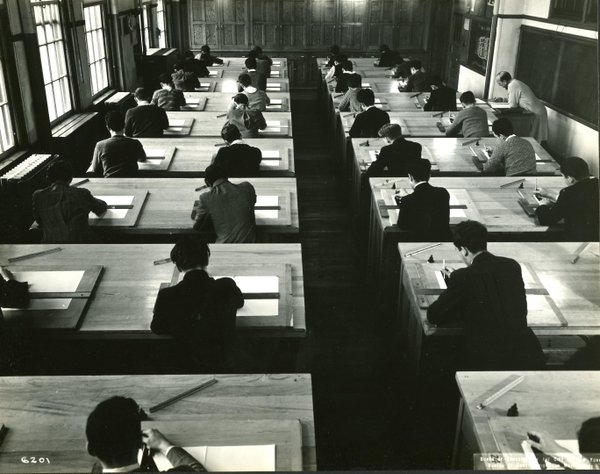
I sometimes wish I had been better at them, because getting a degree in structural engineering and architecture isn’t just cool (where else can you get college credit or money to break stuff?), it can help you improve the lives of others and even make them safer. Simpson Strong-Tie Company, Inc. established the structural engineering/architecture scholarship program to assist architecture and structural engineering students by supporting their education and encourage them to design and build safer structures in their local communities.
And it seems as though there are more and more students committed to those goals, too. Last year, Simpson Strong-Tie awarded 49 scholarships of $2,000. The year before, Simpson Strong-Tie awarded 38 scholarships of $1,000. This year, Simpson Strong-Tie is offering up to 67 scholarship awards of $2,000 for the 2016/2017 academic school year. Applicants must be enrolled as juniors or seniors in full-time undergraduate study (60 semester hours or equivalent) majoring in architecture, structural engineering or construction management at the following colleges or universities for the entire upcoming academic year:
- Arizona State University
- Boise State University
- Brigham Young University
- California State Polytechnic University, Pomona
- California State Polytechnic University, San Luis Obispo
- California State University, Fresno
- California State University, Fullerton
- California State University, Long Beach
- California State University, Sacramento
- Clemson University
- Florida International University
- Georgia Institute of Technology
- Iowa State University
- Louisiana State University
- Milwaukee School of Engineering
- NYU Polytechnic School of Engineering
- North Carolina State University
- Ohio State University, Columbus
- Oklahoma State University
- Oregon Institute of Technology
- Oregon State University
- Penn State University Park
- Portland State University
- Purdue University, West Lafayette
- Southern California Institute of Architecture
- Texas Tech University
- University of Arizona
- University of California, Berkeley
- University of California, Davis
- University of California, Irvine
- University of California, Los Angeles
- University of California, San Diego
- University of Cincinnati
- University of Florida
- University of Idaho
- University of Illinois at Urbana-Champaign
- University of Miami
- University of Michigan
- University of Nevada, Las Vegas
- University of North Texas
- University of Southern California
- University of Texas, Arlington
- University of Texas, Austin
- University of Washington
- University of Wyoming
- Virginia Polytechnic Institute and State University
- Washington State University
The scholarship application will be available on the Simpson Strong-Tie website as of March 15, so if you know any students enrolled in a structural engineering, architecture or construction management major at the schools listed above, you should advise them about this wonderful opportunity. If you have any questions or comments, please let us know in the comments below.
Mass Timber Construction – Building for the Future
The future is here and that future is mass timber construction.
It is common knowledge that wood is a renewable and environmentally friendly building material. There are two types of wood-framing methods in North America. The most common method for residential construction is light-frame construction using either balloon-framing or platform-framing methods. Standardized dimensional lumber has become the dominant building material in light-frame construction because of its economy. The other method is heavy-timber construction, which often uses large solid-wood sections for nonresidential construction, such as for storage, mercantile and industrial buildings.
In Europe, there is a trend to create larger “laminated” wood sections using the more traditional standardized dimensional lumber of the 1990s. This trend culminated in what is now classified as cross-laminated timber, or CLT. CLT can be used to create floor panels and roof panels. In North America, this is classified either as cross-laminated timber (CLT) or generically as mass timber.
CLT is essentially multiple layers of wood panels. Each layer of wooden panels is laid crosswise on the one before at approximately a 90° angle and glued using a polyurethane adhesive to increase the stability of the entire panel. Typical thickness of the individual boards can vary from 3/8″ to 2″ thick. Typical board width can vary from 2-3/8” to 9-1/2” wide. CLT panels are fabricated and marketed from 3-ply CLT up to 7-ply CLT. CLT 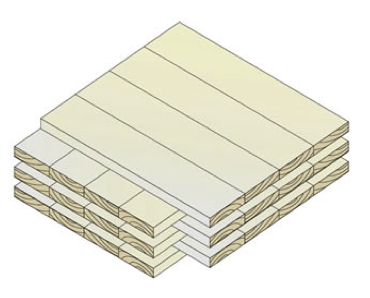 manufacturers normally publish characteristic properties for their panels – such as bending strength, shear strength, modulus of elasticity and panel stiffness – to assist Designers in specifying these products.
A Cross Laminated Timber Handbook has been published by FPInnovations in Canada as an introduction to CLT. The US edition CLT handbook can be downloaded for free here.
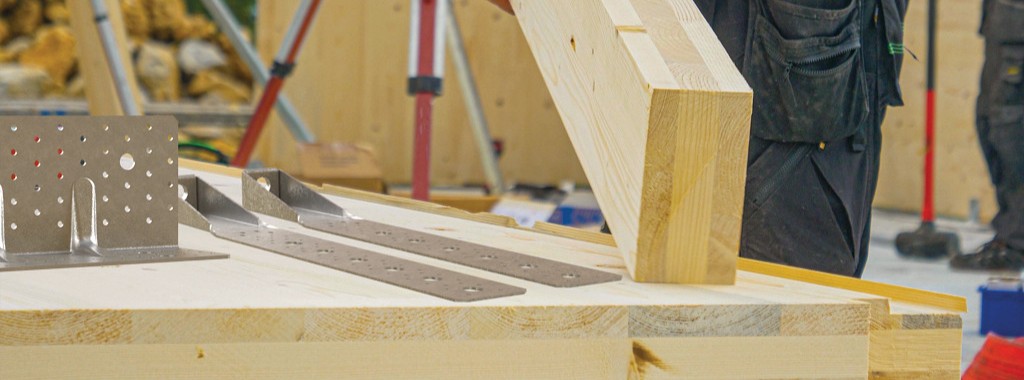
As in all wood buildings, connection designs are critical to the success of this new type of building material. Simpson Strong-Tie offices in Europe have been instrumental in developing and supplying connectors and fasteners in the CLT market. Simpson Strong-Tie has developed many connectors specifically for the CLT market in Europe (Figure 3).
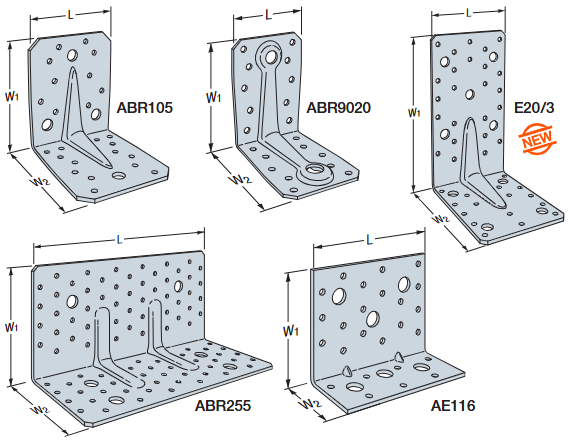
Those connectors are used to join the CLT floor panels to CLT wall panels and CLT wall panels to the concrete foundation (Figures 1 and 2).
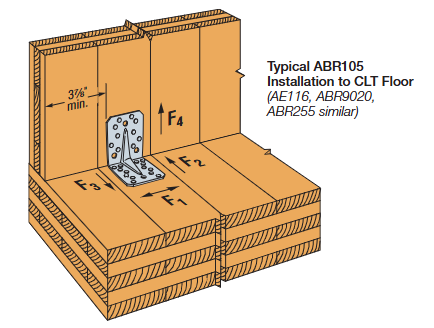
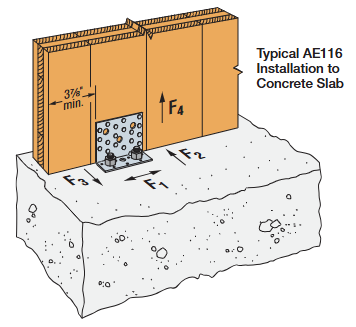 Specialized ring-shank nails and long metal screws have been developed as well. In mid-2014, Simpson Strong-Tie North America (Pleasanton, California Testing Facility) embarked on an initial test program to assess those connectors and fasteners developed for the CLT market by Simpson Strong-Tie Europe, using North American CLT panels to verify and quantify the performance characteristics according to North American testing protocols (American Society for Testing and Materials and Canadian Construction Materials Centre).
The initial test program used CLT panels fabricated in Western Canada using Canadian Spruce-Pine-Fir (S-P-F) lumber. The connectors and ring-shank nails were imported from the Simpson Strong-Tie European manufacturing facilities. Testing of the connectors also included the Simpson Strong-Tie Strong-Drive® SD screws, which as expected, provided higher load capacity than the ring-shank nails. A summary of the test program and the load rating developed for both the Canadian and the U.S. market can be downloaded here.
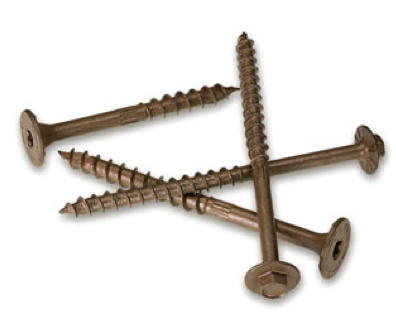
Other types of long countersunk screws such as the Strong-Drive® SDWS Timber screw (countersunk) or Strong-Drive SDWH Timber-Hex (hex head) screw (shown) are used either to splice the floor panels together or to drag the diaphragm loads back to the column or post as necessary.
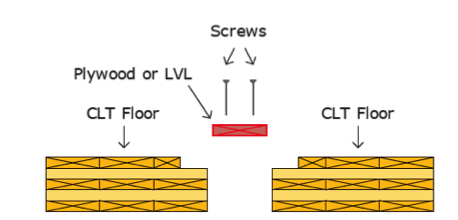
As CLT continues to gain acceptance in North America, other connection details will also become more popular. Simpson Strong-Tie intends to continue developing and improving connection details to support this type of construction.
Building code acceptance is another important requirement and development that is in progress in both Canada and the U.S. In Canada, the 2014 edition of CSA O86 “Engineering Design in Wood” has reserved a section for CLT.
The 2015 edition of the International Building Code (IBC) recognized CLT when it is manufactured to the product standard. CLT walls and floors will be permitted in all types of combustible construction. The 2015 National Design Specification (NDS) for Wood Construction was recently published and approved as an ANSI American National Standard. The 2015 National Design Specification is also referenced in the 2015 IBC.
The future is here. Environmentally friendly mass timber (including CLT) is poised to grow in use, especially with the recognition of CLT in the building codes. North American manufacturing of CLT has been established and can only grow to support the expanding use of this new building material.
References:
https://fpinnovations.ca
*Images with permission from FPInnovations
California Has Funding for $3,000 Grants for Home Retrofits
Are you an engineer working with California clients whose homes were built before 1979 on a raised foundation?
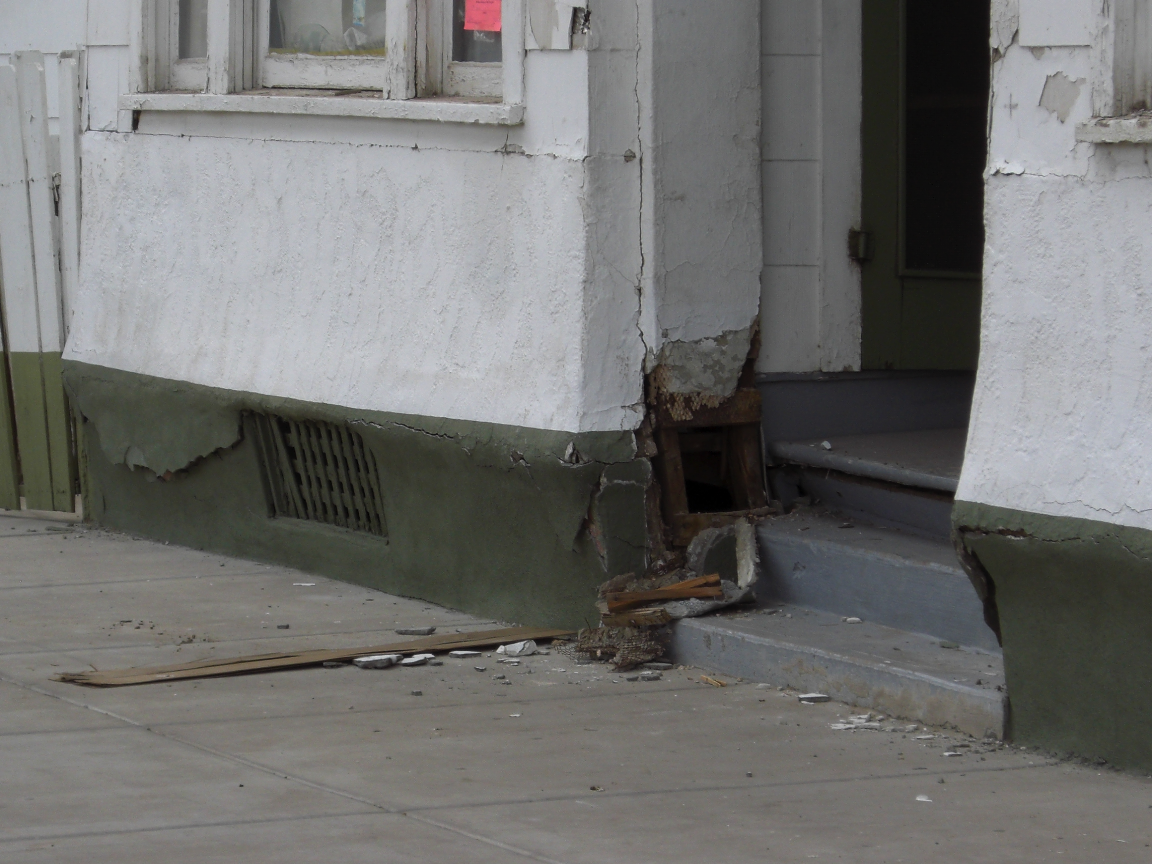
If you are, these clients may be among the 1.2 million California homeowners eligible for a seismic home retrofit. The state of California has approved the continuation of an initiative known as Earthquake Bolt + Brace (EBB). In its second year, this program plans to make as many as 1,600 grants to selected homeowners, nearly three times the number given the previous year. The EBB grant program provides up to $3,000 to homeowners residing in more than 150 California zip codes. Check to see whether your clients live within one of these communities here.
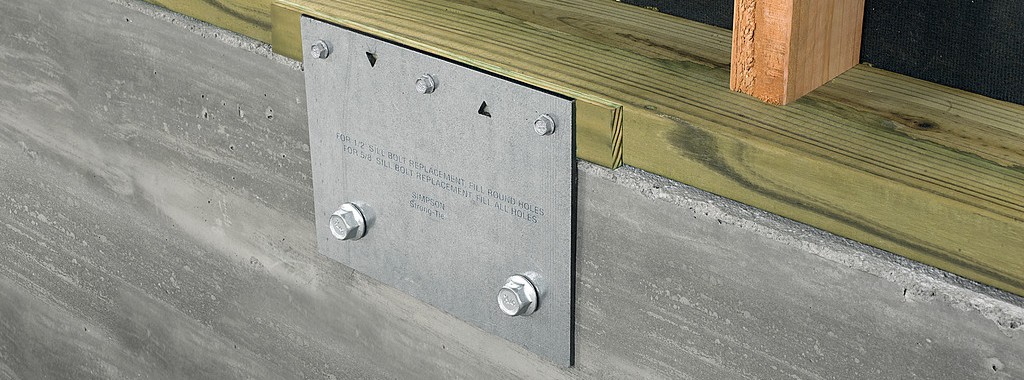
Simpson Strong-Tie has several different resources to assist you in helping your clients understand how to mitigate seismic risks to houses with raised foundations. The Seismic Retrofit Details sheet provides various ways to retrofit the cripple wall system using prescriptive methodologies, which can be adapted for engineered solutions. The picture below highlights the use of the Simpson Strong-Tie universal foundation plate (UFP) to attach the boltless sill plate of the cripple wall to the concrete stemwall. This simple step can help prevent the house from sliding off its foundation. The picture also reveals plywood sheathing used to reinforce the weak cripple wall system. Additional resources for retrofit can be found here.
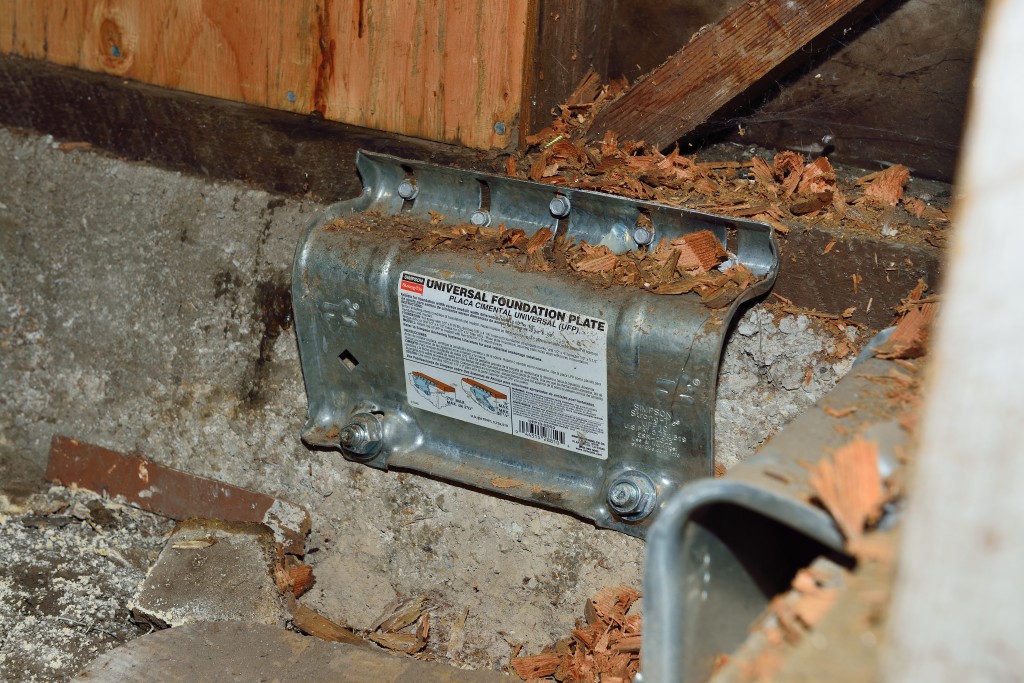
To help your clients better understand the impact these simple steps can have in preventing structural damage in an earthquake, click here to watch the story of a Napa business women who had purchased a structure with a raised foundation for her business and retrofitted it just prior to the 2014 M6.0 Napa earthquake, which caused considerable damage to many similar structures.
Let your clients know that the time to apply is very limited if they think they qualify for a retrofit grant. Registration for the 2016 EBB program ends on February 20. To register or learn more about the program, visit www.earthquakebracebolt.com.
When you finish a retrofit for one of your clients, we want to hear how it went. Let us know in the comments below.
Happy Holidays

Happy holidays from us at Simpson Strong-Tie. Please check back Jan 7 for our regularly scheduled posts.
Fire Protection Considerations with Five-Story Wood-Frame Buildings: Part 2
Last week’s post reviewed some of the common questions WoodWorks receives from engineers designing five-story, Type III wood-frame buildings—including those related to fire retardant-treated building elements, and fire-rated floor and wall assemblies. This week, we extend that conversation to another common issue—details and fire rating of floor-to-wall intersections.Continue Reading
Fire Protection Considerations with Five-Story Wood-Frame Buildings Part 1
As a regional director for WoodWorks, my job is to provide technical assistance related to the design of nonresidential and multi-family wood buildings. I’ve been with the program since it launched in 2007 and, although we support a full range of building types, I’ve seen a steady increase in the number of design professionals looking for information and support related to mid-rise wood structures in particular.Continue Reading
Happy Thanksgiving!

Happy Thanksgiving from all of us here at Simpson Strong-Tie. Our U.S. offices are closed Thursday and Friday, November 26-27 for the holiday. Stay tuned next week for our regularly scheduled blog post. -Paul
LinkedIn Best Practices for Structural Engineers
As many of you know, LinkedIn is a social networking website specifically aimed at business professionals and is designed to help you 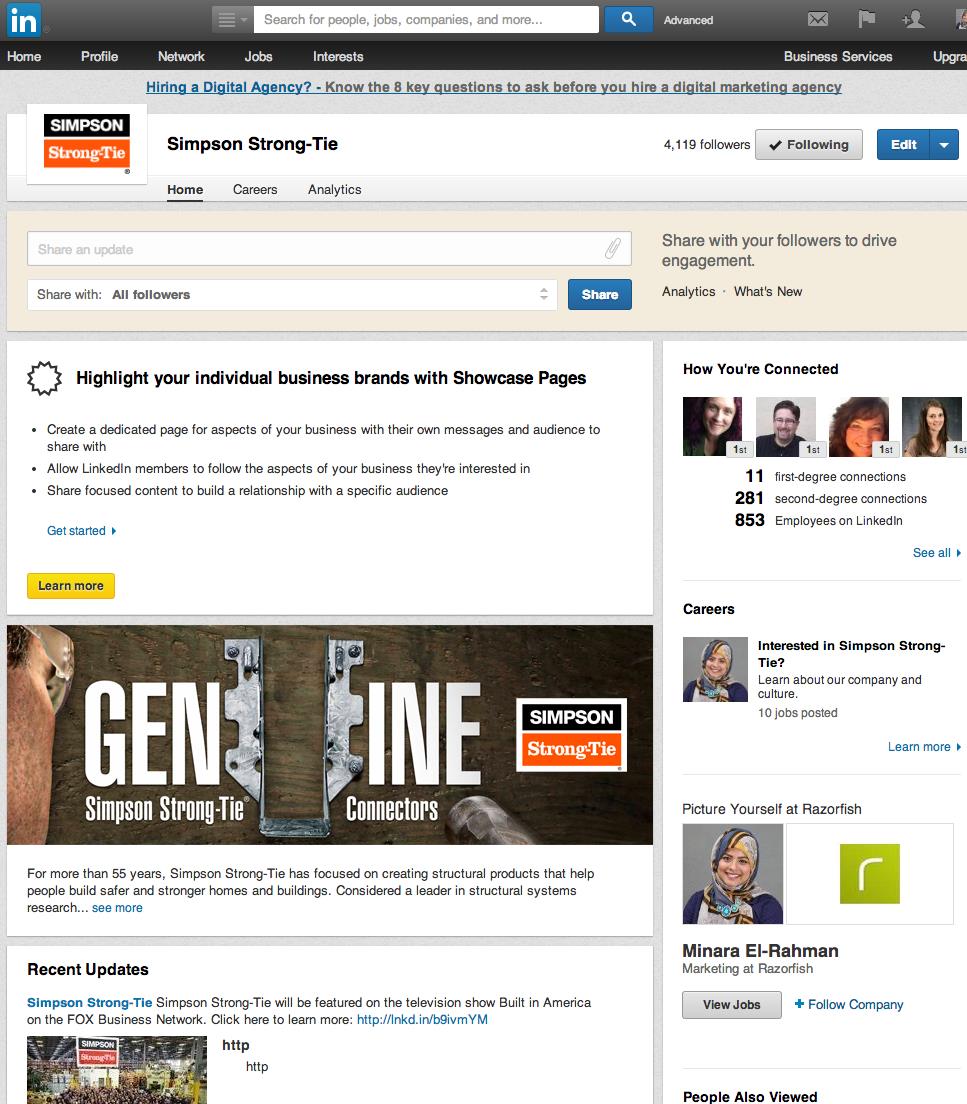 connect and network with people you know and trust. You can add colleagues, peers and others as contacts and send them messages. You can create and update your personal profile to let your contacts know about your professional activities, and both recommend or endorse your contacts and get recommended or endorsed by your contacts for your professional skills. In addition, you can join groups to communicate with other professionals within the same sector or industry. You are also able to ask and answer industry-related questions, and to learn about and apply for job openings.
A basic membership on LinkedIn is free, but you can also upgrade your account in order to have access to professionals outside of your network.
To help guide you, here are some best practices for how to set up and optimize your LinkedIn account.
Update and Complete Your Profile
 Having a complete and updated profile on LinkedIn allows you to put your best face forward. Make sure to summarize your role and responsibilities and current and past work experience, highlighting the details you think will make a prospective customer want to work with you. Include a professional-looking headshot and your current contact information. LinkedIn will even tell you your profile strength on the right-hand rail.
Join Industry Specific Groups
Joining groups that are relevant to our industry will allow you to participate in online industry discussions. Answering questions related to your field of expertise within these discussions is an excellent way to position yourself as an authority and build your professional reputation. Here are some structural engineering groups that you can start with:
SEAOC-Structural Engineers Association of California
Forge Connections
Connect with people you already know using your email contacts. This will help you maintain your existing relationships as well as branch out to connect with industry-related people your contacts may know. Another great feature of LinkedIn is that it will tell you “People You May Know” based on where you work or are already linked to. This feature will help you find meaningful connections.
Follow the Company Page and Share Posts
Simpson Strong-Tie has a company LinkedIn page to connect with customers. Company pages are a way to keep up to date on trends in design and building materials, code changes, product launches and other industry news. Make sure to follow the Simpson Strong-Tie company page so that you can stay informed about our latest news and updates.
Manage Privacy Settings
Make sure to review and manage your privacy settings to help you control how many people can view your activities and personal information. You can do this by hovering your mouse on your thumbnail image on the far right- hand side of your home page.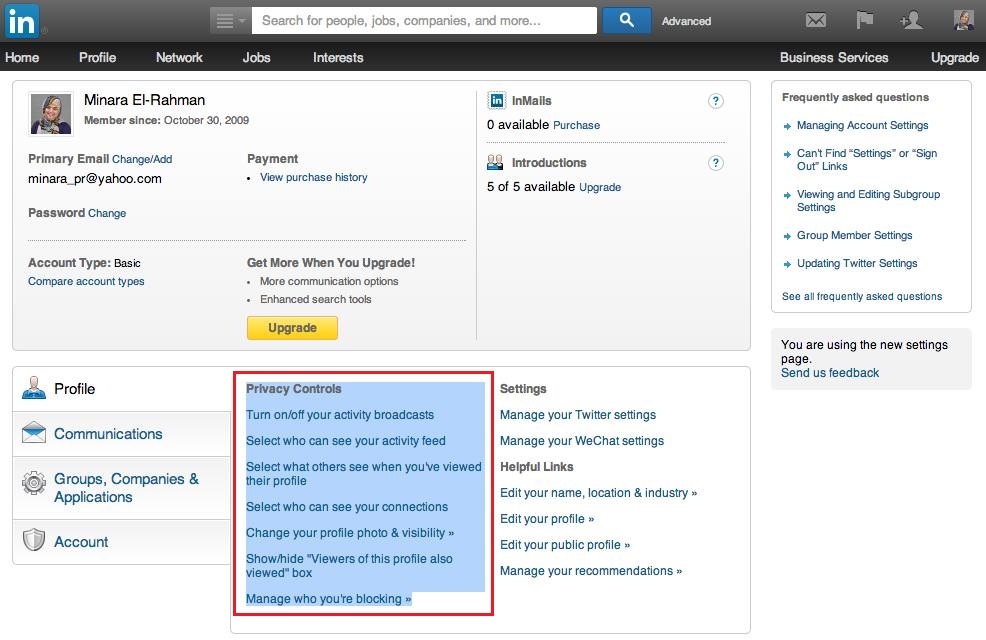 You should see an Account & Settings drop-down menu appear with an option that says “Privacy & Settings: Manage.” Click this option. Once you are there, you can manage all of your privacy settings.
How do you use LinkedIn as part of your engineering career? Let us know in the comments below.

Deck Guardrail Update
This post is an update to David Finkenbinder’s post on Guard Post Resources from August 13.
As David explained, the requirements in the IRC and IBC for guards are intended to prevent people from falling off of raised surfaces. The failure of this guard is a common source of injuries caused by failures of deck components.
Section R312.1.1 of the 2012 International Residential Code (IRC) states that “Guards shall be located along open-sided walking surfaces, including stairs, ramps and landings, that are located more than 30 inches measured vertically to the floor or grade below at any point within 36 inches horizontally to the edge of the open side.”
Table 301.5 of the 2012 IRC requires that guards and handrails be designed for “[a] single concentrated load” of 200 pounds “applied in any direction at any point along the top.”
David mentioned the article Tested Guardrail Post Connections for Residential Decks, which described a testing program at Virginia Tech that examined the ability of various assemblies to resist this concentrated load at the top of the guard post. But rather than test in any direction, the researchers decided to test in what they considered the most critical direction: outward away from the deck.
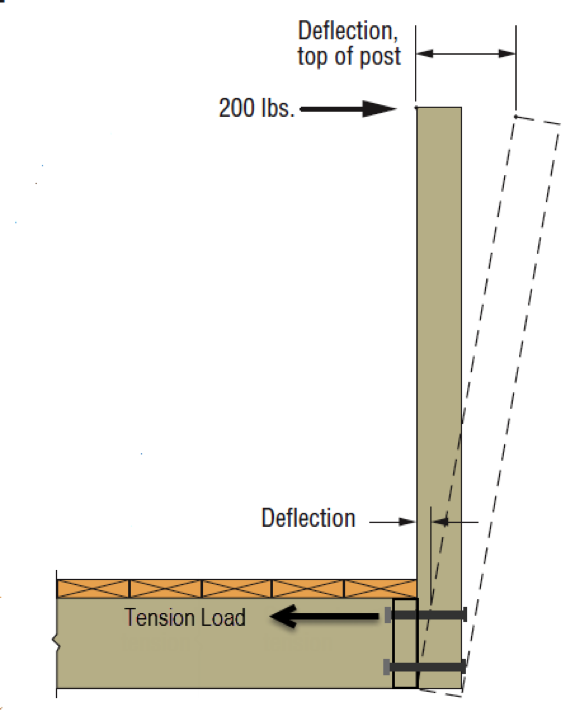
Simpson Strong-Tie subsequently developed a new tension tie, the DTT2Z, to make an economical connection from the top bolt in a deck post back into the framing of the deck to resist the high tension forces that develop in the top bolt when the top of the post is pushed outward. Several details were developed to try to address the various orientations of the post and deck framing.
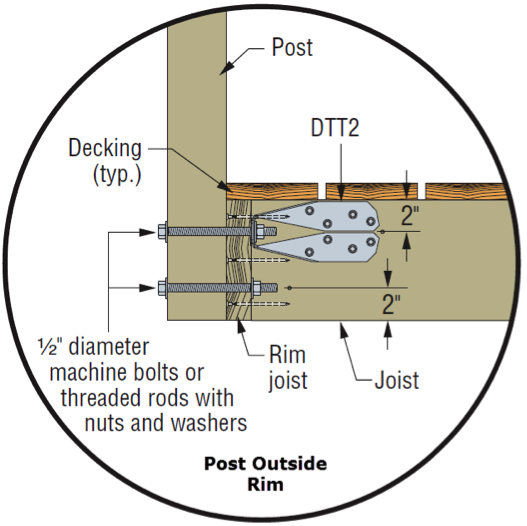
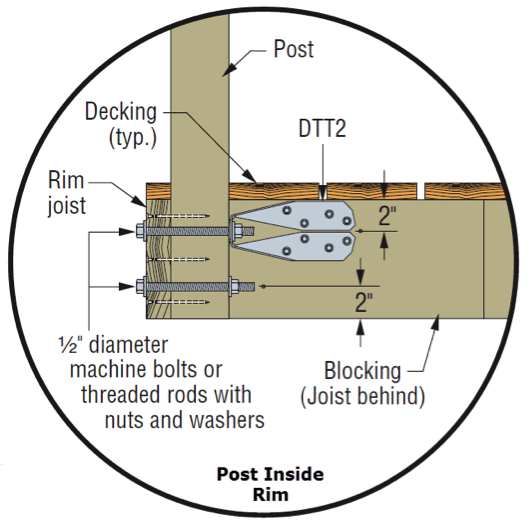
To allow evaluation of assemblies used to resist this deck guardrail force, ICC-ES developed AC273, Acceptance Criteria for Handrails and Guards. AC273 is available for purchase through the ICC bookstore.
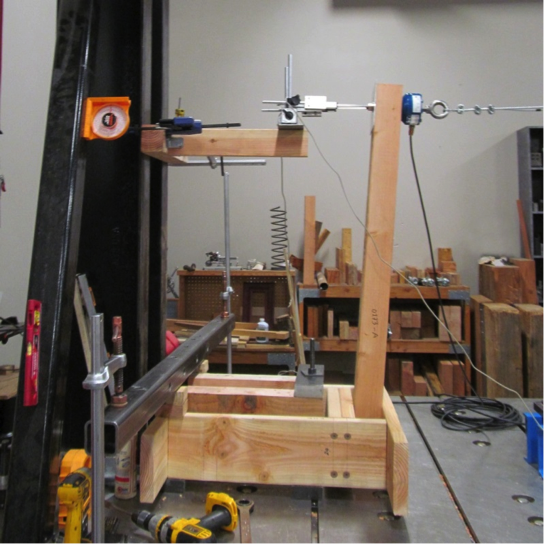
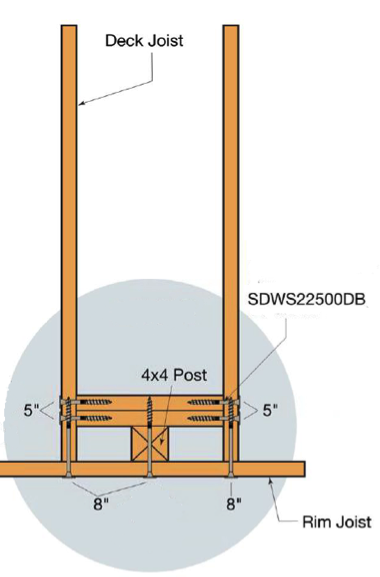
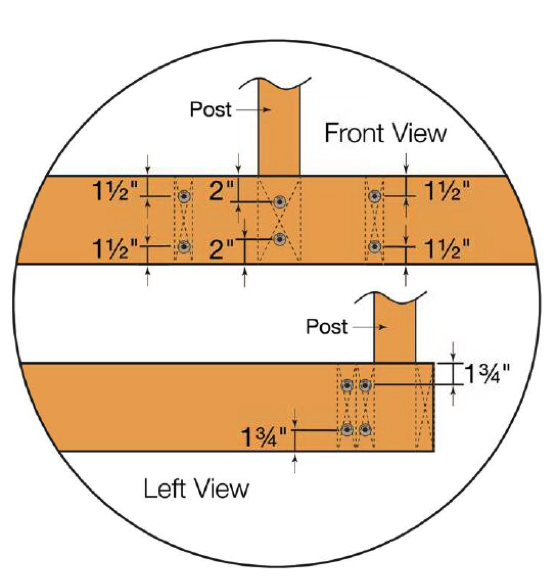
Even with the connectors being readily available, deck builders have asked for guard post connection details that do not involve the use of connection hardware. So Simpson Strong-Tie again tested several framing configurations according to the AC273 criteria, using our Strong-Drive® SDWS TIMBER screws and additional blocking to try to prevent the post from rotating. These details are shown in the engineering letter L-F-SDWSGRD15.
That brings us to the update part.
A committee made up of building officials, manufacturers, deck builders, designers and other interested parties is currently developing a set of code proposals on deck construction for inclusion in the 2018 International Residential Code (IRC). Even though more and more deck information has been incorporated into the last few editions of the IRC, there is still insufficient information in the code to be able to completely build a deck prescriptively. One area of interest is this guard connection. There is a desire to develop prescriptive details for both connection of a 4×4 post to deck framing with blocking and fasteners and for connecting the deck band joist back to the deck framing so that pre-manufactured guard rails can simply be fastened to the deck band with the knowledge that the connection is secure.
The problem is that, with the current requirement, the guard must resist the 200-pound load in ANY direction. All current testing, including AC273, only uses testing in the outward direction away from the floor of the deck. If the post were really required to resist a 200 pound load in the inward direction as well, then two hardware connectors would be required, one on each bolt. However, the belief of the committee is that resistance of 200 pounds in the outward and downward direction is primarily what is needed to ensure the safety of the occupants of the deck.
So they are working on a code proposal to change Table R301.5 of the IRC to require that the guard only resist the 200 pounds in the outward and downward direction and reduce the load to 50 pounds in the inward and upward direction.
The committee recognizes that while this is not necessarily a departure from current practice, it is a departure from current loading requirements in the IRC, IBC, and ASCE 7. So representatives of Simpson Strong-Tie met on September 30 with the NCSEA Code Advisory Committee – General Requirements Subcommittee to get the opinions of this group of active structural engineers. They provided valuable input, including the consideration that at some locations near landings and other changes in elevation, resistance to 200 pounds in the inward direction could be important.
Prior to incorporation of NCSEA’s input, the committee thought the code change might look as shown below.
We are interested in getting additional comments on this code proposal. What do you think? Let us know in the comments below.
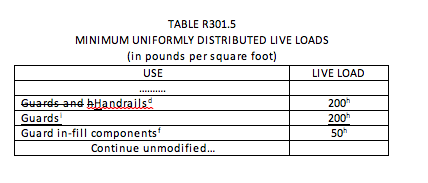
d) A single concentrated load applied in any direction at any point along the top, in pounds.
f) Guard in-fill components (all those except the handrail), balusters and panel fillers shall be designed to withstand a horizontally applied normal load of 50 pounds on an area equal to 1 square foot. This load need not be assumed to act concurrently with any other live load requirement.
h) Glazing used in handrail assemblies and guards shall be designed with a safety factor of 4. The safety factor shall be applied to each of the concentrated loads applied to the top of the rail, and to the load on the in-fill components. These loads shall be determined independent of one another, and loads are assumed not to occur with any other live load.
j) A single concentrated load applied at any point along the top, in pounds. The 200-pound load is required to be applied in either the outward or downward direction, and it is permitted to be reduced to 50 pounds in either the inward or upward direction. The guard is not required to resist these loads applied concurrently with each other.