A couple of years back we hosted a “Take your daughter or son to work day,” which was a great opportunity for our children to find out what their parents did. We had different activities for the kids to learn about careers and the importance of education in opening up career opportunities. People often ask me what I do for Simpson Strong-Tie and I sometimes laugh about how my son Ryan responded to a questionnaire he filled out that day:
Q. What is your mom/dad's job?
A. Goes and gets coffee and sits at his desk
Q. What does your mom/dad actually do at work?
A. Walks in the test lab and checks things
When I am not checking things in the lab or sitting at my desk drinking coffee, I manage Engineering Research and Development for Simpson Strong-Tie, focusing on new product development for connectors and lateral systems.
I graduated from the University of California at Berkeley and I am a licensed Civil and Structural Engineer in California. Prior to joining Simpson Strong-Tie, I worked for 10 years as a consulting structural engineer designing commercial, industrial, multi-family, mixed-use and retail projects. I was fortunate in those years to work at a great engineering firm that did a lot of everything. This allowed me to gain experience designing with wood, structural steel, concrete, concrete block and cold-formed steel as well as working on many seismic retrofits of historic unreinforced masonry buildings.
Every building uses products that are not specifically covered in the building code. IBC Section 104.11 permits this if the “alternative material” is found to comply with the code intent by the building official after review of supporting information, such as research reports and tests.
Reviewing product data might be a challenge for some building departments, as they vary in size and expertise around the country. Some of the questions they might ask are:
1. What, if any, criteria was used to evaluate the product (e.g., test protocol, load rating methodology),
2. Was the criteria developed based on a single individual or a single company’s opinion or was there at least some involvement of others in the construction industry,
3. Are there any potential conflicts of interest in the parties wanting to use the product or the company who evaluated the product, and
4. Are there other tests or analyses that need to be completed prior to accepting the products use in the jurisdiction?
Any contractor that has ever had to replace a corroded connector or fastener will tell you this quote is an understatement. Here at Simpson Strong-Tie, we spend a lot of time refining new product designs to simplify their installation, but uninstalling a joist hanger? It never crosses our minds, and it shows by looking at all the tools you would need: claw hammer, cat’s paw, reciprocating saw, and the all-important first aid kit.
But luckily for the project owner, an ounce of prevention only costs about the price of half a pound of cure. Stainless steel connectors and fasteners are in the range of 5-10 times the cost of galvanized steel. However, connections are usually only a small part of a project’s overall budget and are a critical part of the load path, so the argument for stainless steel is an easy one to make.
It’s that time of year again: newly graduated college students are entering the workforce. For the student, it’s an anxious time. They are often wondering how and if four plus years of college has effectively prepared them for the real working world. For the potential employer, it can be a gamble. They have decided to take a chance on someone who likely does not have any professional work experience, but expect production from day one. On a recent visit to Cal Poly San Luis Obispo, my colleague Scott Fischer got a firsthand view of what students are doing to prepare for a career.
It’s not Friday yet, but I am looking forward to the obnoxious Hawaiian shirts some of my coworkers wear as part of our Engineering Department’s unofficial Hawaiian Shirt Day each week. It’s a little thing, but it definitely helps lighten the mood and gives us all an opportunity to interact with each other.Continue Reading
If you have followed some of my earlier blog posts, you know I am passionate about testing. In my post, Testing – Then and Now, I said, “There simply is no substitute for a physical test.” Something I haven’t discussed in much detail, however, are some of the complexities involved in a good test.
LUS2 10-2 Uplift Test Setup LUS2 10-2 Uplift Test Failure
For wood connector testing, we follow ASTM D7147-21 Testing and Establishing Allowable Loads of Joist Hangers. The actual testing is relatively straight forward – build at least three setups, test them, measure the deflection and ultimate loads.
It actually was that simple years ago, but modern test standards have more requirements than just breaking the part. First off, the steel used in the connector is important. To prevent overestimating a connector’s performance, ASTM D7147 has limits on the strength and thickness of steel used for testing relative to the specified material.
ASTM Steel Reduction Factor
The test standard acknowledges that actual steel strength will exceed the specified strength and the 3/2.5 term in the reduction factor gives you 20% leeway to exceed the specified minimums and not take reductions in allowable loads. Locating production parts made with the right strength steel requires a little bit of searching and we need to do a base metal thickness test on production parts. Prototype parts are somewhat easier because we can hand pick the steel used for making them.
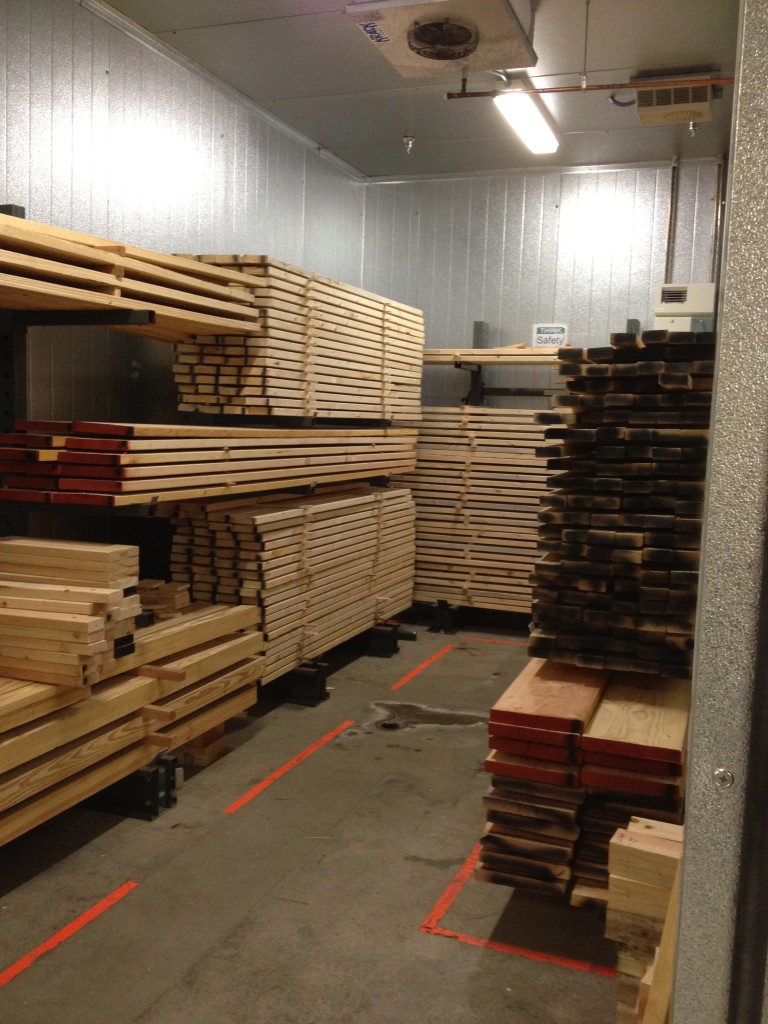
Wood in Conditioning Room
Once we have the parts made with the correct steel in the test lab, we need the right wood. Two properties that affect hanger performance are specific gravity and moisture content of the wood. Moisture content is simply a measure of how wet the lumber is, and the test standards require load reductions if testing is done on wood at less than 11% moisture content. We test the moisture content and specific gravity of every board we receive prior to building test setups. All the good wood is stored in the conditioning room.
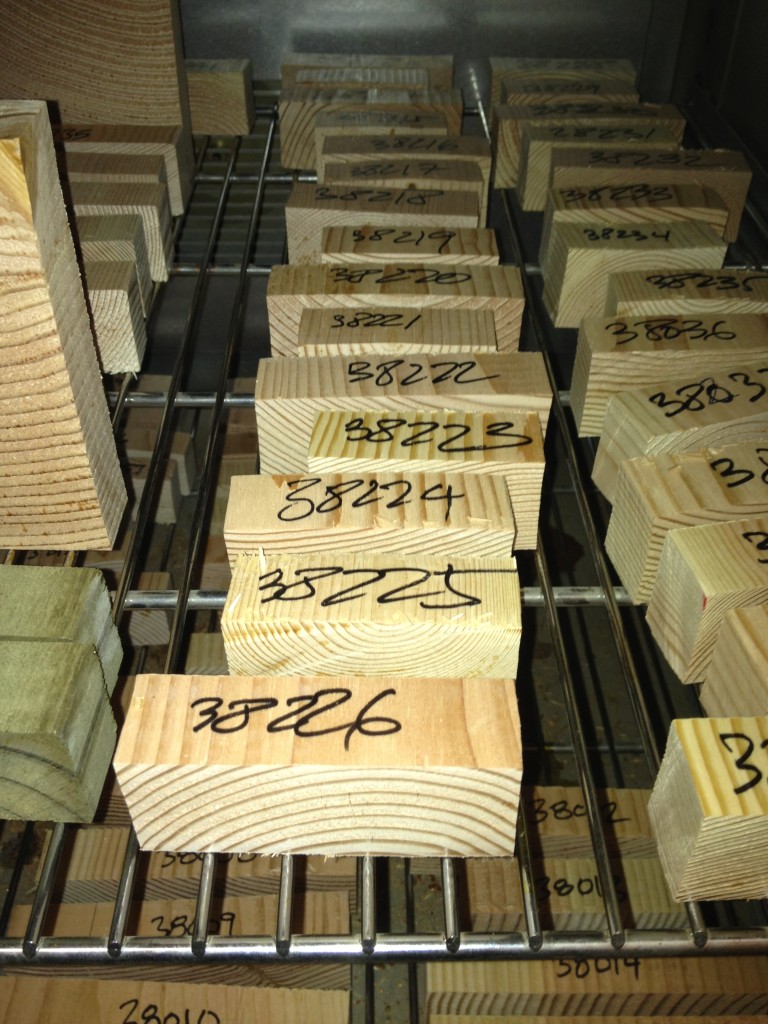
Baking Specific Gravity Samples
Specific gravity is a measure of how dense the wood is – denser wood usually means better test performance. Similar to steel, the test standard requires reductions if your tested specific gravity exceeds the specified. Unlike steel, there is no 20% fudge factor. Once a test is run, specific gravity samples are taken, numbered, measured, and then put in the oven to dry. With testing complete, we can finish the test report and do the calculations to load rate the product. It is a lot of work to create one allowable load for a table in a catalog or a flier – and I still love testing!
Was it JFK who said, “The time to repair the roof is when the sun is shining?” He was likely using the roof as an analogy for the economy, but I take things literally and wanted to talk about roofs. The time to think about the design of your roof and its function in a high wind event like a hurricane or tornado is right now.
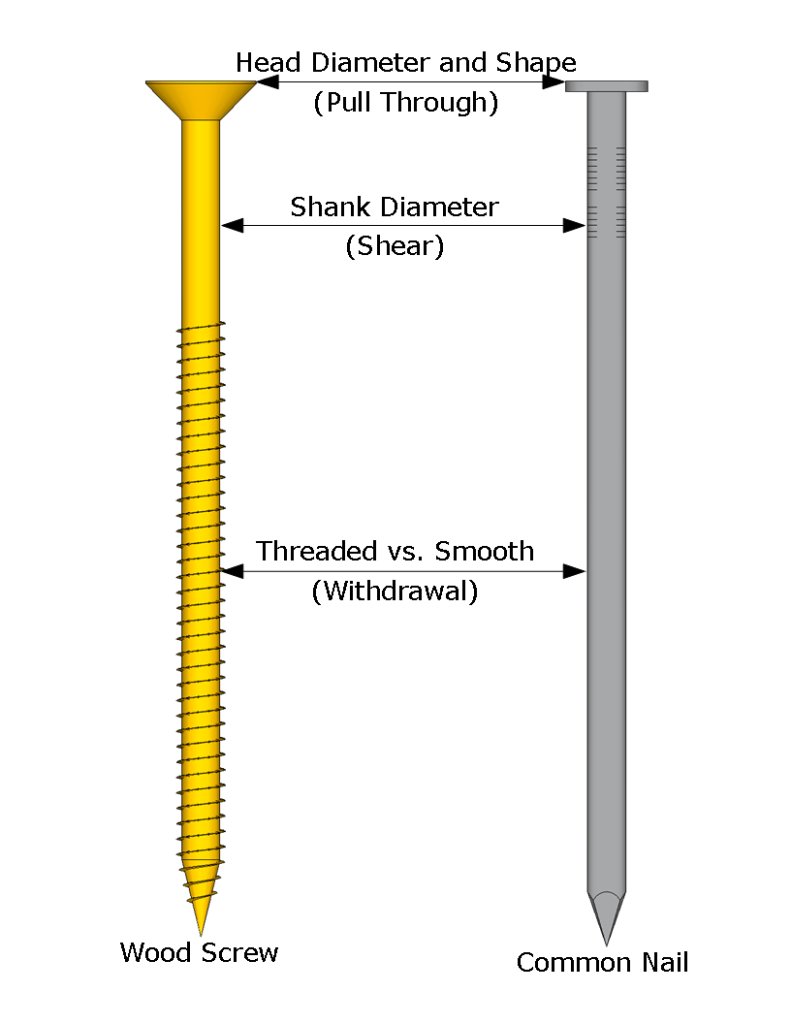
Wood screw vs. common nail
During a high wind event, a roof deck is expected to perform many functions. It should prevent water intrusion from rain, withstand impacts and protect those inside from hail. It also needs to act as a diaphragm – transferring lateral loads to shear walls and resisting the vacuum effects of wind uplift forces.Continue Reading
I like to think I’m flexible, but I’ve been accused of being rigid at times. I guess that’s what therapy is for. If you were to ask a light-frame structure diaphragm that same question, you would likely get multiple conflicting answers. The 1988 UBC first introduced parameters to evaluate diaphragm rigidity. Earthquake Regulations Section 2312(e)6 stated:
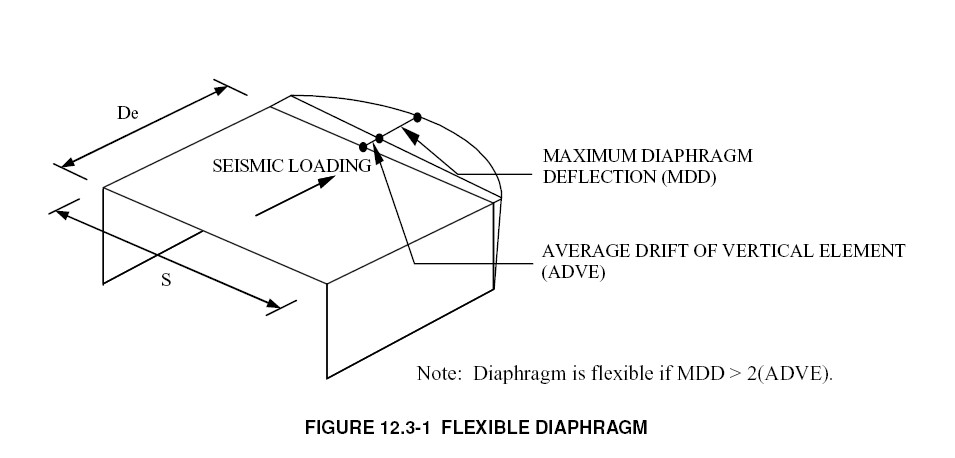
Figure 1. Flexible Diaphragm Definition from ASCE 7-05
Provision shall be made for the increased shears resulting from horizontal torsion where diaphragms are not flexible. Diaphragms shall be considered flexible for the purposes of this paragraph when the maximum lateral deformation of the diaphragm is more than two times the average story drift of the associated story. This may be determined by comparing the computed midpoint in-plane deflection of the diaphragm under lateral load with the story drift of adjoining vertical resisting elements under equivalent tributary lateral load.
My blog post is late this week – I’m going to blame it on vacation. According to this article analyzing a study by Expedia, Americans did not use $34 billion worth of vacation time they were entitled to in 2011. This started me thinking about how difficult it can be for structural engineers to take a real vacation.Continue Reading
According to the National Weather Service, 2011 ranked right up there as one of the worst years on record for tornadoes, having set records for the earliest date of the first tornado, the most states reporting tornadoes, the greatest monthly total, the greatest daily total, and the highest estimated property and crop losses. (Take a look.)
You may wonder: What can I do to protect building occupants (perhaps even my family) in a tornado? It is possible to build your home to higher wind resistance than normally required so that it can resist weak to moderate tornadoes? See my previous blog post, “Designing Light-Frame Wood Structures for Resisting Tornadoes. It Can Be Done!” and also our tornado technical bulletin for more information. But to resist the strongest of tornadoes, the most economical solution is a storm shelter located nearby or in your home. Continue Reading
Prior to joining Simpson Strong-Tie, my career involved the design of projects in California’s San Francisco Bay Area. When designing the primary lateral force resisting system, I would have several pages of seismic base shear calculations and, oh yeah, a one- or two-line calculation of the wind forces – just to show that seismic governed. There was no need for complete wind analysis, since the seismic design and detailing requirements were more restrictive. Of course, building components such as parapets, cladding or roof screens needed a wind design. Unfortunately, when wind appears to control, meeting the seismic requirements is not so simple.
We use cookies on this site to enhance your user experience. By clicking "I AGREE" below, you are giving your consent for us to set cookies. Privacy PolicyI AGREE
Privacy & Cookies Policy
Privacy Overview
This website uses cookies to improve your experience while you navigate through the website. Out of these cookies, the cookies that are categorized as necessary are stored on your browser as they are essential for the working of basic functionalities of the website. We also use third-party cookies that help us analyze and understand how you use this website. These cookies will be stored in your browser only with your consent. You also have the option to opt-out of these cookies. But opting out of some of these cookies may have an effect on your browsing experience.
Necessary cookies are absolutely essential for the website to function properly. This category only includes cookies that ensures basic functionalities and security features of the website. These cookies do not store any personal information.
Any cookies that may not be particularly necessary for the website to function and is used specifically to collect user personal data via analytics, ads, other embedded contents are termed as non-necessary cookies. It is mandatory to procure user consent prior to running these cookies on your website.