Epoxy vs. Acrylic Adhesive Systems: Which Is Right for Me?

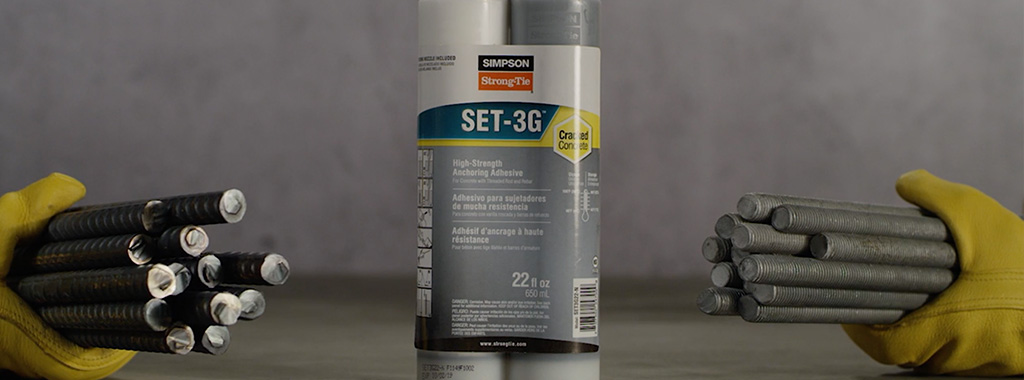
Not all anchoring adhesives are created equal. There are important differences between acrylic-based and epoxy-based adhesive systems — differences that affect installation, gel and cure times, and anchoring performance. In the following post, Marlou Rodriguez, S.E., of Simpson Strong-Tie, lays out some of the comparative installation advantages of each system.

There are two common types of adhesives for anchoring threaded rod or rebar into concrete — epoxy-based systems and acrylic-based systems. What’s the difference? When should you specify one rather than the other? This blog post will help you understand the differences and guide you in choosing the best adhesive for your anchoring solution.
Continue Reading

Simpson Strong-Tie® SET-3G™ Adhesive Offers a Ductile Solution for Post-Installed Anchorage near a Concrete Edge

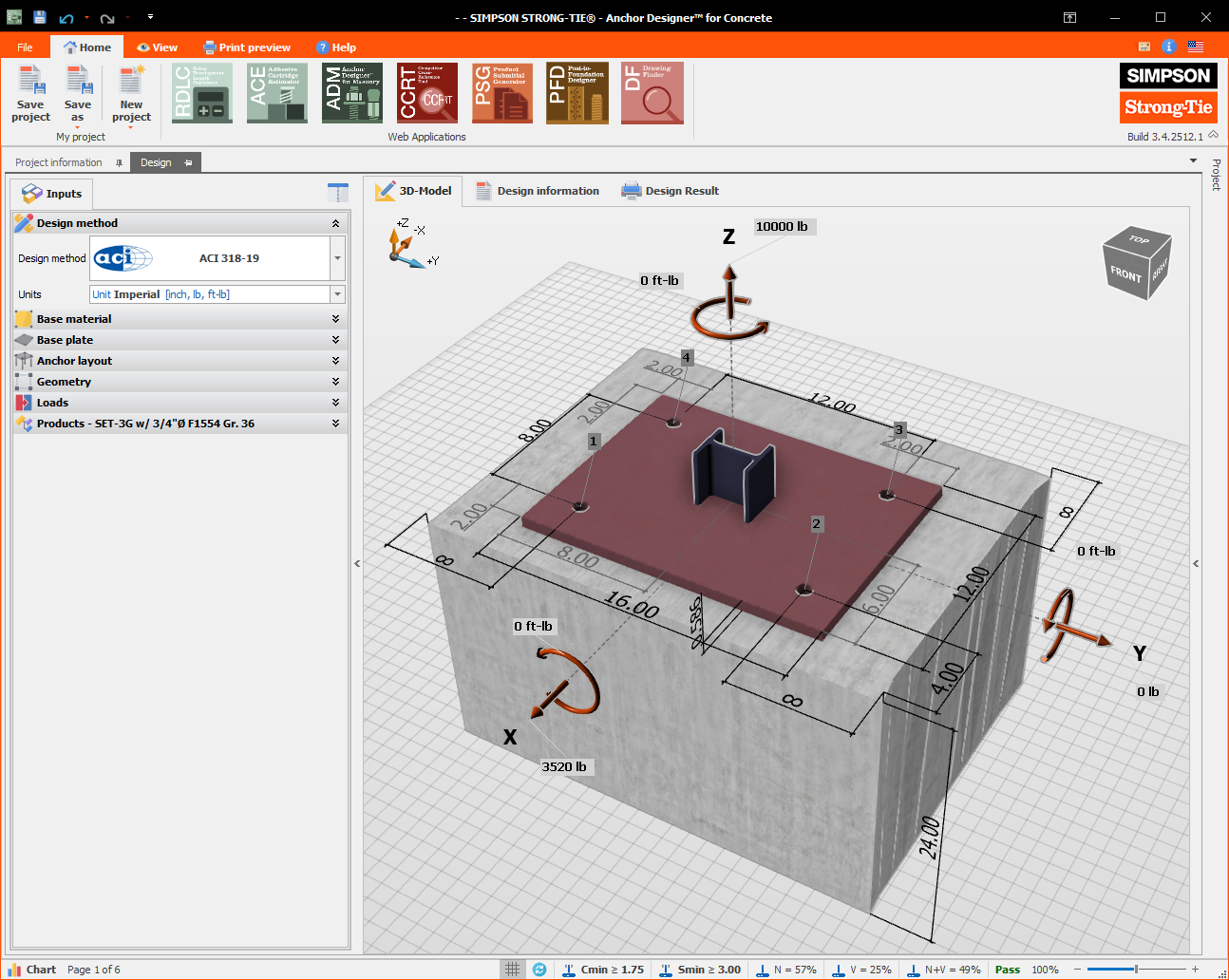
Designing post-installed anchorage near a concrete edge is challenging, especially since the ACI provisions for cracked-concrete anchorage went into effect. In the following post, one of our field engineers, Jason Oakley, P.E., explains how SET-3G™ and Anchor Designer™ for Concrete software from Simpson Strong-Tie make it easier to design a ductile anchor solution.

Engineers often provide holdown anchoring solutions near a concrete edge to help prevent overturning of light-frame shear walls during a seismic (or high-wind) event. Sometimes a post-installed anchor must be used if the cast-in-place anchor was mislocated or misinstalled, or is located where a retrofit or addition is needed. Since the cracked-concrete anchorage design provisions went into effect more than a decade ago, it has been challenging for engineers to offer a near-edge post-installed anchoring solution. This is especially true for structures subject to earthquake loads in seismic design category (SDC) C through F. Simpson Strong-Tie’s new SET-3G epoxy is the first anchoring adhesive in the industry to offer exceptionally high bond-strength values that permit ductile anchorage in concrete near an edge. This blog post will cover a specific example that focuses on Chapter 17 of ACI 318-19 to design a threaded rod, anchored with SET-3G adhesive, used to secure a holdown located 1 3/4″ away from a single concrete edge (Figure 1).
Continue Reading

How Heat Treating Helps Concrete Anchoring Products Meet Tougher Load Demands

There’s a saying in Chicago, “If you don’t like the weather, just wait fifteen minutes.” That’s especially true in the spring, when temperatures can easily vary by over 50° from one day to the next. As the temperature plunges into the blustery 30s one evening following a sunny high in the 80s, I throw my jacket on over my T-shirt, and I’m reminded that large swings in temperature tend to bring about changes in behavior as well. This isn’t true just with people, but with many materials as well, and it brings to mind a thermal process called heat treating. This is a process that is used on some concrete anchoring products in order to make them stronger and more durable. You may have heard of this process without fully understanding what it is or why it’s useful. In this post, I will try to scratch the surface of the topic with a very basic overview of how heat treating is used to improve the performance of concrete anchors.Continue Reading

Why You Should Specify Stainless-Steel Screw Anchors When Designing for Corrosive Environments

I was driving under a concrete bridge one nice clear day in Chicago, and I happened to look up to see rusted rebar exposed below a concrete bridge. My beautiful wife, who is not a structural engineer, turned to me and asked, “What happened to that bridge?” I explained that there are many reasons why spalling occurs below a bridge. One common reason is the expansion of steel when it rusts or corrodes.

Continue Reading

Considerations for Designing Anchorage in Proximity to Abandoned Anchor Holes

danharmon.headshot.finalThis week’s post comes from Dan Harmon, an R&D engineer for Simpson Strong-Tie’s Infrastructure-Commercial-Industrial (ICI) group. Dan specializes in post-installed concrete anchor design and spent a decade managing Simpson’s anchor testing lab, where he developed extensive knowledge of anchor behavior and performance. He has a Bachelor of Science in mechanical engineering from the University of Illinois Urbana-Champaign.

Designers and engineers can spend hundreds of hours on detailed drawings of structures, but there are often conditions and coordination that can change well-planned details and drawings. As we all know, paper and reality don’t always agree. Anchorage locations can move as a result of unforeseen circumstances such as encountering reinforcing bars in an existing concrete slab or interference between different utility trades.

With post-installed anchors, one particular jobsite change may require abandoning a hole that has been drilled, leaving the final anchor location adjacent to the abandoned hole. When a hole for an anchor is drilled but never used, it essentially creates a large void in the concrete. Depending on where this void is located in relation to an installed anchor, there is potential for the capacity of that anchor to be reduced. To give guidance on this situation to specifiers, users and contractors, Simpson Strong-Tie conducted a large series of tests in their ISO 17025–accredited Anchor Systems Test Lab in Addison, Illinois.

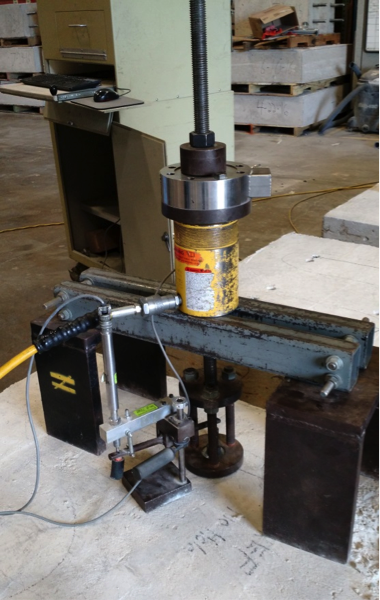
To evaluate the effect of abandoned holes located adjacent to post-installed anchors, we performed tension tests meeting the requirements of ASTM E488-15 (see Figure 1). A variety of anchor types with common diameters were tested:

  • Drop-in anchors (1/2″ and 3/4″ diameter)
  • Wedge-type anchors (1/2″ and 3/4″ diameter)
  • Concrete screws (1/2″ diameter)
  • Adhesive anchors with threaded rod (1/2″ diameter)
Figure 1: Common Unconfined Tension Test Set-Up per ASTM E488-15

Each anchor type and diameter was tested under five different conditions:

  • No abandoned hole near the installed anchor. This is considered the reference condition to which other tests are to be compared.
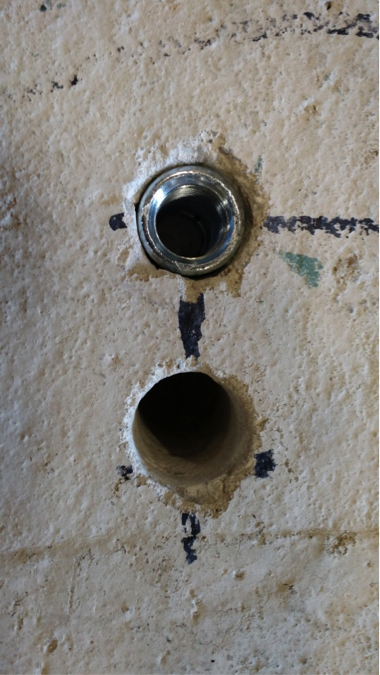
  • One abandoned hole at a distance of two times the hole diameter (2d) away from the installed anchor. See Figure 2.
  • One abandoned hole at a distance of four times the hole diameter (4d) away from the installed anchor.
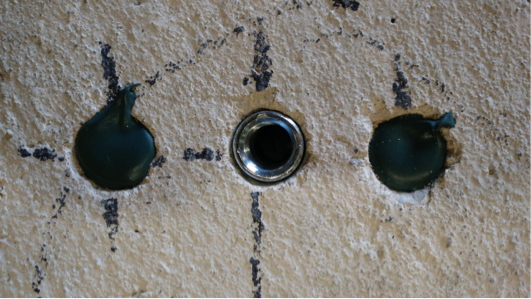
  • Two abandoned holes, each at a distance of two times the hole diameter (2d) away from the installed anchor. In test conditions with two holes, the holes were located on either side of the installed anchor, approximately 180º from each other. See Figure 3.
  • Two abandoned holes, each at a distance of two times the hole diameter (2d) away from the installed anchor, with the holes refilled with a concrete anchoring adhesive that was allowed to cure fully prior to testing. See Figure 4.
Figure 2: Drop-In Anchor with a Single Hole at a Distance of 2d
Figure 3: Drop-In Anchor with Two Holes at a Distance of 2d
Figure 4: Drop-In Anchor with Two Holes, Filled with Anchoring Adhesive, at a Distance of 2d

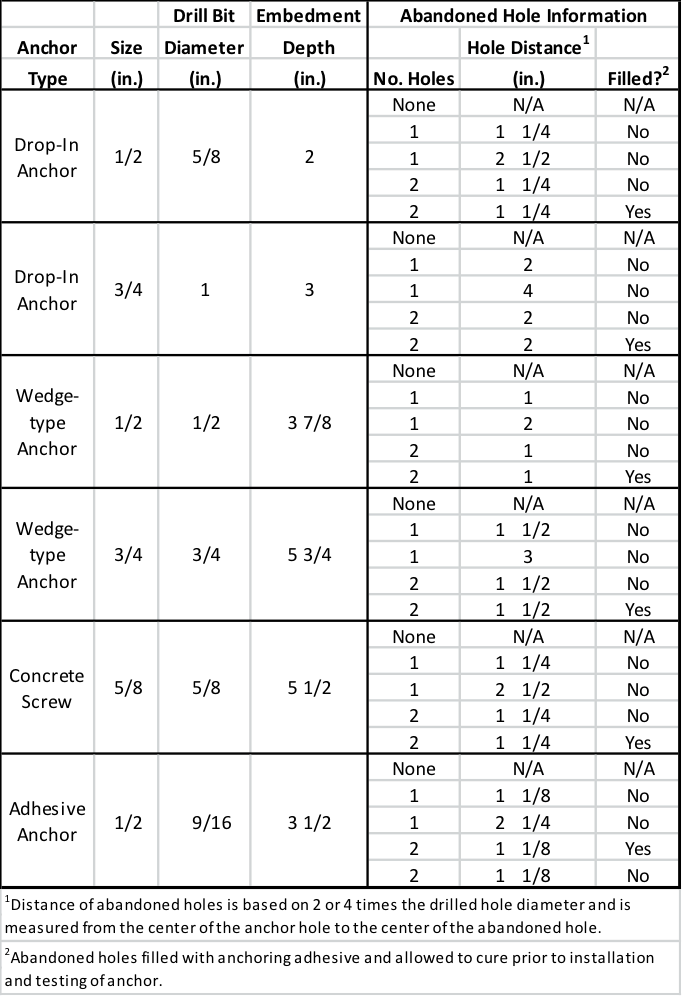
This test program is summarized in Table 1. In all cases, the abandoned hole was of the same diameter and depth as the hole prescribed for the installed anchor.

Table 1. Summary of Test Program

Five tests for each anchor under each condition were tested, and the mean and coefficient of variance of each data set were calculated. These calculated values were used to compare the different conditions.

Across the different anchor types and diameters, the test results showed a number of general rules that held true.

Summary Results

Abandoned holes that are 2” or more away from the anchor have little to no effect on the tension performance of the anchor. Compared to the reference condition with no abandoned hole near the anchor, conditions where the abandoned hole was sufficiently far away were found to be essentially equivalent. This equivalence held true even for anchor types that create expansion forces (drop-in and wedge-type anchors) during their installation.

Two abandoned holes have the same effect on performances as one, regardless of distance from the anchor. This testing showed that adding a second abandoned hole near an installed anchor did not adversely affect tension performance in a significant way. Even within distances of 2 inches, performance did not drop substantially – if at all – in conditions involving two abandoned holes as compared to one.

Filling abandoned holes with an anchoring adhesive prior to installation of the anchor improves performance. In all cases tested, filling abandoned holes with adhesives resulted in increased performance compared to leaving the holes empty. In a majority of cases, performance with filled holes was equivalent to performance in the reference condition regardless of the distance from the anchor.

When the abandoned hole is more than two times the drilled hole diameter but less than 2″from the anchor – and left unfilled – the testing showed a loss in performance. Not surprisingly, the degree of that loss was dependent on the type of anchor. Table 2 shows the capacity reduction compared to the reference condition in testing with expansion anchors. Table 3 shows the same results for concrete screws and adhesive anchors. Conservative suggested performance reductions in these conditions would be 20% for expansion anchors and 10% for concrete screws and adhesive anchors.

Table 2: Performance Reduction for Expansion Anchors
Table 3: Performance Reduction for Concrete Screws and Adhesive Anchors

In an ideal world, the engineer’s designs could be followed at all times at the jobsite. But we don’t live in an ideal world. Good engineering judgment is needed in situations where variation is required, and having data to support those decisions is always helpful. In the case of abandoned holes near post-installed anchors, it’s Simpson Strong-Tie’s hope that this testing provides additional guidance for the designer, inspector, and jobsite worker.


Concrete Anchorage for ASD Designs

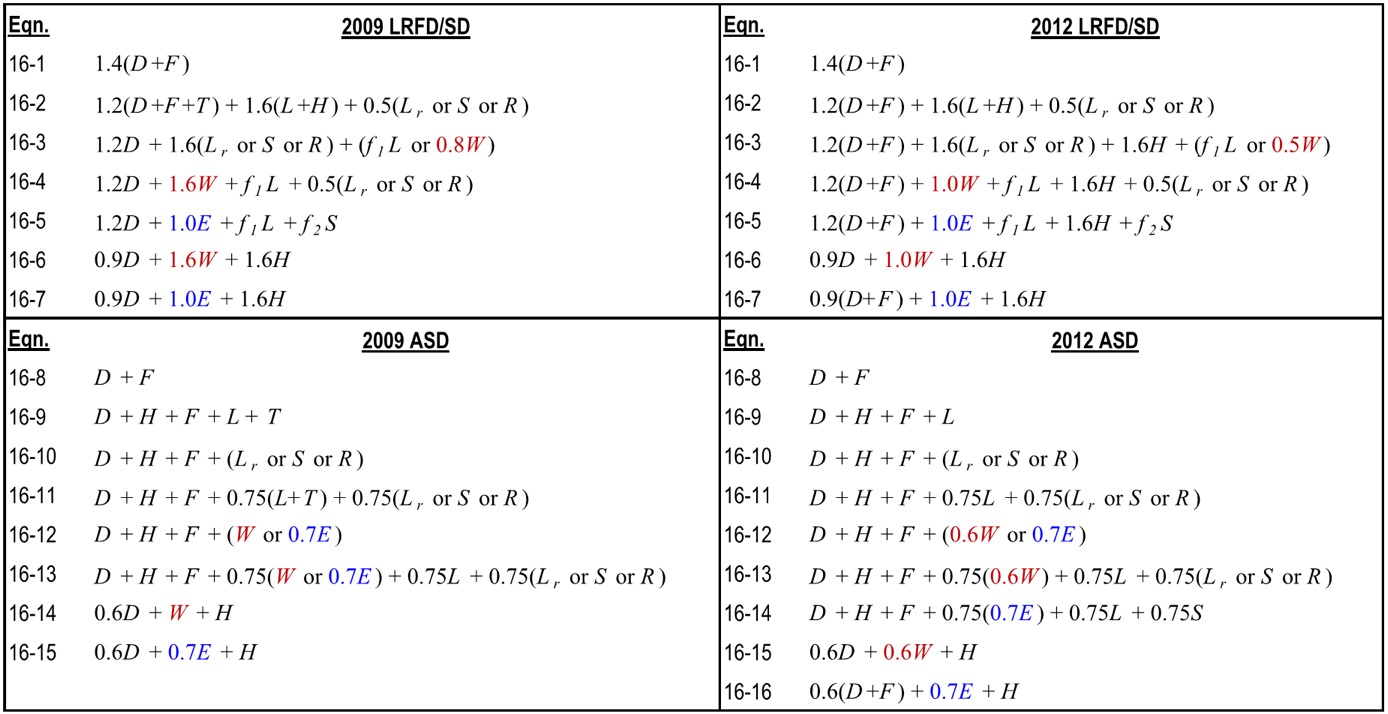
One of the first things I learned in school about using load combinations was that you had to pick either Load and Resistance Factor Design (LRFD)/Strength Design (SD) or Allowable Stress Design (ASD) for a building and stick with it, no mixing allowed! This worked for the most part since many material design standards were available in a dual format. So even though I may prefer to use LRFD for steel and ASD for wood, when a steel beam was needed at the bottom of a wood-framed building that was designed using ASD load combinations, the steel beam could easily be designed using the ASD loads that were already calculated for the wood framing above since AISC 360 is a dual- format material standard. And when the wood-framed building had to anchor to concrete, ASD anchor values were available in the IBC for cast-in-place anchors and from manufacturers for post-installed anchors in easy-to-use tables, even though ACI 318 was not a dual-format material standard. (Those were good times!)

Then along came ACI 318-02 and its introduction of Appendix D – Anchoring to Concrete, which requires the use of Strength Design. The 2003 IBC referenced Appendix D for Strength Design anchorage, but it also provided a table of ASD values for some cast-in-place headed anchors that did not resist earthquake loads or effects. This option to use ASD anchors for limited cases remained in the 2006, 2009 and 2012 codes. In the 2015 IBC, all references to the ASD anchor values have been removed, closing the book on the old way of designing anchors.

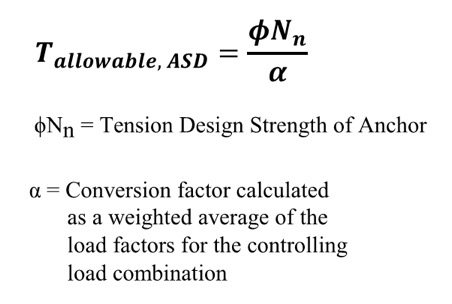
ICC-ES-equation-tensionSo what do you do now? Well, there is some guidance provided by ICC-ES for manufacturers to convert calculated SD capacities to ASD allowable load values. Since there is no conversion procedure stated in the IBC or referenced standards, designers may want to use this generally accepted method for converting anchor capacities designed using ACI 318. ICC-ES acceptance criteria for post-installed mechanical and adhesive anchors (AC193 and AC308) and cast-in-place steel connectors and proprietary bolts (AC398 and AC399) outline a procedure to convert LRFD capacities to ASD using a weighted average for the governing LRFD/SD load combination. So if the governing load combination for this anchor was 1.2D + 1.6L and the dead load was 1,000 pounds and the live load was 4,000, then the conversion factor would be (1.2)(0.2) + (1.6)(0.8) = 1.52 (keep in mind that the LRFD/SD capacity is divided by the conversion factor in the ICC-ES equation shown here for tension).

Right away, there are a few things that you may be thinking:

  1. What about load factors that may exist in ASD load combinations?
  2. It may just be easier to just recalculate my design loads using LRFD/SD combinations!
  3. The resulting allowable loads will vary based on the load type, or combination thereof.
  4. If the ACI 318 design strength is limited by the steel anchor, then the conversion will result in an allowable load that is different from the allowable load listed for the steel element in AISC 360.

Let’s take a look at these objections one by one.

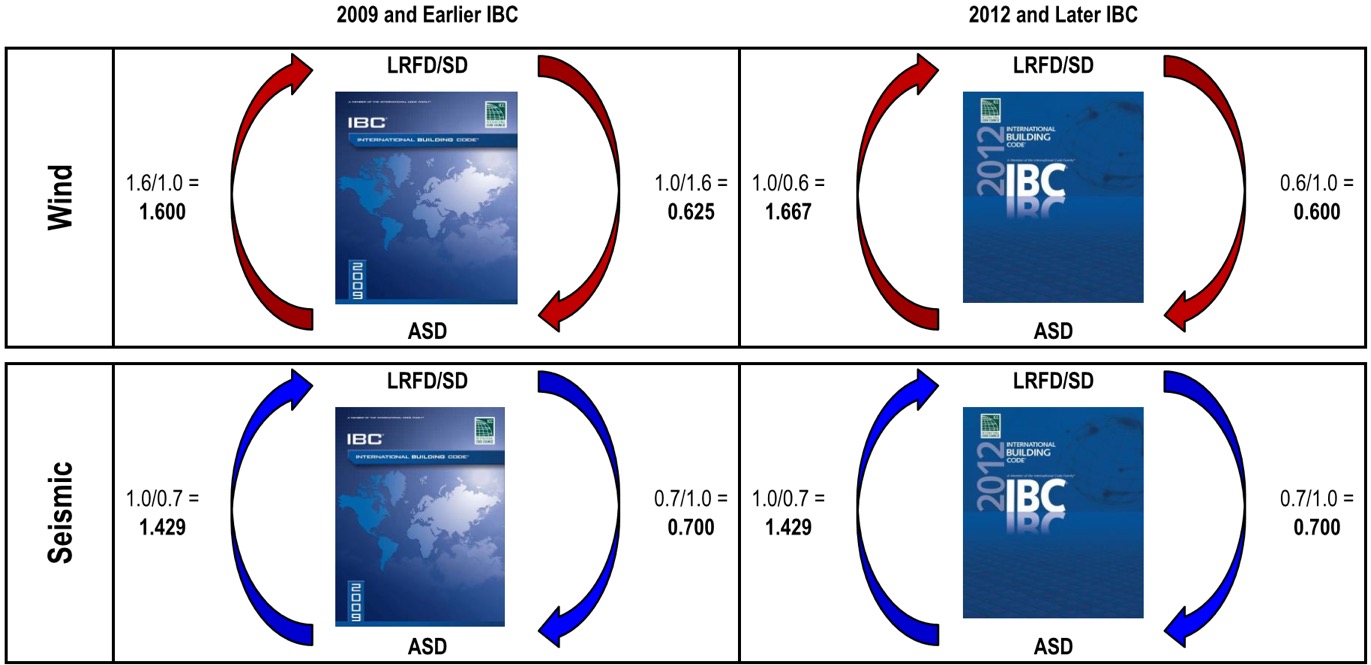
Item 1: Since unfactored earthquake loads are determined at the ultimate level in the IBC, they have an LRFD/SD load factor of 1.0 and an ASD load factor less than 1.0, which is also true for wind loads in the 2012 and 2015 IBC (see graphic below). Using the LRFD/SD load factor of 1.0 obviously does not convert the capacity from LRFD to ASD so you must also account for ASD load factors when calculating the conversion factor. To do so, instead of just using the LRFD load factor, use the ratio of LRFD Factor over ASD Factor. So if the governing load combination for an anchor was 0.9D + 1.0E and the dead load was 1,000 pounds and the seismic load was 4,000, then the conversion factor would be (0.9)(0.2) + (1.0/0.7)(0.8) = 1.32.

ICC-ES-equations

Item 2: Even though the weighted average conversion requires you to go back and dissect the demand load into its various load types, often this can be simplified. ICC-ES acceptance criteria permit you to conservatively use the largest load factor. The most common application I run into is working with ASD-level tension loads for wood shearwall overturning that must be evaluated using SD-level capacities for the concrete anchorage. Since these loads almost always consist of wind or seismic loads, using the largest factor is not overly conservative. Depending on the direction in which you are converting the demand loads or resistance capacities, the adjustment factors are as shown in the figure below. Affected Simpson Strong-Tie products now have different allowable load tables for each load type. (For examples, see pp. 33-36 of our Wood Construction Connectors catalog for wind/seismic tables and pp. 28-30 of our Anchoring and Fastening Systems catalog for static/wind/seismic tables.)

IBC-ealier-later

Item 3: I am unsure whether there is any sound rationale for having allowable loads for an anchor resisting 10% dead load and 90% live load differ from those of an anchor that resists 20% dead load and 80% live load. Perhaps a reader could share some insight, but I just accept it as an expedience for constructing an ASD conversion method for a material design standard that was developed for SD methodology only.

Item 4: We have differing opinions within our engineering department on how to handle the steel strength component of the various SD failure modes listed in ACI 318. Some believe all SD failure modes in ACI 318 should be converted using the load factor conversion method. I side with others who believe that the ASD capacity of a steel element should be determined using AISC 360. So when converting SD anchor tension values for a headed anchor, I would apply the conversion factor to the concrete breakout and pullout failure modes from ACI 318, but use the ASD steel strength from AISC 360.

Finally, I wanted to point out that the seismic provisions in ACI 318, such as ductility and stretch length, must be considered when designing anchors and are not always apparent when simply converting to ASD. For this reason, I usually suggest converting ASD demand loads to SD levels so you can use our Anchor Designer™ software to check all of the ACI 318 provisions. But for some quick references, we now publish tabulated ASD values for our code-listed mechanical and adhesive anchors in our C-A-2016 catalog —  just be sure to read all of the footnotes!

Concrete Anchor Design for the International Building Code: Part 3

Specification of Concrete Anchors
The 2024 IBC and its Referenced Standard, ACI 318-19, is the first to mandate that contract documents specifically address installation, inspections and design parameters of concrete anchorage. For this reason, the specification of anchors in drawing details alone is impractical. To fully and effectively address these code mandates, concrete anchorage is more practically specified in both drawing detail(s) and the General Structural Notes or specifications of the contract documents. The drawing detail(s) would typically call out the anchor type, material specification, diameter, and embedment depth. The General Structural Notes or specifications would include the name of the qualified anchor(s) and address the installation, inspections and design parameter requirements of ACI 318-19.

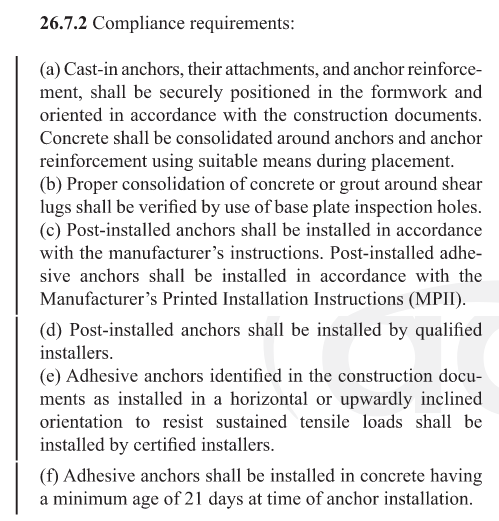
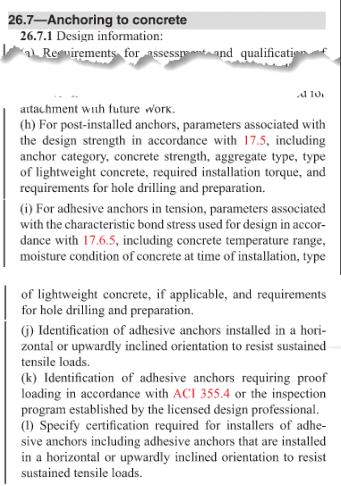
The following provisions of ACI 318-19 Chapter 26 discuss the contract document requirements for concrete anchorage. Section 26.7.2 establishes compliance requirements for anchor installation, including proper positioning of cast-in anchors, consolidation of concrete around anchors, and installation of post-installed anchors in accordance with the Manufacturer’s Printed Installation Instructions (MPII). Section 26.7.2 further requires that post-installed anchors be installed by qualified installers, and that adhesive anchors installed in horizontal or upwardly inclined orientations to resist sustained tensile loads be installed by certified installers. Minimum concrete age requirements for adhesive anchors are also addressed.

The commentaries to Section 26.7.2, R26.7.2 (c)(e)(f) emphasize the sensitivity of anchor performance to proper installation and reinforces the importance of qualified personnel and strict compliance with MPII for post-installed anchors. Simpson Strong-Tie Co. Inc. provides free installer training conducted by experienced Technical Sales Representatives for adhesive, mechanical, and specialty anchors. For additional information regarding installer training opportunities, contact 1-800-999-5099.
Additional requirements related to inspection, installer qualification, and testing of adhesive anchors – including special inspection and proof loading where required – are addressed in ACI 318-19 Sections 26.7.1 and 26.7.2, as well as through the applicable inspection provisions of the general building code.

Per the section above, anchor installation requires inspection per ACI 318-19 Section 26.7.2. In addition, the design parameters for adhesive anchors are required to be specified in the contract documents. An explanation of the design parameters listed in ACI 318-19 Section 26.7.1 is provided below:

  1. Proof loading where required in accordance with ACI 355.4. Proof loading is only required for adhesive anchors loaded in tension in which the inspection level chosen for the adhesive anchor design is “Continuous” (Ref. ACI 355.4 Section 10.4.6). Selecting “Continuous Inspection” can result in a higher “Anchor Category,” which in turn results in a higher strength reduction factor, φ. Reference Section 13.3.4 of ACI 355.4 for the minimum requirements of the proof loading program, where required. The Design Professional is responsible for performing the quantity, the duration of the applied load, and the proof load to which the anchors will be tested. These parameters will be specific to the anchor design conditions.
  2. Minimum age of concrete at time of anchor installation. Per ACI 318-19 Section 26.7.2(f), adhesive anchors must be installed in concrete having a minimum age of 21 days at time of anchor installation unless otherwise permitted by the applicable evaluation report. Design professionals should refer to current manufacturer evaluation reports and published technical data for any product-specific allowances, limitations, or installation requirements.
  3. Concrete temperature range. This is the in-service temperature of the concrete into which the adhesive anchor is installed. Temperature Ranges are categorized as 1, 2 or 3. Some manufacturers use A, B, or C as the category designations. Each Temperature Range category has a maximum short-term concrete temperature and a maximum long-term concrete temperature. Short-term concrete temperatures are those that occur over short intervals (diurnal cycling). Long-term concrete temperatures are constant temperatures over a significant time period.
  4. Moisture condition of concrete at time of installation. Moisture conditions, as designated by ACI 355.4, are “dry,” or “water-saturated.” Moisture condition impacts the characteristic bond stress of an adhesive.
  5. Type of lightweight concrete, if applicable.
  6. Requirements for hole drilling and preparation. These requirements are specific to the adhesive, and are described in the Manufacturer’s Printed Installation Instructions (MPII). Reference to the MPII in the contract documents is sufficient.

Adhesive anchors installed in a horizontal or upwardly inclined orientation that resist sustained tension loads require a “certified” installer according to ACI 318-19 Section 26.7.1(l).

According to the commentary to Section 26.7.1, R26.7.1(l), certification may also be appropriate for other safety-related applications. Installers can become certified through testing and training programs that include written and performance examinations as defined by the ACI Adhesive Anchor Installer Certification program (ACI CPP 680.1-17) or similar programs with equivalent requirements. The acceptability of certification other than the ACI Adhesive Anchor Installer Certification should be determined by the Licensed Design Professional. In addition, installers should obtain instruction through product­specific training offered by manufacturers of qualified adhesive anchor systems.
An equivalent certified installer program should test the adhesive anchor installer’s knowledge and skill by an objectively fair and unbiased administration and grading of a written and performance exam. Programs should reflect the knowledge and skill required to install available commercial anchor systems. The effectiveness of a written exam should be verified through statistical analysis of the questions and answers. An equivalent program should provide a responsive and accurate mechanism to verify credentials, which are renewed on a periodic basis.

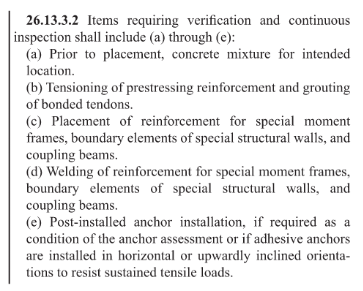
The installation of adhesive anchors in a horizontal or upwardly inclined orientation presents unique challenges to the installer. Simply put, the effects of gravity for these applications make it difficult to prevent air bubbles and voids, which can limit full adhesive coverage of the insert (threaded rod or reinforcing bar). Due to the increased installation difficulty of these anchors, they are required to be continuously inspected by a certified special inspector according to ACI 318-19 Section 26.13.3.2(e).

Suggested General Structural Notes or specifications for post-installed anchors can be viewed and downloaded at here, or contact a Simpson Strong-Tie® representative for help with your post-installed General Structural Notes or specifications.

Simpson Strong-Tie Suggested General Note for Anchor Products

Post-Installed Anchors into Concrete, Masonry and
Steel and Cast-in-Place Anchors into Concrete

The below products are the design basis for this project. Substitution requests for products other than those listed below may be submitted by the contractor to the Engineer-of-Record (EOR) for review. Substitutions will only be considered for products having a code Report recognizing the product for the appropriate application and project building code. Substitution requests shall include calculations that demonstrate the substituted product is capable of achieving the equivalent performance values of the
design basis product. Contractor shall contact manufacturer’s representative (800-999-5099) for product installation training and a letter shall be submitted to the EOR indicating training has taken place. Refer to the building code and/or evaluation report for special inspections and proof load requirements.

For anchoring into cracked and uncracked concrete

a) Mechanical anchors shall have been tested in accordance with ACI 355.2 and/or ICC-ES AC193 for cracked concrete and seismic applications. Pre-approved products include:

  1. Simpson Strong-Tie® Strong-Bolt® 2 (ICC-ES ESR-3037)
  2. Simpson Strong-Tie® Titen HD® (ICC-ES ESR-2713)
  3. Simpson Strong-Tie® Titen HD® Rod Hanger (ICC-ES ESR-2713)

b) Adhesive anchors shall have been tested in accordance with ACI 355.4 and/or ICC-ES
AC308 for cracked concrete and seismic applications. Adhesive anchors shall be installed
by a certified adhesive anchor installer where designated on the contract documents.
Pre-approved products include:

  1. Simpson Strong-Tie® AT-3G™ (ICC-ES ESR-5026)
  2. Simpson Strong-Tie® SET-3G™ (ICC-ES ESR-4057)
  3. Simpson Strong-Tie® ET-3G™ (ICC-ES ESR-5334)

cadp3.6

Concrete Anchor Design for the International Building Code: Part 2

Designing “Alternative Materials”

Concrete anchor types whose designs are not addressed in the IBC or its referenced standards, or are specifically excluded from the scope of the referenced standard (ACI 318-19 Chapter 17), may be recognized as Alternative Materials. Section 1901.3 of the 2024 IBC requires anchoring to concrete to be designed in accordance with ACI 318-19 Chapter 17, as supplemented by Section 1905, for anchor types that fall within its scope.

Anchor types that are excluded from the scope of ACI 318-19 Chapter 17 are therefore not considered code-prescribed anchors and must be evaluated as alternative materials, designs, or methods of construction. While ACI 318-19 Chapter 17 identifies certain anchor types that are excluded from its scope, the list of excluded anchor types is not intended to be comprehensive.

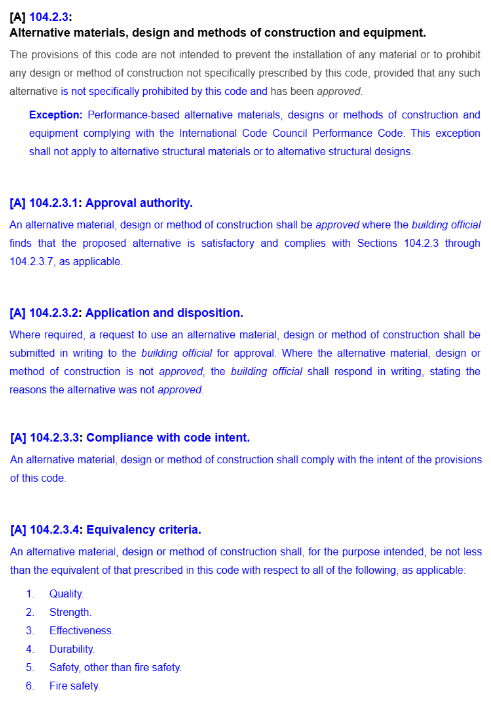
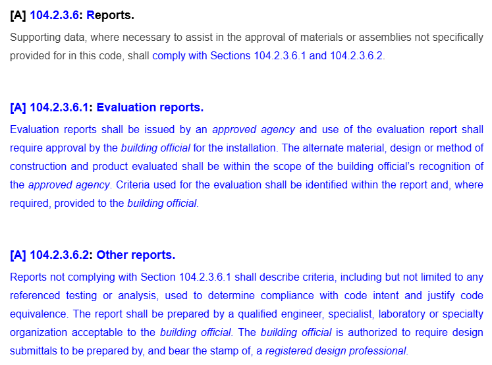
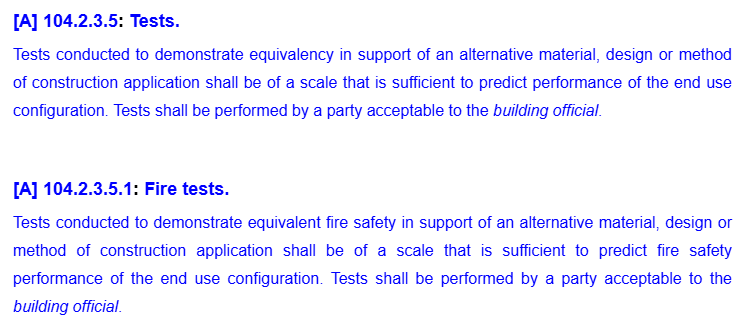
Section 104.2.3 of the 2024 IBC describes how the design professional must approach the design and approval of Alternative Materials, including demonstrating that the proposed system is equivalent to that prescribed by the code in terms of quality, strength, effectiveness, durability, and safety, subject to approval by the building official.

Section 104.2.3 of the 2024 IBC provides the design professional with two options for the substantiation of the acceptable performance of an Alternative Material:

a.
Evaluation Reports. As described in the previous section (Design of Code Anchors), Evaluation Reports are referenced as the primary source for the design and qualification of Alternative Materials. In accordance with IBC Section 104.2.3.6, supporting data submitted to assist in the approval of materials or assemblies not specifically provided for in the code shall comply with Sections 104.2.3.6.1 and 104.2.3.6.2. Evaluation reports, as addressed in Section 104.2.3.6.1, are issued by an approved agency and require approval by the building official for the installation. Evaluation Reports for anchors are published by IAPMO UES or ICC-ES, both ANSI ISO 17065 accredited agencies. Publicly developed, majority-approved acceptance criteria are used to establish the test program and minimum performance requirements for an anchor type. Some anchor types historically evaluated as Alternative Materials have established acceptance criteria. However, under the 2024 IBC, screw anchors in concrete are recognized as code anchors when designed in accordance with ACI 318-19 Chapter 17 and therefore are no longer considered Alternative Materials. Examples of anchor types for which acceptance criteria have been developed include:

  • Headed Cast-in Specialty Inserts: ICC-ES AC446
  • Powder- or Gas-Actuated Fasteners (such as Simpson Strong-Tie® PDPA and GDP): ICC-ES AC70

If Evaluation Reports are used to substantiate an anchor’s performance, the design professional is bound by the design methodology and product limitations described in the Evaluation Report.

b.
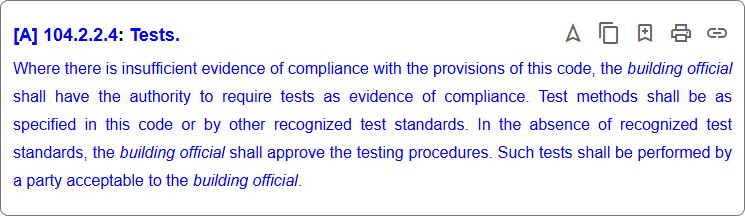
Tests

If an evaluation report is not available and no acceptance criteria exist for a given anchor type, IBC Section 104.2.2.4 permits the use of tests to demonstrate compliance where there is insufficient evidence of code conformity. Tests must be performed using recognized test standards, or other testing procedures approved by the building official, and conducted by a party acceptable to the building official. One example of an anchor type for which no published acceptance criteria currently exist is:

  • Helical Wall Ties (such as Simpson Strong-Tie® Heli-Tie™)

Cracked Concrete Determination
One of the many design considerations that the design professional must determine when designing either “Code Anchors” or anchors qualified as “Alternative Materials” is whether to consider the state of the concrete “cracked” or “uncracked.” The concrete state can significantly influence the anchor’s capacity. Neither the 2024 IBC nor ACI 318-19 Chapter 17 explicitly defines which applications should be categorized as “cracked” or “uncracked” concrete. The design professional must determine by analysis whether cracking will occur in the region of the concrete member where the anchors are installed. Absent an analysis to determine whether cracking will occur, the design professional may conservatively assume that the concrete state is “cracked.” With that said, there are two circumstances that require the design professional to design for “cracked” concrete:

a) Anchors in structures assigned to Seismic Design Categories C, D, E, or F (per 2024 IBC Chapter 16, referencing ASCE/SEI 7) are required to be designed for “cracked” concrete unless the design professional can demonstrate that cracking does not occur at the anchor locations. The prequalification requirements of ACI 355.2 for mechanical anchors and ACI 355.4 for adhesive anchors include a test program that evaluates the performance of anchors in cracked concrete. Only anchors that have been tested and have passed the cracked concrete test program qualify for use in “cracked” concrete. The Evaluation or Research Report for a post-installed anchor (mechanical or adhesive) will clearly indicate whether it qualifies for use in “cracked concrete.”
b) Anchors located in a region of the concrete element where analysis indicates cracking at service level loading must be designed for “cracked” concrete (ACI 318-19 Eq. (19.2.3.1)).

The design professional must consider additional factors that have the potential to result in concrete cracking in the region of anchorage. These factors include restrained shrinkage, temperature changes, soil pressure, and differential settlement. If no cracking is assumed in the region of the anchorage, the design professional should be able to justify that assumption.

Design Calculations

The design methodology in ACI 318-19 Chapter 17 is detailed and can be cumbersome. Calculations can be performed by hand using the design equations in Chapter 17, inserting the substantiated data from an anchor manufacturer’s data tables or applicable evaluation or research reports to design with post-installed anchors. Designing with cast-in-place “Code Anchors” does not require additional data beyond what is included in ACI 318-19 Chapter 17 since these are “standard” anchors with standard design characteristics.

Performing hand calculations can be time-consuming, and for most design professionals is impractical due to the complexity of the design equations associated with multiple failure modes required to be considered. Design software, such as Simpson Strong-Tie® Anchor Designer™ Software for ACI 318, ETAG and CSA provides a fast, reliable method of calculating anchor performance for both cast-in-place and post-installed anchors. This software designs both “Code Anchors” and “Alternative Materials” for which an acceptance criteria exists.

Simpson Strong-Tie® Anchor Designer™ Software for ACI 318, ETAG and CSA is free and can be downloaded here.

Concrete Anchor Design for the International Building Code: Part 1

Purpose
The intent of this technical bulletin is to clarify code language and outline the correct path for the design of concrete anchors under the International Building Code (IBC). The reader will be able to clearly distinguish between “code anchors” and anchors that are considered “alternative materials,” as well as understand the logical sequence of code language for designing each type. The distinction between “cracked” concrete and “uncracked” concrete anchor design will be made. This technical bulletin will lend clarity to the qualification of post-installed anchors for use in concrete. Excerpts from the IBC and its Referenced Standards will be provided to facilitate the description of the design requirements.

Background
More than a decade after the introduction of the American Concrete Institute’s ACI 318, Appendix D design methodology for anchor design in 2002, many design professionals either do not fully understand or are unaware of the code requirements for the design of concrete anchors. Several factors contribute to the challenges associated with understanding the code mandates:
1. The incorrect notion that ACI 318, Appendix D is exclusively for anchors designed for “cracked concrete,” leading to regionally varying degrees of enforcement and implementation of the design requirements
2. Multiple Reference Standards for the design and qualification of different anchor types
3. The evolving scope of Reference Standards, which have reclassified some anchors as “Code Anchors” that were previously considered “Alternative Materials”
4. Confusing language in IBC sections that address concrete anchorage
5. Complexity of the anchor design methodology itself
6. Varying levels of special inspections enforcement

It is nevertheless incumbent upon the licensed design professional to design anchors in accordance with the minimum provisions of the code in order to protect public safety, reduce liability risk and fulfill professional responsibilities.

The International Building Code, beginning with the 2000 edition, describes the design methodology of concrete anchors by virtue of the language within the IBC itself, or through language in the Referenced Standard (ACI 318). In this technical bulletin, specific reference to the 2024 IBC and ACI 318-19 will be made, since this is currently the most widely adopted edition of the IBC.
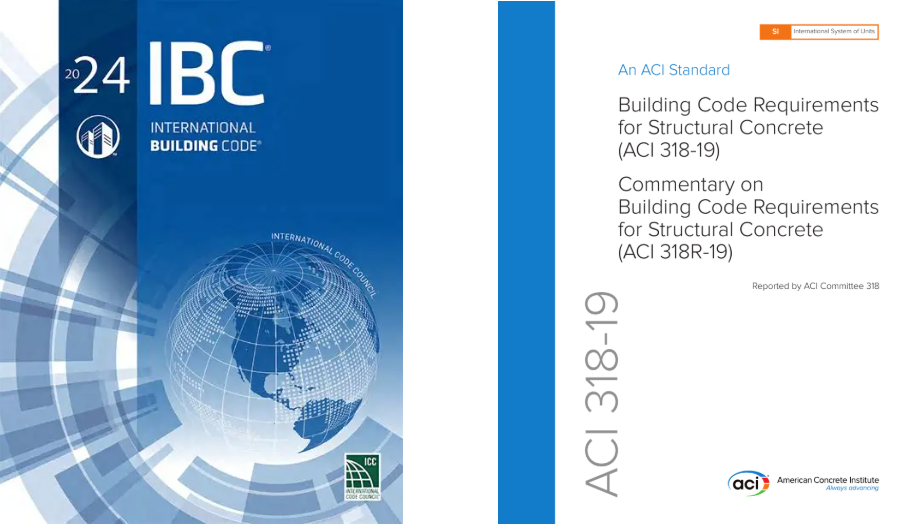
“Code Anchors” and “Alternative Materials”
Anchors can be divided into two major categories: 1) “Code Anchors”, which are those that are specifically addressed in the IBC or its Referenced Standards, and 2) “Alternative Materials”, the design and qualification of which are not addressed in the IBC or its Referenced Standards.
The following “Code Anchors” recognized by the 2024 IBC:

  • Headed studs
  • Headed bolts
  • Hooked (J- or L-) bolts
  • Expansion anchors (such as Simpson Strong-Tie® Strong-Bolt® 2)
  • Undercut anchors
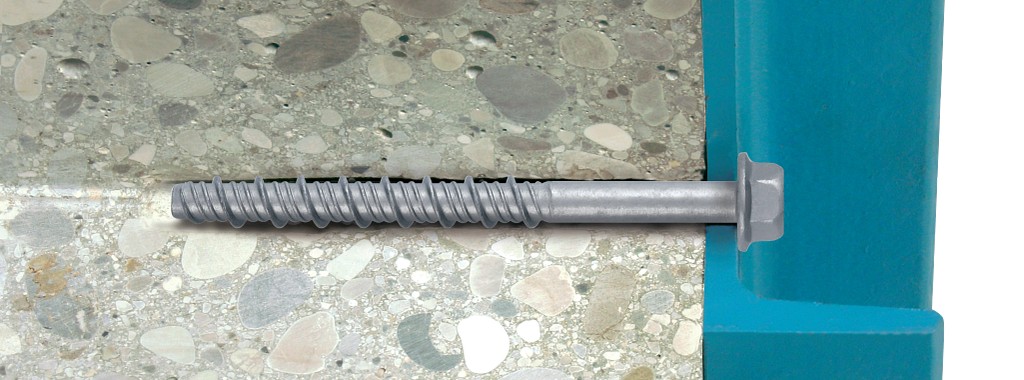
  • Screw anchors (such as Simpson Strong-Tie® Titen HD®)
  • Adhesive anchors (such as Simpson Strong-Tie® ET-3G™, AT-3G™ and SET-3G®)

Anchor types not listed above are considered “Alternative Materials.”

Alternative materials also apply to anchor types specifically excluded from ACI 318-19 calculation and analysis requirements.

  • Specialty inserts
  • Through-bolts
  • Multiple anchors connected to a single steel plate at the embedded end
  • Grouted anchors
  • Powder- or gas-actuated fasteners (such as Simpson Strong-Tie® PDPA)

Designing “Code Anchors”
The starting point for the design of all anchors is Section 1901.3 and Section 1905 of the 2024 IBC, which reference ACI 318-19 Chapter 17 for anchorage design requirements.

Under the 2024 IBC, anchor design is governed by Section 1901.3 and Section 1905, which reference ACI 318-19 Chapter 17. Chapter 17 establishes a comprehensive strength design (LRFD) approach for anchoring to concrete, rather than traditional “Allowable Stress Design” (ASD). It provides detailed equations for steel strength, concrete breakout, pullout, and pryout failure modes for both cast-in and post-installed anchors, applying strength reduction factors (ϕ) and load factors (γ). For general calculations, the compressive strength of concrete (f’c) is limited to 8,000 psi.
While Chapter 17 is fundamentally strength design, some anchor product evaluations – such as ICC-ES Evaluation Reports (ESRs) or Technical Engineering Bulletins (TEBs) – include ASD tables derived from ACI 318 strength design equations. These tables use specific footnotes and conversion factors to present allowable service loads, and may incorporate additional safety factors or seismic overstrength factors (Ω0). Designers must carefully review these footnotes to confirm whether values represent strength design capacities or manufacturer-provided allowable loads, and ensure compliance with the applicable code edition.
In essence, ACI 318-19 Chapter 17 sets the governing rules for strength design, while manufacturers bridge the gap for projects requiring allowable loads through ESRs or TEBs. Regardless of format, all anchors – cast-in or post-installed – must meet the qualification standards in ACI 355.2 (mechanical anchors) and ACI 355.4 (adhesive anchors), and comply with the performance requirements referenced by the IBC.
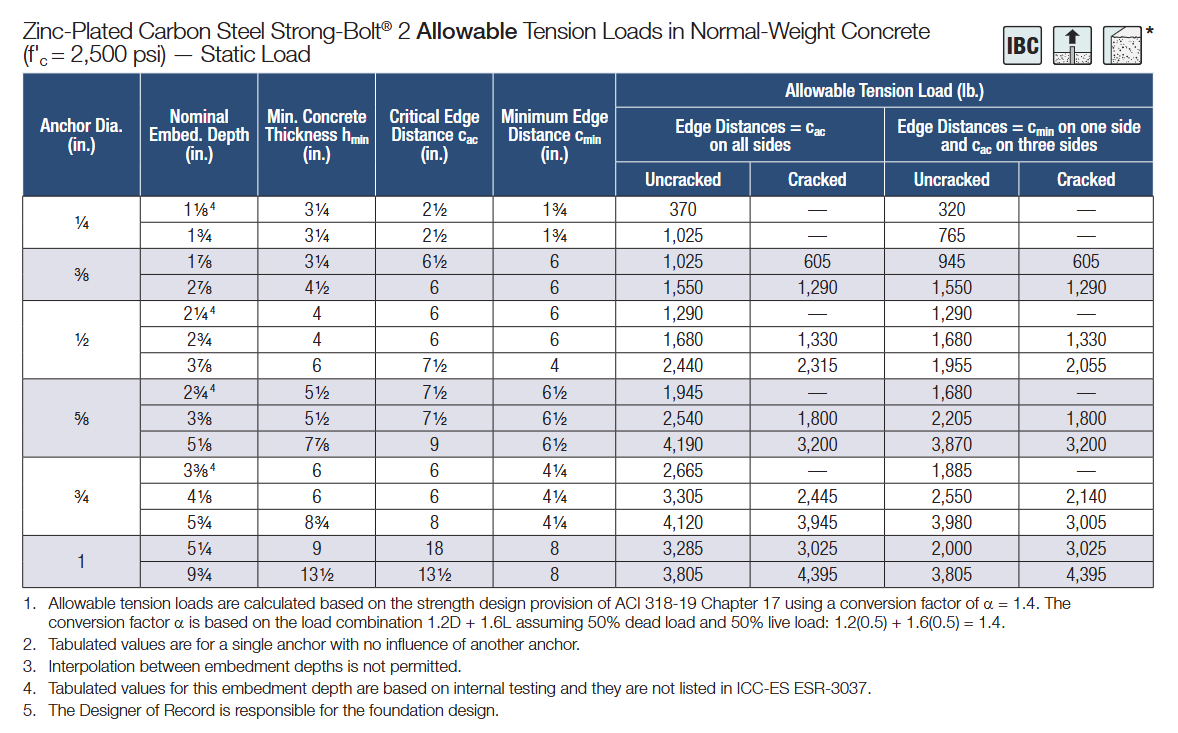
Anchors resisting earthquake loads or effects must be designed using strength design in accordance with ACI 318-19 Chapter 17, as referenced by 2024 IBC Section 1901.3 and Section 1905. This includes cast-in headed bolts, headed studs, hooked bolts, and post-installed anchors such as mechanical and adhesive anchors. Adhesive anchors are explicitly included in ACI 318-19 and must meet installation and qualification requirements defined in ACI 355.4, with special provisions for sustained tension and seismic applications. The design professional must confirm that anchors fall within the scope of ACI 318-19 Chapter 17 and meet all seismic and load combination provisions. Post-installed anchors must also satisfy qualification standards and be supported by ICC-ES Evaluation Reports (ESRs) or equivalent documentation to confirm compliance.

Anchors used for temporary construction purposes, such as tilt-up wall panel bracing, are not addressed by the anchorage provisions of the IBC and therefore are not required to be designed in accordance with ACI 318-19 Chapter 17. Chapter 17 clearly defines the scope of anchors covered by the code, including cast-in and post-installed anchors (mechanical and adhesive), and identifies anchor types that fall outside its requirements. Anchors excluded from Chapter 17 are considered alternative materials and must be evaluated and approved under the provisions of 2024 IBC Section 104.2.3, which allows alternative materials and methods when they provide equivalent performance to code requirements.
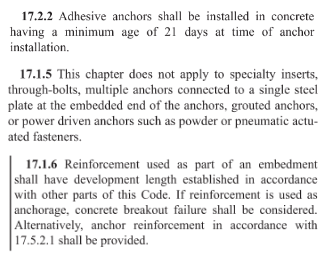
Code Anchors are required to meet the ACI 318-19 Section 17.1.2 qualification requirements described below.

ACI 355.2 (Qualification standard for expansion, undercut, and screw anchors) and ACI 355.4 (Qualification standard for adhesive anchors) are referenced here as the qualification criteria for specific types of post-installed anchors. For the design professional it can be difficult to determine, without fully investigating these Referenced Standards, whether a specific proprietary anchor has been tested and is qualified for use in concrete. A simpler means by which to identify whether a proprietary anchor has been qualified to the Referenced Standard is a current Research Report (e.g., Evaluation or Code Report) which provides third-party review and verification that the product has been tested to and meets the qualification standard. There are two primary Research Report providers: IAPMO UES (International Association of Plumbing & Mechanical Officials Uniform Evaluation Service) and ICC-ES (International Code Council Evaluation Service).
These agencies are ANSI ISO 17065 accredited. They review independent laboratory test data, witnessed or conducted by an accredited third party, for a product and verify its conformance to publicly developed and majority-approved qualification criteria (or acceptance criteria) established for a given anchor type. Research Reports are an invaluable tool to the design professional and building official as evidence of conformance with the IBC.

There are two acceptance criteria that apply to post-installed “Code Anchors”:

  • ICC-ES AC193 – Acceptance Criteria for Post-Installed Mechanical Anchors in Concrete Elements
  • ICC-ES AC308 – Acceptance Criteria for Post-Installed Adhesive Anchors in Concrete Elements

These acceptance criteria reference ACI 355.2 and ACI 355.4, respectively, as the foundation for the test program by which the anchor is evaluated, and establish minimum performance standards for qualification. A Research Report is issued for an anchor that meets these minimum standards.

Overcoming Adhesive Anchor Orientation Challenges with the Piston Plug Adhesive Delivery System

Modern code-listed adhesive anchors offer high-strength connection solutions for a variety of applications. However, as in all construction projects, good product performance requires proper selection and installation. In this blog post, we will discuss the challenge of installation orientation and an accessory that can help installers more easily make proper adhesive anchor installations—the piston plug adhesive delivery system.

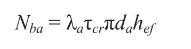
ACI 318-19 Chapter 17 (Anchoring to Concrete) calculations use a uniform bond stress model to calculate an adhesive anchor’s resistance to bond failure. According to this theory, an adhesive anchor is assumed to transfer applied loads into the concrete base material uniformly along its effective embedment depth, hef. The equation for an anchor’s basic bond strength (expressed in pounds of force) is simply the adhesive formulation’s bond strength per unit area ( λaτcr ) multiplied by the idealized cylindrical surface area of the insert that is in contact with the adhesive ( πdahef ):

(ACI 318-19, Eq. (17.6.5.2.1))

oaa1Although the model is a simplification of reality, the mathematical expression represents the core assumption that the adhesive is able to transfer stress completely along the entire depth of the anchorage. This is a key requirement in installation: Anchoring adhesives must be installed such that air entrapment and significant voids are prevented.

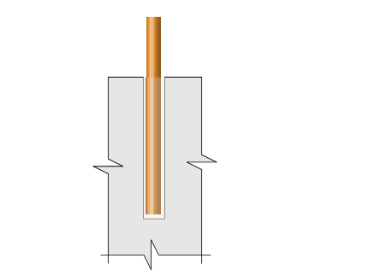
Downward installations (Figure 1) have historically presented relatively few challenges for adhesive injection in this regard. In such applications, gravity is helpful; the adhesive naturally flows to the bottom of the drilled hole while being dispensed from the cartridge through a static mixing nozzle. The installer maintains the open end of the nozzle below the free surface of the adhesive until the drilled hole is filled to the desired level. For deep holes, extension tubing is affixed to the open end of the nozzle to increase reach. This procedure avoids entrapping air bubbles in the adhesive material.

Figure 1 – Downward installation orientation

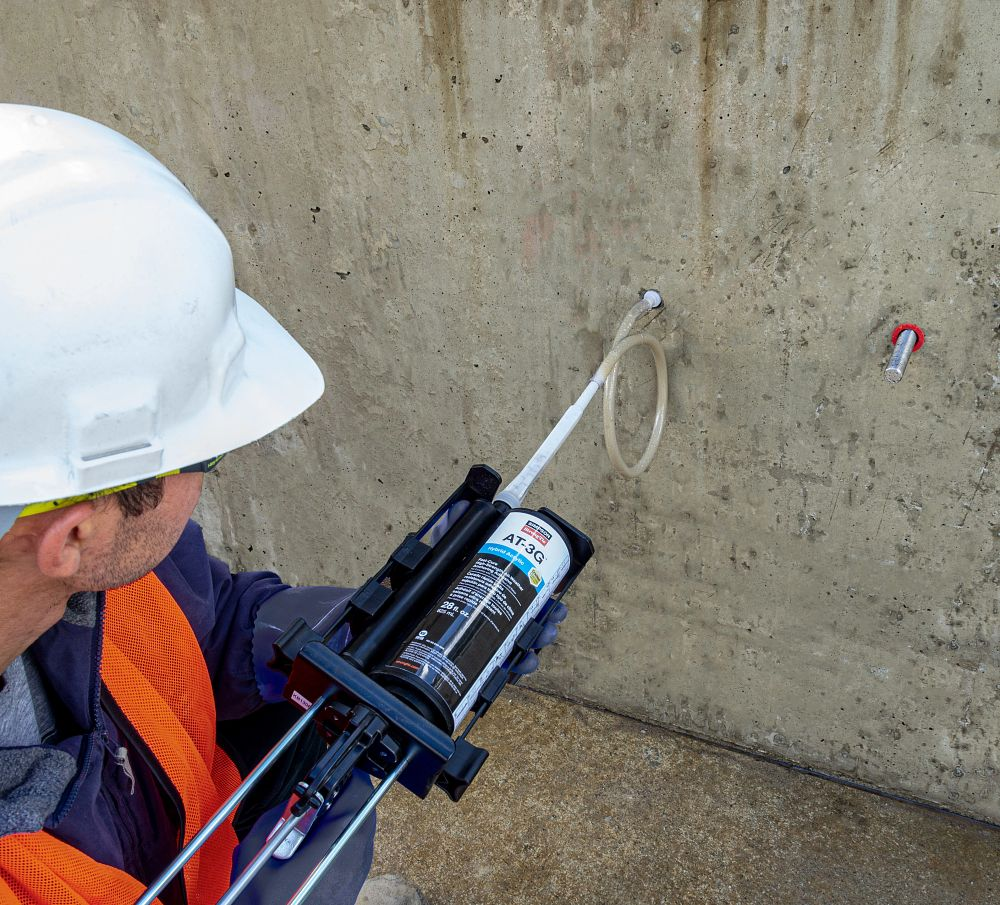
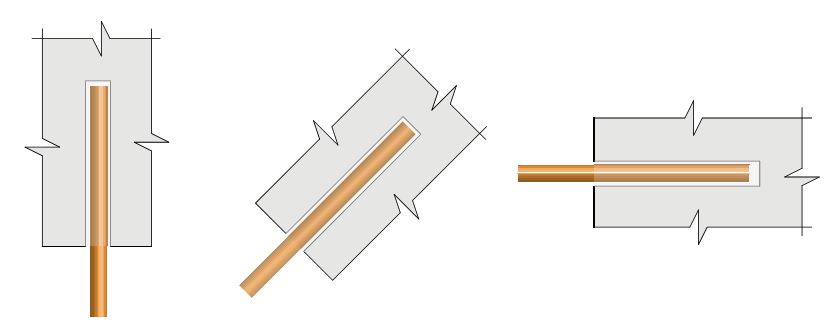
Installations into horizontal, upwardly inclined or overhead drilled holes (Figure 2) require more care on the part of adhesive anchor installers. Although the installation principle to avoid entrapping air is similar for these orientations, a key difference is that gravity does not help to keep the adhesive towards the “bottom” (deepest point) of the drilled hole. At worst, it can work against the installer when ambient temperatures may cause the adhesive to run out of the hole during injection. These adhesive anchor installations can be more difficult for an untrained installer and can slow the rate of work. This is one of the reasons that ACI 318-19 Section 26.13.3.2(e) requires continuous special inspection of adhesive anchor installations in these three orientations when the application is also intended to resist sustained loads.

Figure 2 – Overhead, upwardly inclined and horizontal installation orientations (Source: ACI 318-19, Fig. R2.2)
Figure 2 – Overhead, upwardly inclined and horizontal installation orientations (Source: ACI 318-19, Fig. R2.2)

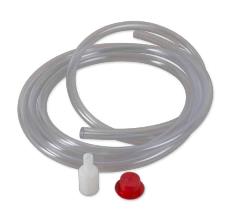
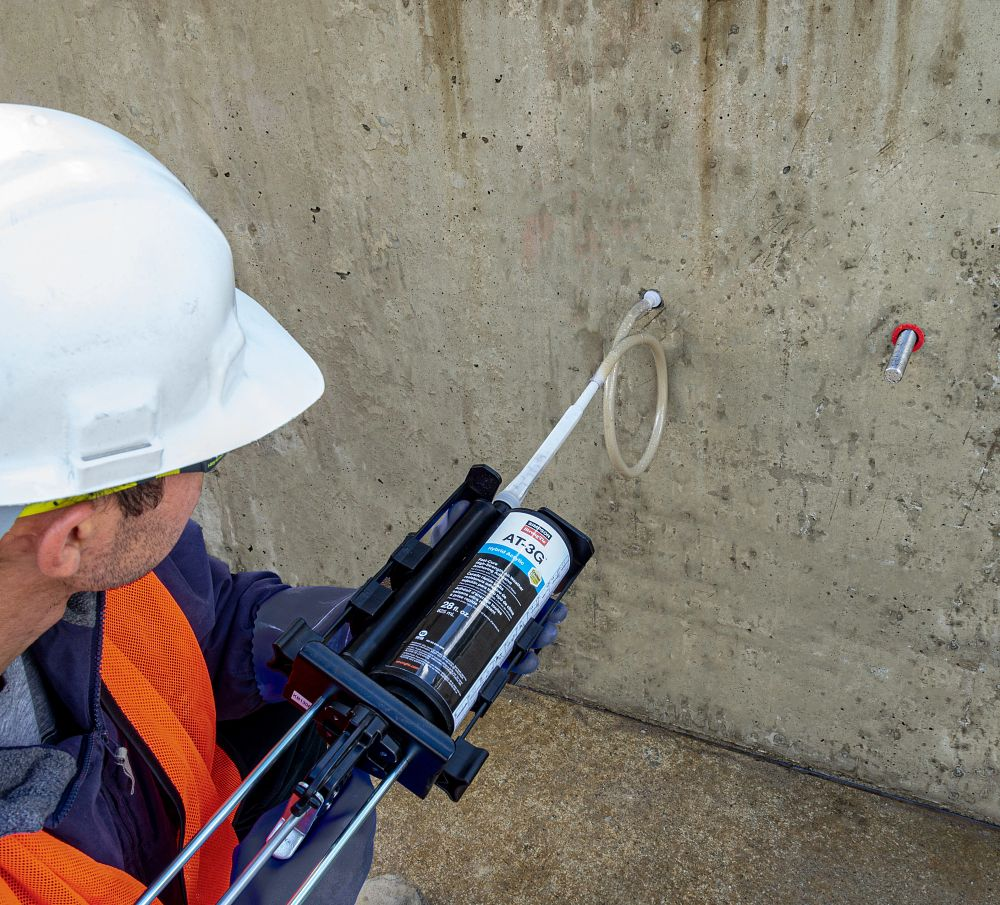
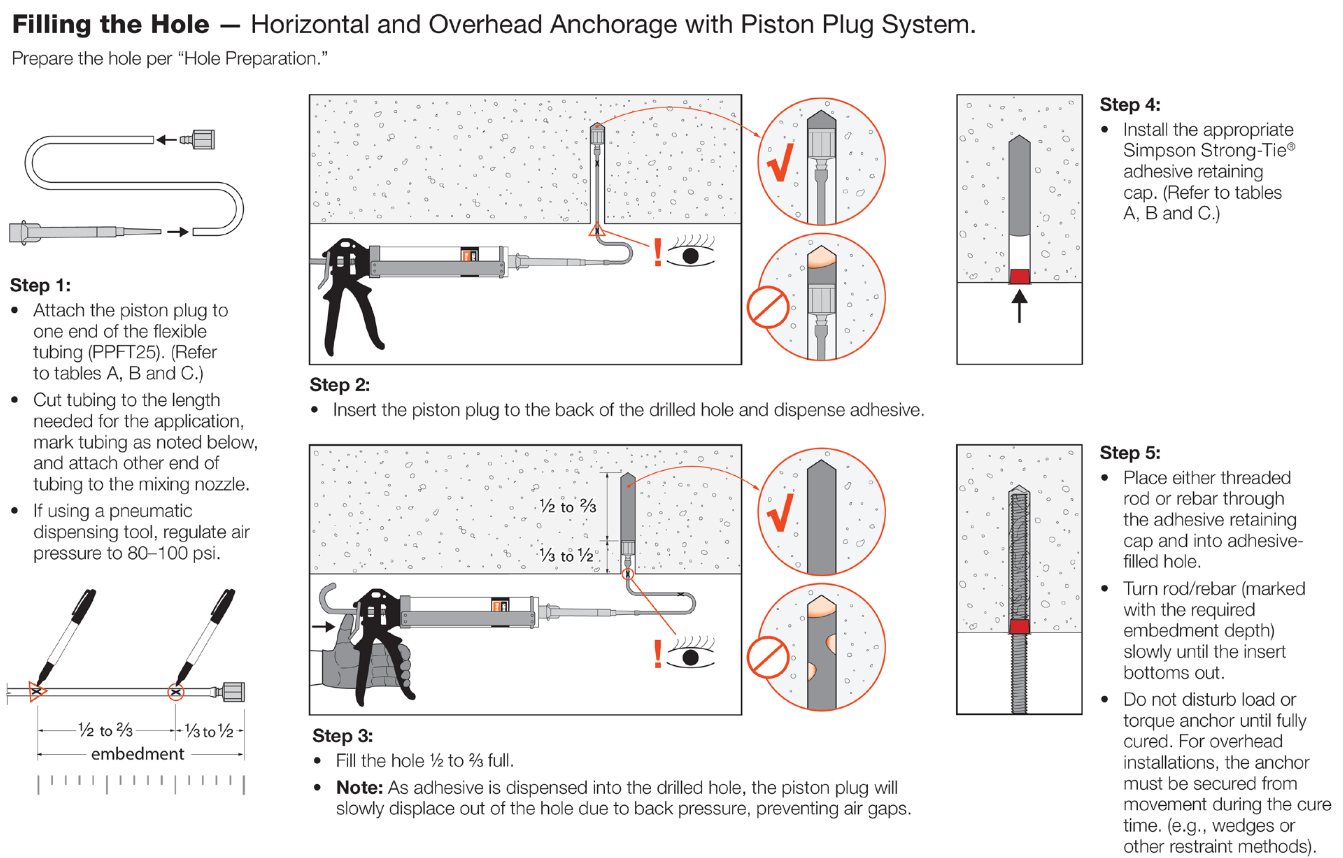
To aid the installer, Simpson Strong-Tie offers a piston plug adhesive delivery system (Figure 3). Consisting of pre-packaged flexible tubing, piston plugs and an adhesive retaining cap, this system allows installers to more easily and consistently make high-quality installations while completing their work efficiently. The installation sequence is provided in Figure 4.

Figure 3 – Piston plug delivery system

The system consists of three components:

  • Piston plug – The key component of the system, it is slightly smaller in diameter than the drilled hole. As the adhesive is dispensed into the drilled hole, the piston plug is displaced out of the hole by the advancing volume of the injected adhesive. The displacement creates a more positive feel for the installer to know where the free surface of the adhesive is.


  • Flexible tubing – For use with the piston plug to facilitate injection at the deepest point of the drilled hole.
  • Adhesive retaining cap – Provided to prevent adhesive material from flowing out of the drilled hole after dispensing and to provide a centering mechanism for the insert. For heavy inserts in overhead conditions, other means must be provided to carry the weight of the insert and prevent it from falling or becoming dislodged from the hole before the adhesive has fully cured.

Figure 4 – Installation sequence

What do you think about the piston plug adhesive delivery system? Let us know by posting a comment below.